
Key Takeaways
- To prove medical malpractice in Pennsylvania, you must show four things: duty, breach of the standard of care, causation, and damages. Missing any one ends the case.
- A bad outcome alone is not malpractice. The question is whether a careful, competent provider in the same specialty would have acted differently, and whether that difference mattered.
- Most cases must be filed within two years. Death cases run two years from the date of death. Some deadlines are much shorter.
- These cases cost tens of thousands of dollars to investigate. They are generally viable only when the harm is permanent, catastrophic, or fatal.

Contact Us for a Free, Confidential Consultation
This article was written by Brendan Lupetin, Esq. & Greg Unatin, Esq. Brendan and Greg are the founding partners in the law firm of Lupetin & Unatin, a medical malpractice law firm located in Pittsburgh and serving Western Pennsylvania.
Published September 2026 · Last legally reviewed September 2026
Most of the calls we get start the same way: something went wrong with your medical care, and you cannot tell whether it was malpractice or misfortune. Your mother had a lung nodule that nobody followed up on, and now her cancer has spread. A routine surgery turned into three more surgeries. Your father walked into an emergency room and never walked out. You know the outcome was bad. What you do not know is whether the law calls it medical malpractice.
That is the question everyone asks us: “Was this medical malpractice or just bad luck?”
In Pennsylvania, a bad outcome is not malpractice by itself. To prove a medical malpractice case here, you must be able to answer “yes” to four questions:
- Did the provider or hospital owe the patient a duty to provide reasonably competent medical care?
- Did the provider or hospital breach that duty?
- Did the breach cause harm to the patient?
- Is the harm, loss, or death serious enough to justify the cost of a medical malpractice case?
A single “no” ends the case, no matter how badly things turned out. This guide walks through each question and explains the Pennsylvania rules that decide the answer.
Why Trust This Guide
This guide was written by Brendan Lupetin and Greg Unatin, the founding partners of Lupetin & Unatin. Together they have spent decades representing injured patients and families across Pennsylvania, and they try these cases to verdict.
- Both have been repeatedly named to Super Lawyers’ Top 50 Lawyers in Pittsburgh and Top 100 Lawyers in Pennsylvania.
- Both are recognized by Best Lawyers in America for plaintiffs’ personal injury litigation and medical malpractice law, including a Pittsburgh “Lawyer of the Year” designation in plaintiffs’ personal injury litigation.
- The case examples in this guide come from our own files, with identifying details removed.
If Your Loved One Is Still in the Hospital
- Focus on their care first. Ask questions. Ask for a patient advocate if you are not getting answers.
- Write down names, times, and what you are told. A simple note on your phone is enough.
- Do not sign anything from hospital risk management without talking to a lawyer.
- Do not confront the staff or post about it online.
You do not have to decide anything today. When you are ready, call (412) 281-4100. There is no charge to talk, and we will tell you honestly whether the care deserves a closer look.
- The 4 Elements Required to Prove Medical Negligence in PA
- Medical Malpractice vs. Ordinary Negligence: Key Legal Differences
- What Does NOT Qualify as Medical Malpractice in PA?
- Pennsylvania Medical Malpractice Statute of Limitations & Deadlines
- What Is a Certificate of Merit under Pa. R.C.P. 1042.3?
- Other Pennsylvania Procedural Rules: Venue and Hospital Notice Letters
- Can You Sue a Pennsylvania Hospital for a Doctor’s Negligence?
- How Medical Records and Electronic Audit Trails Prove Negligence
- What to Do If You Suspect Medical Malpractice
- How Lupetin & Unatin Can Help
- Pennsylvania Medical Malpractice FAQs
The 4 Elements Required to Prove Medical Negligence in PA
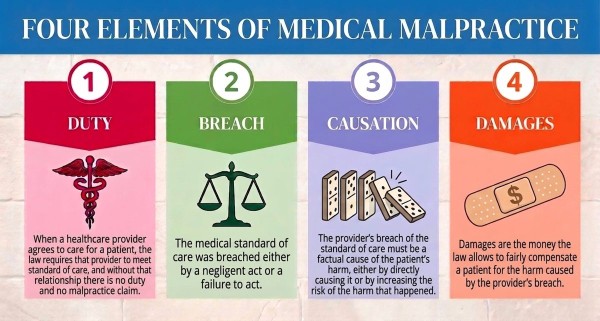
Every Pennsylvania medical malpractice case rests on four elements: duty, breach, causation, and damages. They are the same four questions from the top of this guide, stated the way a lawyer or a judge would state them, and you need all four to win.
Element 1: Duty of Care (When Does a Physician-Patient Relationship Exist?)
Duty means a professional relationship existed between the patient and the provider. It forms when a doctor or hospital accepts you as a patient and you rely on their skill.
This is usually obvious and rarely the fight. A surgeon who operates on you owes you a duty. So does the radiologist who reads your scan, even though you never meet them. So does the overnight hospitalist, the nurse assigned to monitor your vital signs, and the pathologist who reads your biopsy.
Emergency departments also have a separate duty under federal law. The Emergency Medical Treatment and Labor Act (EMTALA) requires hospitals that take Medicare to screen anyone who comes to the emergency department with a possible emergency. If an emergency is found, the hospital must stabilize the patient before discharge or transfer. This applies regardless of insurance. An EMTALA claim is a separate federal claim against the hospital. It is not the same as a malpractice claim.
Outside those emergency rules, a provider who never accepted you as a patient or gave you medical advice generally owes you no legal duty. The real fight is almost always over the next two elements.
Element 2: Breach of the Standard of Care
What is the standard of care?
The standard of care is what a reasonably careful and competent provider in the same specialty would have done in similar circumstances. Falling below it is a breach. In Pennsylvania, a breach of the standard of care is called medical negligence or medical malpractice. The two terms mean the same thing.
This element is the heart of the case.
The standard is not perfection, it is not the best care imaginable, and it does not guarantee a good result. Medicine carries real risk, and bad outcomes happen even when the care is proper. The question is always whether the provider acted the way a careful, competent peer would have acted in the same situation.
Pennsylvania judges the standard of care by two core rules:
- It is specialty-specific. An emergency physician is measured against other emergency physicians handling a similar crisis in the ER. The comparison is not a neurologist reviewing the chart a week later in a quiet office, already knowing the diagnosis. A general surgeon at a community hospital is measured against other general surgeons with the same resources. The question is never what the most famous specialist at the best hospital in the country would have done.
- It is judged in the moment, not in hindsight. A provider is not negligent just because a diagnosis turned out to be wrong or a rare complication happened. A provider is negligent only if, based on the information available at that moment, a reasonably competent peer would have acted differently.
The MCARE Section 512 Expert Qualification Rules
The standard of care is a technical medical question. So Pennsylvania does not let juries guess. A jury cannot decide on its own how a cardiologist should read an EKG or when a surgeon should convert to an open procedure. To prove a case, an injured patient must present testimony from a qualified medical expert.
Section 512 of Pennsylvania’s Medical Care Availability and Reduction of Error (MCARE) Act, 40 P.S. § 1303.512, sets strict rules for who can testify:
- Same specialty. If the defendant doctor is board-certified, the patient’s expert generally must be board-certified in the same or a similar specialty.
- Active clinical practice. The expert must be in active clinical practice or teaching, or have retired from it within the past five years.
Pennsylvania also requires a sworn Certificate of Merit early in every case. It confirms that a qualified professional has reviewed the records. (See “What Is a Certificate of Merit” below.) Finding an expert who meets the MCARE rules and is willing to testify against a peer is one of the hardest parts of building a case.
In rare cases where the negligence is obvious, such as a sponge left inside a patient, the law technically allows a case without expert testimony. In our experience, these cases are uncommon. Even then, we believe the claim is stronger with a medical expert behind it.
Common Types of Medical Negligence
When medical negligence happens, it usually falls into one of these patterns:
- Failure to diagnose or delayed diagnosis. Missing cancer on an imaging scan. Discharging a patient in the middle of an evolving stroke or heart attack. Ignoring an abnormal workup or test results. Diagnostic error is one of the largest sources of preventable serious harm in American medicine. A 2023 study led by Johns Hopkins researchers estimated that about 795,000 Americans die or are permanently disabled each year from diagnostic errors. Stroke, sepsis, pneumonia, blood clots, and lung cancer were among the leading causes.
- Failure to act on results. A cancerous biopsy result that nobody tells the patient about. A critical lab value that sits unread in the electronic chart. An imaging report recommending urgent follow-up that nobody acts on.
- Failure to monitor or rescue. Hospital staff failing to recognize, react to, or escalate worsening vital signs (e.g. abnormal blood pressure, heart rate, respirations, temperature, oxygen saturation, blood test results). Patients who are getting sicker can suffer a preventable arrest when bedside alarms are missed.
- Labor and delivery failures. Misreading fetal heart monitor tracings. Missing signs of fetal distress. Delaying an emergency C-section. Mismanaging excessive contractions caused by drugs like Pitocin. These failures can cut off a baby’s oxygen and cause brain injury (hypoxic-ischemic encephalopathy, or HIE), cerebral palsy, or death.
- Surgical errors. Operating on the wrong site. Performing the wrong procedure. Damaging nearby nerves, organs, or blood vessels through substandard technique. Leaving sponges or instruments inside a patient. Fires in the operating room. Placing the patient in the wrong position or dropping the patient.
- Medication errors. The wrong drug, the wrong dose, a dangerous combination, or a drug the patient’s allergies or kidney or liver function made unsafe.
- Anesthesia and airway errors. Inadequate monitoring. Failing to secure a difficult airway or losing it. Mismanaging a toxic reaction to anesthetic. Administering the wrong or contraindicated medication.
- Premature discharge and failure to refer. Sending an unstable patient home instead of admitting them. A primary care provider failing to refer to a specialist when the symptoms call for it.
Element 3: Causation (Factual Cause vs. Increased Risk of Harm under Hamil v. Bashline)
Proving medical negligence is only half the battle, because in the law, no harm means no case. Causation asks one question: was the provider’s mistake a cause of the injury?
This is where many seemingly strong claims fail. At the same time, Pennsylvania gives injured patients a fairer path to proving causation than many other states. Causation generally follows one of two frameworks.
Factual Cause
The basic rule is that the negligence must have been a real factor in causing the harm. It cannot be an insignificant or remote one. Older Pennsylvania cases call this a “substantial factor.” Courts use the two terms interchangeably.
Factual cause does not mean the negligence was the only cause. It just has to be a cause. A patient with pre-existing heart disease can still recover in full if a surgical error was a real factor in their death.
Factual cause typically governs when the provider’s own act directly causes the injury. For example:
- A surgical team operates on the wrong limb.
- A nurse gives a drug that the chart lists as a known allergy.
- A surgical sponge is left inside the patient.
Increased Risk of Harm (Hamil v. Bashline)
What is “increased risk of harm” in Pennsylvania?
Increased risk of harm is Pennsylvania’s rule for proving causation in a medical malpractice case. Under Hamil v. Bashline, 392 A.2d 1280 (Pa. 1978), the patient does not have to prove to a certainty that proper care would have prevented the harm. The patient must show that the provider’s negligence increased the risk of the harm that happened. The question of causation then goes directly to the jury.
This rule is often called “increased risk of harm” or IROH. It is one of the most important rules in Pennsylvania medical malpractice law. It is why delayed diagnosis and delayed treatment cases can succeed here when they would fail elsewhere.
The rule comes from Hamil v. Bashline, 481 Pa. 256, 392 A.2d 1280 (1978). A man came to an emergency room with chest pain. The hospital’s EKG machine was not working. He was sent away and died of a heart attack shortly after. No expert could say for certain that proper treatment would have saved him. The defense argued that meant no liability.
The Pennsylvania Supreme Court disagreed. It set out a different path to causation. The patient must show three things:
- The provider negligently failed to give care needed to protect the patient.
- That failure increased the risk that the patient would suffer harm or death.
- The patient was actually harmed.
Once those three things are shown, the case goes to the jury. The jury decides whether the increased risk was a factual cause of the injury. In Mitzelfelt v. Kamrin, 526 Pa. 54, 584 A.2d 888 (1990), the court added that the patient’s expert must give the increased risk opinion to a reasonable degree of medical certainty.
The rule can feel counterintuitive. So we explain it to juries with an analogy.
Imagine someone falls off a boat into rough, freezing water. The conditions alone are dangerous. There is a real chance they might drown no matter what. But someone on the deck has a sturdy life preserver right beside them and carelessly fails to throw it. The swimmer drowns. That person cannot turn to a jury and say:
“The water was freezing, the waves were high, and you can’t prove with absolute certainty that my life preserver would have saved them.”
That defense fails. The swimmer was already in danger. But failing to throw the life preserver increased the risk that they would drown. Once that is shown, the jury decides whether the failure was a factual cause of the death. The law does not demand mathematical certainty when a human life is at stake.
From Our Files: A Leg Lost to Delay
We represented a man who suddenly developed an acute vascular occlusion. A clot cut off the blood supply to his leg. He reached the hospital in time. There was still a window in which the clot could have been removed and his lower leg saved. Instead, there was a delay of several hours before he got the treatment he needed. By then it was too late, and he lost his leg.
The defense made the argument they always make in these cases. Earlier treatment would not have changed anything. The leg was already gone when he arrived.
Nobody could say with certainty the exact minute the window closed. Medicine does not work that way. So we did not try to prove the exact point of no return. We proceeded under increased risk of harm. Our vascular surgery expert testified that the failure to timely evaluate, diagnose, and treat our client increased the risk that he would lose his leg. The jury agreed and returned a verdict of $2.1 million. You can read our full case summary on the $2.1M ischemic leg verdict.
Under a strict certainty standard, that case is lost. Under Pennsylvania’s increased risk of harm rule, we found our path to the jury and a verdict for our client.
Did a Delay in Diagnosis or Treatment Cost You Something You Cannot Get Back?
If a delay led to a death, an amputation, paralysis, a brain injury, or a cancer that spread, Pennsylvania’s increased risk of harm rule may give you a path to a jury even when no one can promise what would have happened with proper care. Call (412) 281-4100 or request a free case review from our Pittsburgh medical malpractice lawyers. If we do not believe you have a case, we will tell you that, and explain why.
Two parts of the increased risk of harm rule are often misunderstood.
Pennsylvania is not a “lost chance” state. Some states treat the lost chance of a better outcome as its own injury. There, a jury can award only the percentage of damages that matches the chance that was lost. Pennsylvania did not go that way. Increased risk of harm is a rule about proving causation. It is not a separate claim with reduced damages. Once the jury finds causation, the patient recovers full damages for the harm that happened.
The rule does not fit every case. It applies where a provider failed to protect the patient from harm coming from another source, usually the underlying disease. A missed cancer, an untreated stroke, an untreated clot, or a delayed response to a heart attack are the kinds of cases where it applies. Where the provider’s own act directly caused the injury, ordinary factual cause governs instead. Defendants often fight about which framework applies.
When There Is Negligence but No Case
Some claims involve real negligence and real harm and still cannot be brought, because the causal link is missing. This is the most common reason we decline cases that truly involve substandard care.
From Our Files: An Honest No
A family contacted us about a mom who passed due to metastatic breast cancer. We gathered her medical records going back years. We consulted experts in three specialties: oncology, primary care, and obstetrics. The investigation ran for months. The expert review cost our firm tens of thousands of dollars.
Our experts reached a split conclusion. Her primary care providers had been negligent. They had unreasonably delayed an ultrasound that would have found the cancer earlier. But our oncology expert determined that by the time of that negligence, the cancer had already spread. Proper care would not have changed the outcome. The negligence was real. It did not cause the harm, and it did not meaningfully increase the risk of harm.
Pennsylvania requires expert support for both breach and causation. We had the first and not the second. So there was no case to file.
We sat down with the family and explained what the experts found and why the law would not give them a remedy. They were grateful to finally have an answer. They owed us nothing for our time or for the costs we had advanced.
That case makes two things concrete. An honest answer has value, even when the answer is no. And you pay nothing for our investigation. Our fee is a portion of the recovery, and only if we win money for you. Because we take on that risk, we are highly selective about the cases we accept.
Not Sure Whether Your Case Is Viable?
We review catastrophic injury and wrongful death claims throughout Pennsylvania at no cost and no risk to you. If the medicine and the law support a case, we will explain exactly what comes next. If they do not, you will get the same honest explanation this family received. Call (412) 281-4100 or request a free case review from our Pittsburgh medical malpractice lawyers.
Element 4: Damages (Economic, Non-Economic, and MCARE Restrictions)
“Damages” means the harm the law will compensate with money. Some of that harm can be calculated, like medical bills and lost wages, and some of it cannot, like chronic pain, permanent impairment, and the loss of life’s pleasures. Pennsylvania law lets an injured patient seek full compensation for both.
- Economic damages (financial losses). Past and future medical expenses, lost wages, lost earning capacity, home nursing and attendant care, medical equipment, and home or vehicle changes. In catastrophic cases, such as a baby with a birth-related brain injury, these are often the largest part of the claim. They are projected over the patient’s lifetime through a life care plan and an economist’s analysis.
- Non-economic damages (human losses). Past and future pain, mental anguish, embarrassment and humiliation, disfigurement, and loss of the ability to enjoy life’s pleasures. When a married person suffers a serious injury, their spouse may also bring a claim for loss of consortium. It compensates for the loss of companionship and support in the marriage.
Five Pennsylvania rules shape these damages.
Are There Caps on Medical Malpractice Damages in Pennsylvania?
Short answer: No. Pennsylvania does not cap compensatory damages in medical malpractice cases. Article III, Section 18 of the Pennsylvania Constitution bars the legislature from limiting damages for injury or death. The only caps on compensatory damages apply to claims against government entities, which are protected by immunity statutes.
Many states cap pain and suffering damages. Pennsylvania does not. A jury may award whatever amount it finds fair and just based on the evidence.
Death Cases Involve Two Claims: Wrongful Death and Survival
When medical negligence causes a death, Pennsylvania splits the case into two claims with different beneficiaries:
- Wrongful death action (42 Pa.C.S. § 8301). Brought for the surviving spouse, children, or parents. It compensates the family for what they lost. That includes funeral and medical expenses, lost financial support, and the loss of the person’s guidance, companionship, and services.
- Survival action (42 Pa.C.S. § 8302). Belongs to the person’s estate. It recovers what the person who died lost. That includes their conscious pain and suffering before death and their lost lifetime earning capacity, minus their personal living costs. Think of it as the deceased person’s personal injury claim that survives their death.
Punitive Damages Are Limited Under MCARE
Punitive damages do not compensate the patient. They punish outrageous conduct. They are not available for ordinary mistakes. They require proof of willful or wanton conduct or reckless indifference to the patient’s rights. Under Section 505 of the MCARE Act:
- Punitive damages against an individual physician are capped at 200% of the compensatory damages, unless the case involves intentional misconduct. The cap does not apply to hospitals.
- 25% of any punitive damages award goes to the state’s MCARE Fund, not to the patient.
Health Insurance and Past Medical Bills (MCARE Section 508)
Pennsylvania has a special rule for malpractice cases. Under Section 508 of the MCARE Act, 40 P.S. § 1303.508, you generally cannot recover past medical bills or past lost wages that insurance or other benefits paid before trial. In exchange, those payers generally have no right to be repaid from your recovery for what they paid.
There are important exceptions. Medicare, Medicaid, and some employer health plans governed by federal law can still claim a lien on the recovery. Those liens are rarely final. A key part of closing a case is negotiating them down, so more of the recovery reaches you.
Workers’ compensation is a special case. Sometimes a person is hurt at work and then harmed again by malpractice during treatment. The comp carrier generally cannot recover the benefits it paid before trial or settlement. But it may be able to take a credit against future comp benefits. That credit applies only to the extent the malpractice added to the disability or medical costs. We look at this closely in every case where workers’ comp is involved.
Future Medical Expenses Are Paid Over Time (MCARE Section 509)
In most injury cases, a verdict is paid in one lump sum. Malpractice cases work differently. Under Section 509 of the MCARE Act, 40 P.S. § 1303.509, a jury award of more than $100,000 in future medical expenses is generally paid in periodic payments over time, as the care is needed.
- The important catch: If the patient dies sooner than expected, the payments for future medical care stop. Nothing more is owed to the family or estate for that part of the award.
- This rule applies only to future medical care. Future lost earnings and pain and suffering are still paid in a lump sum.
Settlements can be structured differently by agreement.
Not sure whether your situation has all four elements?
That is the question we answer for free. Call (412) 281-4100 or request a free case review from our Pittsburgh medical malpractice lawyers. If the answer is no, we will tell you and explain why.
Medical Malpractice vs. Ordinary Negligence: Key Legal Differences
Medical malpractice is a special branch of negligence law. Pennsylvania treats it very differently from other injury cases. The difference affects how a case is evaluated, filed, funded, and tried.
In an ordinary injury case, fault is judged by what a reasonably careful person would do. Jurors can use everyday experience to decide whether a driver should have stopped at a red light, or whether a store took too long to clean up a spill. Most car crash and slip-and-fall cases need no expert testimony on fault.
In a malpractice case, fault is judged by what a reasonably competent professional in the same specialty would do. Jurors cannot use common sense to decide whether a cardiologist properly handled heart monitor alarms or whether a surgeon used proper technique. Pennsylvania law requires a qualified medical expert to define that standard.
| Ordinary Negligence | Medical Malpractice | |
|---|---|---|
| Standard Applied | What a reasonably careful person would do | What a reasonably competent provider in the same specialty would do |
| Expert Testimony | Usually not required on fault | Required on standard of care and causation |
| Certificate of Merit | Not required | Required under Pa. R.C.P. 1042.3 |
| Typical Number of Experts | Zero to one | Three to eight |
| Typical Cost to Develop | Thousands of dollars | Tens to hundreds of thousands of dollars |
| Typical Time to Resolve | One to two years | Two to five years |
| Records Involved | Hundreds of pages | Thousands to tens of thousands of pages |
Professional Judgment vs. Ordinary Carelessness
The test is never where the injury happened. It is whether the conduct involved medical judgment or patient care. A hospital is both a business and a place of medical care.
Consider a patient who falls in a hospital hallway:
- Ordinary negligence: A maintenance worker mops the floor and leaves a puddle with no warning sign. That is a premises claim. No medical skill was involved.
- Medical malpractice: A nurse leaves a heavily sedated patient alone after surgery, even though the patient’s fall-risk assessment required two-person help. That is malpractice. The failure came from professional nursing care.
Other common examples:
- Non-medical events. A visitor who trips on cracked concrete in the parking garage, or is assaulted because of poor security, has a premises claim, not a malpractice claim.
- Equipment failures. A monitor that fails because of a manufacturing defect may support a product liability claim against the manufacturer. A hospital’s failure to maintain or test that monitor may support a corporate negligence claim.
The label matters. If a claim involves medical judgment, Pennsylvania courts treat it as malpractice no matter what it is called, and the Certificate of Merit rules apply (Grossman v. Barke, 868 A.2d 561 (Pa. Super. 2005)). If a claim is really about ordinary carelessness, a defective product, or security, other claims and other insurance may be available.
What Does NOT Qualify as Medical Malpractice in PA?
Most medical care is not malpractice, even when the outcome is devastating, because medicine carries real risks that no doctor can eliminate. Most doctors and nurses work hard for their patients. Knowing what the law does not cover can save you months of stress and frustration.
These situations usually do not count as medical malpractice in Pennsylvania:
- A known complication that happens even with proper care.
- A bad or unexpected outcome, by itself.
- A doctor or nurse expressing sympathy for a bad result.
- A doctor who is rude, cold, or has a poor bedside manner.
- A second doctor criticizing your first doctor. That is not enough by itself, but it is worth telling us about.
- A medical mistake that caused no permanent injury.
- Typos or messy notes in your medical chart.
- A long emergency room wait, by itself, or a dispute over medical bills.
Cases We Typically Review
We focus on cases where medical negligence caused death or permanent, life-changing harm. For example:
- Death after a missed diagnosis, a surgery, or a hospital stay
- Permanent brain injury, including birth injury
- Cancer that spread because of a delayed diagnosis
- Paralysis or spinal cord injury
- Amputation or loss of a limb
- Serious permanent injury from surgery, medication, or anesthesia
If your situation sounds like one of these, call (412) 281-4100.
Several legal rules can defeat a claim outright. Here is how each one works, and where it stops working.
Known Complications vs. Failure to Rescue
A known complication that happens during proper care is not negligence. An infection can develop after a clean surgery. A surgeon might nick a nearby organ during a difficult operation despite careful technique. These things can happen to good doctors.
Hospital defense lawyers almost always claim an injury was just a known complication. Sometimes they are right.
The real question is what the medical team did once the problem started. Did they anticipate the risk? Did they spot the warning signs quickly? Did they handle the emergency correctly?
A known risk is no longer a defense if the team ignored clear warning signs, failed to step in, or made choices that turned a manageable problem into a disaster.
From Our Files: An Airway Emergency
We represented a young girl born with a rare genetic disorder. This rare condition causes weak, fragile airways. Medical studies have long shown that these patients face a high risk of delayed airway swelling a day or two after a breathing tube is removed. The risk was well known and documented.
She came through heart surgery successfully, and the ICU team removed her breathing tube. But the anesthesia team never warned the ICU nurses about her risk of delayed swelling.
Two days later, she started struggling to breathe. This was the classic sign that her airway was closing. The team assumed she was just tired from surgery.
Then the providers made choices that turned a complication into a tragedy. Instead of carefully replacing the tube while she was awake and breathing on her own, an anesthesia provider gave her a heavy dose of a paralytic drug. That drug stopped her breathing completely. Providers without advanced airway training then made repeated, forceful attempts to place the tube. Those attempts caused more swelling and closed her airway.
Simple rescue tools, like a special breathing mask, were available. They were never used. Instead, she was rushed to an operating room and given another paralytic while she was suffocating. Her heart stopped. She survived with permanent brain damage.
Her airway risk was a known complication. Her case became malpractice because the team ignored her anatomy, missed obvious warning signs, and eliminated every chance to save her.
The “Two Schools of Thought” Defense (Jones v. Chidester)
Sometimes doctors disagree on the best way to treat a condition. If a doctor chooses one accepted treatment over another, the doctor is not negligent under Pennsylvania law. This is true even if most doctors would have picked the other option.
The rule comes from the Pennsylvania Supreme Court’s decision in Jones v. Chidester, 610 A.2d 964 (Pa. 1992). The idea is simple. A jury should not have to choose between two respected medical opinions.
Defense lawyers often push this defense too far. It applies only when all four of these are true:
- More than one accepted treatment must really exist. If medical practice supports only one approach, the defense does not apply.
- It concerns treatment, not diagnosis. Choosing between two treatments is protected. Failing to recognize the illness in the first place is not.
- It does not protect sloppy work. A doctor is protected for choosing Treatment A over Treatment B. The doctor is still liable for performing Treatment A carelessly.
- It requires support from a considerable number of respected doctors. A single expert witness cannot invent a personal theory for trial.
Other Defenses: When the Hospital Blames the Patient
Pennsylvania uses a rule called comparative negligence (42 Pa.C.S. § 7102). A jury can reduce your recovery by your own share of fault. If the jury finds you more than 50% responsible, you recover nothing.
Defense teams look for ways to blame the patient. They point to missed appointments, unfilled prescriptions, smoking, or delays in calling the doctor.
These arguments often fail when the real problem was poor communication by the provider. A patient cannot be blamed for failing to follow up on a test result they never knew about. If a clinic never calls you about an abnormal biopsy, that is the clinic’s failure, not yours.
Other Defenses: Consent Forms and Apologies
Two common beliefs confuse patients about their rights:
- “I signed a consent form, so I cannot sue.” Not true. A consent form does not give a doctor permission to be careless. It means you accepted the normal risks of a procedure done correctly. If the surgeon makes a negligent mistake, the form does not protect them. Separately, Pennsylvania lets patients bring an informed consent claim if the doctor did not personally explain the risks, benefits, and alternatives a reasonable patient would need (Shinal v. Toms, 162 A.3d 429 (Pa. 2017)).
- “The doctor apologized, so they admitted fault.” It depends on what was said. Under Pennsylvania’s Benevolent Gesture Medical Professional Liability Act, an apology or expression of sympathy cannot be used to prove negligence. “I am so sorry this happened” is usually just human kindness. But the law does not protect a statement admitting a mistake or fault. If a provider told you they made an error, write down exactly what was said, and when, and tell your lawyer.
The High Cost of Litigation: Why Viable Claims Must Involve Permanent Harm
Some people have valid claims that still cannot be brought to court. The reason is the high cost of litigation.
In Pennsylvania, building a medical malpractice case can cost $50,000 to $200,000 before trial even starts. Those costs include:
- Paying qualified doctors to review records and testify under the MCARE Act.
- Taking sworn video depositions of the medical staff.
- Hiring life care planners and economists to calculate future care costs.
Our firm pays these expenses up front. We are repaid only if we win money for you, and then out of the recovery.
Because the financial risk is so high, a case must meet two standards to move forward:
- The medical mistake and its connection to the harm must be clear enough to convince a jury.
- The injury must be severe and permanent.
A short delay in diagnosing an illness that fully healed will not support a malpractice lawsuit in Pennsylvania. When we turn down a case, it does not mean your pain was not real. It means the costs and risks of the court system will not lead to a good outcome for your family.
If the harm was permanent or fatal, call us before the deadline passes.
We will review what happened for free and give you a straight answer.
Call (412) 281-4100 or contact our Pittsburgh medical malpractice lawyers for a confidential review.
Pennsylvania Medical Malpractice Statute of Limitations & Deadlines
How long do I have to file?
Short answer: In most Pennsylvania medical malpractice cases, you have two years to file. The clock usually starts on the date of injury, but the discovery rule can delay the start. Death cases must be filed within two years of the date of death. Children generally have until their 20th birthday. Claims against government and federally funded providers have shorter, stricter deadlines.
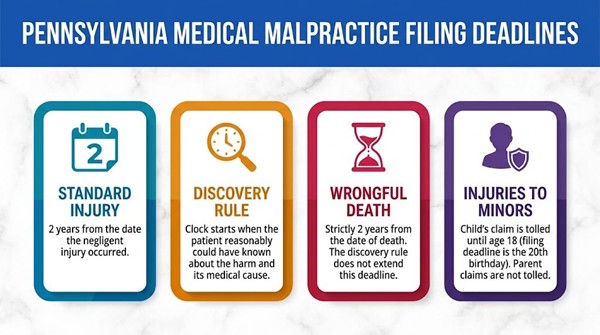
The deadlines come from Section 513 of the MCARE Act, 40 P.S. § 1303.513, and related laws. Missing one usually ends the case for good.
| Situation | Deadline | Key Rule |
|---|---|---|
| Standard injury | 2 years | Usually runs from the date of injury. |
| Injury discovered later | 2 years from discovery | Applies only if a reasonably careful person could not have discovered it sooner. |
| Wrongful death and survival | 2 years from death | The discovery rule does not extend it. Narrow exception for misrepresentation or concealment of the cause of death. |
| Injured child | Generally the 20th birthday | Parents' own claim for medical bills is not paused. |
| State or local government provider | Written notice within 6 months | Required under 42 Pa.C.S. § 5522 before suit. |
| Federally funded health center | Federal claim within 2 years | Federal Tort Claims Act. Not paused for children. |
The Discovery Rule in Delayed Diagnosis Cases
Sometimes you could not reasonably know you were injured, or that the injury came from medical care. Then the clock may not start until you discovered it. This rule matters most in delayed cancer cases, where a scan may have been misread years before the tumor was finally caught. You must show that a reasonably careful person would not have discovered the problem sooner.
The Seven-Year Repose Rule Is Gone (Yanakos v. UPMC)
Pennsylvania once had a seven-year cutoff that barred most malpractice lawsuits seven years after the care, even if the patient could not have discovered the injury. The Pennsylvania Supreme Court struck it down as unconstitutional in Yanakos v. UPMC, 218 A.3d 1214 (Pa. 2019). Any website that still describes an absolute seven-year limit is citing outdated law.
Wrongful Death Deadlines (Dubose v. Quinlan)
In death cases, the two-year deadline runs from the date of death (Dubose v. Quinlan, 173 A.3d 634 (Pa. 2017)). The discovery rule does not extend it. There is one narrow exception. If a provider affirmatively misrepresented or concealed the cause of death, the deadline may be extended. Do not count on that exception. If more than two years pass after a loved one’s death, the claim is usually lost forever.
Pediatric Injuries (Minor’s Tolling Statute)
A child’s own claim is paused while the child is a minor. In a malpractice case, it generally must be filed by the child’s 20th birthday. But a parent’s separate claim for medical bills they paid for the child is not paused. Families should never wait to investigate a birth injury or pediatric case.
Government and Federally Supported Health Centers (FTCA Deadlines)
Claims against government providers follow different rules. For state or local government facilities, you usually must give written notice within six months (42 Pa.C.S. § 5522).
Many community health centers are federally funded. Claims against them fall under the Federal Tort Claims Act (FTCA). You must first file a written administrative claim with the federal government within two years (28 U.S.C. § 2401(b)). This federal deadline is not paused for children. A birth injury at a community health center can be lost years before the child’s 20th birthday. If you are not sure who owns the clinic, ask a lawyer right away.
The two-year clock does not stop while you decide.
If you are near a deadline, call (412) 281-4100 today. We can tell you quickly whether your case needs immediate attention.
Certificate of Merit
What is a Certificate of Merit under Pa. R.C.P. 1042.3?
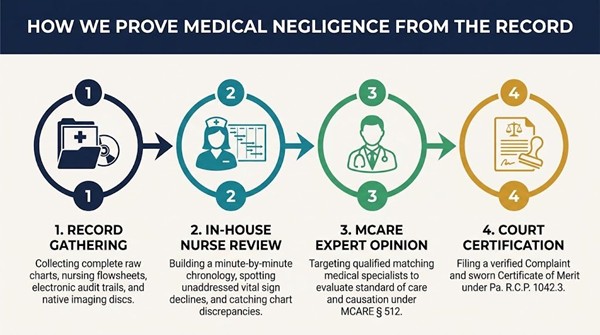
A Certificate of Merit is a sworn document Pennsylvania requires in every medical malpractice lawsuit. It must be filed with the complaint or within 60 days after filing, for each defendant. It certifies that a licensed professional, qualified under MCARE Section 512, has stated in writing that there is a reasonable probability the care fell below the standard and caused the harm. If no certificate is filed and no extension is granted, the defendant can seek a judgment of non pros, which dismisses the claim.
In Pennsylvania, a patient cannot sue a healthcare provider just because a lawyer thinks there was a mistake. The Certificate of Merit must state one of three things:
- A qualified medical professional has provided a written statement that there is a reasonable probability the care fell below the standard and caused the injury.
- The claim against this defendant is based only on the conduct of others it is responsible for, such as its employees.
- Expert testimony is not needed to prove the claim. This is rare. It applies only when the mistake is obvious, like a surgical clamp left inside a patient.
In our practice, we never rely on guesswork. We get a supportive written opinion from a qualified medical specialist before we file a lawsuit.
Four important facts about the Certificate of Merit:
- It is required for every defendant. A certificate for the surgeon does not cover the hospital or the nurses.
- The reviewing professional must be qualified. The reviewer must meet the standards the MCARE Act sets for medical experts.
- Missing the deadline can end the claim. If no certificate is filed and no extension is granted, the defendant can give 30 days’ written notice and then seek a “judgment of non pros” (Pa. R.C.P. 1042.6 and 1042.7). That dismisses the claim against that defendant. Courts grant relief only in limited situations.
- It applies to informed consent claims too. Calling a case a lack of informed consent does not avoid the requirement.
Other Pennsylvania Procedural Rules: Venue and Hospital Notice Letters
Where Can a Medical Malpractice Case Be Filed?
Where you file matters. Jury pools, local court practices, and trial schedules vary widely between counties.
Since January 1, 2023, Pennsylvania malpractice cases follow the general venue rules. A case can be filed in any county where:
- The medical care took place;
- A defendant can be served with legal papers; or
- A corporate healthcare defendant regularly conducts business.
Pennsylvania health systems have merged into large regional networks. A patient may receive negligent care at a small community hospital. But the system that owns it may do substantial business, employ thousands of workers, and run major facilities in counties like Allegheny or Philadelphia.
In Hangey v. Husqvarna Professional Products, Inc., 304 A.3d 1120 (Pa. 2023), the Pennsylvania Supreme Court held that a court cannot reject venue in a county just because that county is a small percentage of a large company’s total business. The court must look at whether the company’s business contacts in that county are regular and continuous.
Serious Event Letters and Infection Letters
- Serious event letters (Act 13). Under the MCARE Act, a hospital must send the patient or family a written notice within seven days of discovering a “serious event” that harmed the patient. The letter itself is not an admission of liability. But it tells you the hospital recognized that something went wrong.
- Infection letters (Act 52). Under Pennsylvania’s Act 52 of 2007, hospitals must also notify patients or families in writing about certain healthcare-associated infections. These letters often arrive after a serious infection or a death.
If you received either kind of letter, keep it and show it to your attorney right away. It does not always mean there was medical malpractice but often it does.
Can You Sue a Pennsylvania Hospital for a Doctor’s Negligence?
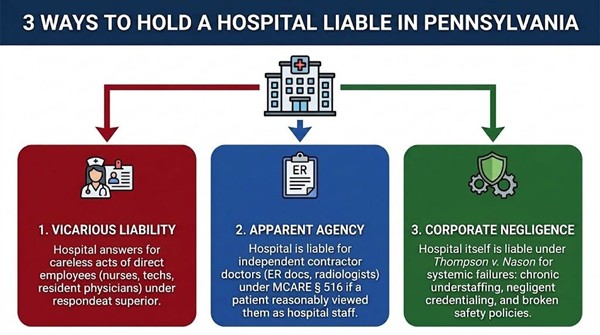
When a medical mistake happens inside a hospital, who is legally responsible? Pennsylvania law gives injured patients three separate paths to hold a hospital accountable.
| Theory | Who It Covers | What You Must Show |
|---|---|---|
| Vicarious Liability | Hospital employees: nurses, residents, techs, employed doctors | An employee was negligent while on the job. |
| Apparent Agency (MCARE § 516) | Non-employee doctors, such as many ER doctors, radiologists, and anesthesiologists | A reasonable patient would believe the doctor worked for the hospital, or the hospital held itself out as providing the care. |
| Corporate Negligence (Thompson v. Nason) | The hospital itself | The hospital breached one of its own duties and knew or should have known of the problem. |
Respondeat Superior (Hospital Employees)
A hospital is legally responsible for the careless acts of its employees while they are on the job. The legal term is respondeat superior, which means “let the master answer.” This rule covers:
- Registered nurses and nursing assistants.
- Resident doctors in training programs.
- Surgical technicians and therapists.
- Doctors directly employed by the hospital network.
If a floor nurse ignores abnormal vital signs and fails to call a rapid response team, the hospital is liable for that failure. You do not have to prove anything was wrong with the hospital as an institution. The hospital answers for its staff’s mistakes.
Can You Sue a Hospital for an ER Doctor? (Apparent Agency under MCARE § 516)
Short answer: Often, yes. Many ER doctors are not hospital employees. But under MCARE Section 516, a Pennsylvania hospital can be liable for a non-employee doctor if a reasonable patient would believe the doctor worked for the hospital, or if the hospital held itself out as providing the care. Most ER patients never choose their doctor, which makes this rule important.
Many doctors who treat patients in hospitals are not hospital employees. Emergency physicians, radiologists, anesthesiologists, and overnight hospitalists are often independent contractors. They may work for separate staffing companies or private practices.
Hospitals often try to avoid responsibility by arguing: “That doctor was an independent contractor, not our employee.”
Pennsylvania law limits that excuse through a rule called apparent agency (also called ostensible agency). Under Section 516 of the MCARE Act, 40 P.S. § 1303.516, a hospital can be responsible for a non-employee doctor’s negligence if either test is met:
- A reasonably prudent patient in your position would have believed the doctor was acting for the hospital.
- The hospital advertised or held itself out as providing the care.
Pennsylvania courts understand how patients experience a hospital. You go to a hospital emergency room for care, not to a specific doctor. The staff wear badges with the hospital logo. The building carries the hospital’s name. The bill comes on hospital letterhead. You did not choose the radiologist who read your CT scan. You never met the anesthesiologist who put you to sleep.
Corporate Negligence and Hospital System Failures (Thompson v. Nason)
What is hospital corporate negligence in Pennsylvania?
Corporate negligence is a claim against a hospital for its own institutional failures, not for the acts of its staff. In Thompson v. Nason Hospital, 591 A.2d 703 (Pa. 1991), the Pennsylvania Supreme Court held that every hospital owes patients four non-delegable duties:
- Maintain safe and adequate facilities and equipment.
- Select and retain only competent physicians.
- Oversee everyone who practices medicine inside its walls.
- Create, adopt, and enforce rules and policies that ensure quality patient care.
The patient must also prove the hospital had actual or constructive notice of the defect or procedure that caused the harm. That means the hospital knew, or should have known, about the problem.
A hospital owes safety duties directly to its patients. If the institution violates one, the hospital itself is negligent. This is often the most powerful claim against a healthcare facility.
Pennsylvania courts have applied this rule beyond hospitals. In Scampone v. Highland Park Care Center, 57 A.3d 582 (Pa. 2012), the Pennsylvania Supreme Court held that nursing homes and their management companies can also be sued for corporate negligence.
The notice requirement. To win a corporate negligence claim, the patient must prove the hospital had actual or constructive notice of the problem. That means the hospital knew, or should have known, about the unsafe condition. Proving notice takes deep investigation, including:
- Internal incident reports and safety logs.
- Doctor credentialing files.
- Unit staffing levels and shift schedules.
- Prior safety complaints from nurses and patients.
Common examples of corporate negligence:
- Dangerous understaffing. Too few nurses on a floor to safely monitor high-risk patients.
- Negligent credentialing. Granting surgical privileges to a doctor with a known record of incompetence, substance abuse, or discipline.
- Safety policies on paper only. Writing stroke, sepsis, or triage policies but failing to train staff to follow them.
- Broken communication systems. Electronic record systems that fail to deliver critical lab results or scan alerts to the treating doctor.
- Equipment failures. Failing to maintain, test, or replace broken monitors or anesthesia equipment.
Why We Name Both the Provider and the Hospital
In major cases, we routinely sue both the individual providers and the hospital system. The claim against the doctor or nurse addresses the specific mistake at the bedside. The corporate negligence claim addresses the broken systems, poor staffing, or bad policies that allowed the mistake to happen.
Pursuing both helps us uncover the hospital’s internal records. It also gives access to the insurance coverage needed to fully compensate a catastrophic injury and fund lifelong care.
How Medical Records and Electronic Audit Trails Prove Negligence
Medical malpractice cases are won with the medical chart, not with outrage. Families come to us with a personal story, and the medical record is what tells us whether that story will hold up in court.
Why Chart Analysis Comes First
Pennsylvania requires a written opinion from a qualified medical professional to support a Certificate of Merit. Outside specialists charge thousands of dollars to review records. Modern hospital records can run thousands of pages, full of repetitive electronic templates.
No law firm can afford to send every phone call straight to an outside doctor. No family should have to pay for that review out of pocket.
So the real investigation starts in-house. At Lupetin & Unatin, our attorneys and our in-house registered nurse review the records before we spend a dollar on outside experts.
From Our Files: The Skipped Verification
An elderly woman on dialysis was admitted to a hospital after a fall at home. She had end-stage kidney disease and had missed four scheduled dialysis treatments. Four days later, she was dead. Her family was told her body simply declined for unknown reasons. Two MRI scans had ruled out a stroke.
Our in-house nurse reviewed her complete chart, starting from the first page.
The medication list from the ambulance did not match what the patient reported in the emergency department. The chart documented the conflict. Hospital safety rules required staff to verify the list against a second source, like her pharmacy or family doctor. That step was skipped.
Because of that, she was restarted on an old muscle relaxant she had not taken in more than ten years. The kidneys clear that drug from the body. In a patient with kidney failure, it builds up quickly and becomes toxic. She was given one dose in the early afternoon and a second dose that evening.
At three o’clock the next morning, nurses called a rapid response. She was confused and slurring her words. The hospital never told her family. Later that day, nurses called a second rapid response because she was completely unresponsive. She never woke up.
When her daughter asked about the medication, the doctor said her mother received only one dose, which could not have caused the decline. The chart showed two full doses.
The discharge summary blamed an unavoidable decline. The raw chart proved a documented medication conflict, a required verification that was skipped, a toxic drug given to a patient in kidney failure, two separate doses, and a patient who slipped into a coma hours later.
Finding that truth did not require an expensive outside expert at first. It required an experienced nurse reading the chart line by line.
What Our Nurse Review Reveals
When our nurse investigates a case, we build the core medical evidence:
- A timeline of care. A minute-by-minute timeline built from the raw bedside notes, not the summary written afterward.
- Vital sign and lab trends. Blood pressure, oxygen levels, and lab values that show exactly when the patient started getting worse.
- Contradictions in the chart. Nursing notes compared against doctor notes. This is where conflicting stories usually surface.
- Specialty identification. Every doctor who treated the patient, which tells us which specialties we need under the MCARE Act.
- Missing records. Missing notes and blank flowsheets are often critical evidence.
- Hospital policies. The internal safety rules that applied to the patient’s condition.
By the time we hire an outside medical expert, we hand them an organized timeline and specific clinical questions. That makes the expert review faster and more reliable.
Key Records That Prove Medical Negligence
- Timestamps. When was the order entered? When was the drug given? When was the surgeon paged, and when did they arrive? Minutes matter in a stroke, heart attack, or emergency delivery.
- Nursing flowsheets. These show what was happening at the bedside, hour by hour. They often contradict the narrative notes written later.
- Audit trails. Electronic records track who opened a chart, what they viewed, and when. If a doctor claims they never saw a critical lab result, the audit trail tells the true story. These logs are usually obtained through discovery after a lawsuit is filed.
- The actual images. We get the actual MRI, CT, or X-ray files, not just the written report. Our independent experts review the images directly to see whether a tumor or clot was missed.
- Fetal heart monitor strips. In birth injury cases, we line up the tracings with the delivery notes to show when a baby began losing oxygen.
- Medication records. The Medication Administration Record (MAR) confirms the exact drug, dose, and time.
How to Get Your Medical Records
You have a legal right under federal law (HIPAA) to see and get copies of your medical records. Request them in writing from each doctor, clinic, and hospital that treated you. You can download Allegheny Health Network’s medical authorization here. You can download UPMC’s medical authorization here. Ask specifically for the complete record, including:
- Nursing notes and bedside flowsheets;
- Medication administration records;
- Doctor orders and progress notes; and
- Diagnostic images on disc (DICOM format).
Hospitals often send a short summary unless you ask for the complete file. Keep every bill, discharge paper, and letter you receive. If we represent you, our office handles the entire records process for you.
What to Do If You Suspect Medical Malpractice
If you believe you or a loved one was harmed by medical negligence, take these steps:
- Write down your memories. Dates, times, provider names, and what you were told, while the details are fresh.
- Save all paperwork. Discharge instructions, bills, patient portal messages, appointment reminders, and any letters from the hospital.
- Do not sign anything from hospital risk management. Never sign a release, settlement, or waiver without talking to a lawyer first.
- Do not argue with the provider or post online. Arguing will not help your case. Social media posts can give defense lawyers statements to use against you.
- Check your deadlines. The standard deadline is two years, but special rules apply to death cases, children, and government or federally funded providers.
- Contact an experienced Pennsylvania medical malpractice lawyer. Choose a firm that focuses on medical malpractice, has a registered nurse review charts, and regularly tries cases to a jury verdict.
What Happens When You Call Us
- Our nurse calls you. After you contact us, our intake nurse calls you. She conducts a detailed interview and gathers the facts.
- Our attorneys review the facts. They decide whether there is reason to get the medical records. If there is, our office requests all the relevant records at no cost to you.
- We review the records. An attorney reviews the records and decides whether there is a case. We tell you honestly either way.
- We recruit a medical expert. If there is a case, we retain a qualified medical expert to support the Certificate of Merit Pennsylvania requires.
How Lupetin & Unatin Can Help
We are a boutique Pittsburgh firm. Medical malpractice and catastrophic injury is what we do, and close to all we do.
We keep our caseload deliberately small so a partner works your case personally. You will not be handed off to a case manager. Our attorneys and our in-house nurse review your records before we bring in outside experts. If we take your case, we advance every cost. You owe no fee and no costs unless we recover money for you.
We handle cases throughout Western Pennsylvania and across the Commonwealth, including delayed diagnosis and cancer cases, birth injuries, surgical errors, brain injuries, sepsis cases, and misdiagnosis and incorrect treatment claims.
The review is free and confidential. If we do not think you have a case, we will tell you directly and explain why. Many callers tell us that answer was what they needed most.
Speak To A Lawyer
Call (412) 281-4100 or request a free case review from our Pittsburgh medical malpractice lawyers.
Frequently Asked Questions
Generally two years. The clock usually starts on the date of injury. The discovery rule can delay the start if you could not reasonably have known you were harmed. In death cases, the two years run from the date of death. A child’s own claim usually must be filed by the child’s 20th birthday. Claims against government and federally funded providers have shorter, stricter deadlines, and the federal deadline is not paused for children. Because so many exceptions exist, have a lawyer confirm your date rather than assuming.
In nearly every case, yes. Pennsylvania requires a Certificate of Merit with the complaint or within 60 days of filing. It must be based on a qualified licensed professional’s written statement that the care likely fell below accepted standards and caused harm. A narrow exception exists where expert testimony is unnecessary, such as a surgical instrument left inside a patient. That exception is rare. In practice, no responsible lawyer files a Pennsylvania malpractice case without an expert opinion in hand.
No. Pennsylvania asks whether the care met the professional standard, not whether the result was good. Recognized complications happen to careful providers. What makes an outcome actionable is evidence that a reasonably competent provider in the same specialty would have done something different, and that the difference would have mattered.
That is the two schools of thought defense. In Pennsylvania it is a complete defense when it applies. Under Jones v. Chidester, a physician who followed a course of treatment supported by a considerable number of recognized and respected professionals is not liable, even if most would have chosen otherwise. The defense has real limits. It requires more than one genuinely accepted method. It does not excuse a failure to recognize an illness. And it does not cover performing the chosen treatment badly.
Yes. A signed form does not waive your rights. Informed consent is a separate claim in Pennsylvania. Under Shinal v. Toms, the question is whether the physician personally gave you the information a reasonably prudent patient would need about the risks, benefits, and alternatives. A signature is evidence that a conversation happened. It is not proof that the conversation covered what it had to cover.
Often both can be. A hospital answers for its employees through vicarious liability. It can answer for non-employee physicians through apparent agency under MCARE Section 516. And it answers for its own institutional failures through corporate negligence under Thompson v. Nason Hospital. Which theory applies depends on the employment arrangements and the facts. Sorting that out is part of the investigation.
Often, yes. Many ER doctors are not hospital employees. But under MCARE Section 516, a Pennsylvania hospital can be liable for a non-employee doctor if a reasonable patient would believe the doctor worked for the hospital, or if the hospital held itself out as providing the care. Most ER patients never choose their doctor, which makes this rule important.
No. Pennsylvania does not cap compensatory damages in medical malpractice cases. Article III, Section 18 of the Pennsylvania Constitution bars the legislature from limiting damages for injury or death. Punitive damages against an individual physician are capped at 200% of compensatory damages, except in cases of intentional misconduct. Claims against government entities are also subject to statutory caps.
Since January 1, 2023, Pennsylvania malpractice cases follow the general venue rules. A case can be filed where the care occurred, where a defendant can be served, or where a transaction giving rise to the claim took place. For corporations, that includes any county where they regularly conduct business. Because many Pennsylvania health systems operate across dozens of counties, there is often more than one proper venue.
Nothing up front, and nothing at all unless we recover money for you. We work on a contingent fee. We also advance the case costs, which in a serious malpractice case are substantial. If we recover for you, our fee is a percentage of the recovery, and the costs we advanced are repaid from it. If we do not recover, you owe us no fees and no costs. Asking us to review your case is a no-risk inquiry. We review the entire fee agreement with you before you sign anything.
Usually not, and that is not what a malpractice case decides. A malpractice lawsuit is a civil case about money and accountability to the patient. Medical licenses are handled separately by the Pennsylvania State Board of Medicine or the State Board of Osteopathic Medicine, through the Department of State. Those boards discipline providers for things like impairment, criminal conduct, or a pattern of incompetent care. A single malpractice verdict or settlement rarely results in license discipline, though malpractice payments are reported to the National Practitioner Data Bank. If you want a provider’s conduct reviewed by the licensing board, you can file a complaint with the state yourself. You can do that whether or not you bring a lawsuit by filing a Complaint with the State Board which you can do here.
About the Authors
Brendan B. Lupetin, Esquire is a founding partner of Lupetin & Unatin, LLC, a Pittsburgh medical malpractice and catastrophic injury firm. He has represented injured patients and their families in Pennsylvania for about twenty years. He has been named repeatedly to Super Lawyers’ Top 50 Lawyers in Pittsburgh and Top 100 Lawyers in Pennsylvania, and he is recognized by Best Lawyers in America for plaintiffs’ personal injury litigation and medical malpractice law. He was named a 2026 Best Lawyers “Lawyer of the Year” in Pittsburgh. He is a Fellow of the American College of Trial Lawyers and a member of the American Board of Trial Advocates. He teaches Trial Strategy and Practice as an adjunct professor at the University of Pittsburgh School of Law, and he hosts the Just Verdicts podcast.
Greg Unatin, Esquire is a founding partner of Lupetin & Unatin, LLC. He represents patients and families in medical malpractice and catastrophic injury cases throughout Pennsylvania. He has been named repeatedly to Super Lawyers’ Top 50 Lawyers in Pittsburgh and Top 100 Lawyers in Pennsylvania, and he is recognized by Best Lawyers in America for plaintiffs’ personal injury litigation and medical malpractice law. He is a member of the American Board of Trial Advocates.
Lupetin & Unatin, LLC, Grant Building, 310 Grant Street, Suite 3204, Pittsburgh, PA 15219. (412) 281-4100.