

When a uterine rupture happens during a trial of labor, the response must be immediate. A baby may have only minutes to avoid injury or death. An immediate response is not available or possible at some hospitals. The necessary rapid response depends on the right people and the right resources being inside the building, ready, the moment they are needed. If your delivery turned into an emergency, one fair question is whether the hospital was ever equipped to handle it.
A trial of labor requires a prepared setting
A trial of labor after cesarean, often called TOLAC, is an attempt to deliver vaginally after a prior C-section. Its most dangerous complication is uterine rupture, when the old cesarean scar tears during labor. A rupture can cut off the baby’s oxygen supply within minutes.
The American College of Obstetricians and Gynecologists addresses this directly. ACOG advises that a trial of labor should be undertaken in a setting where an emergency cesarean delivery can be performed. The reason is simple. The complication is foreseeable, and the only effective response is fast surgery. Offering a trial of labor without the means to deliver that immediate response puts mom and baby in danger from the start.
You must be informed if your hospital lacks needed resources
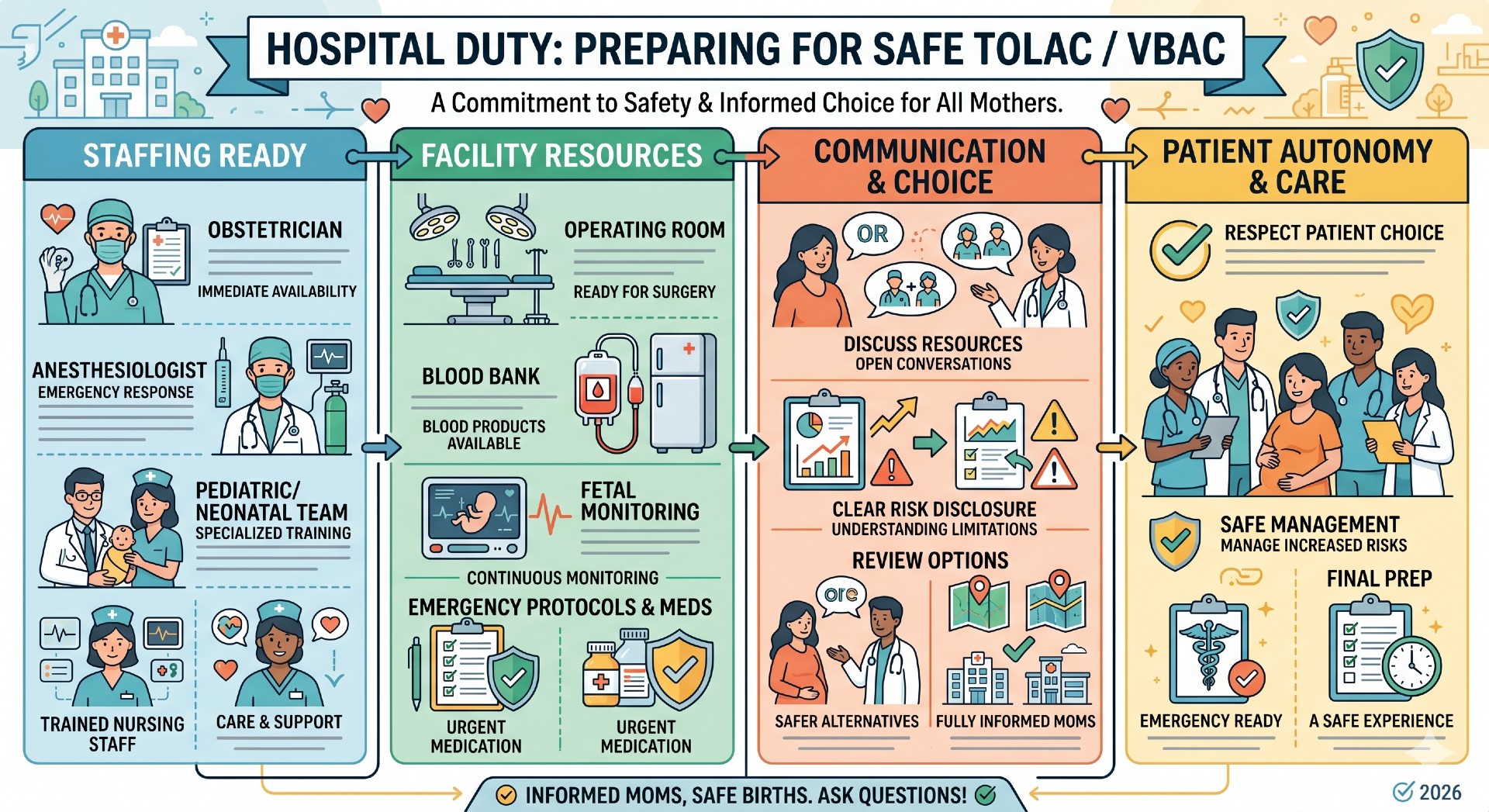
If your hospital lacks a dedicated, round-the-clock emergency response team your obstetrician must tell you. ACOG issued a practice bulletin advising that obstetricians are obligated to disclose to TOLAC patients whether the facility is appropriate staffed and equipped. While you have the fundamental right to choose your birth plan and accept a higher level of risk, you cannot make a truly informed decision if the true dangers are minimized. Your doctor must clearly explain the hospital’s exact limitations and the severe risks those delays pose to you and your baby.
What a prepared facility has
For a hospital to respond to a rupture in time, several things need to be available without delay. A physician capable of performing an emergency cesarean must be reachable and able to be present quickly. Anesthesia care must be available, because surgery cannot proceed without it. An operating room must be ready, or able to be readied fast. And a team capable of resuscitating a newborn and caring for a critically ill mother must be on hand.
These resources cannot be theoretical. The question is not whether a hospital could eventually assemble a surgical team. It is whether the hospital can do so quickly enough to matter when a rupture is unfolding in real time.
How a setting fails the family
A facility can fall short in several ways, and any one of them can cost a baby the minutes that matter most.
- The obstetrician was not in the hospital during the labor and had to travel in from elsewhere.
- No anesthesia provider was physically present or immediately available.
- No operating room was open and staffed when the emergency arose.
- The hospital did not have the staff or the plan to perform a true emergency cesarean on short notice.
- The mother was offered a trial of labor at a facility that should have referred her to a hospital better equipped to manage one.
Sometimes the failure is not in the moment of the emergency at all. It is in the earlier decision to offer a trial of labor in that setting. A hospital that is not equipped for a rupture should not be collecting the chance of a vaginal birth while leaving the family exposed to the risk.
Resources and response are different questions
It helps to separate two issues, because a case can turn on either one.
The first issue is resources. Did the hospital have what it needed available? Was the surgeon reachable? Was anesthesia present? Was an operating room ready? This is about whether the hospital was equipped to offer a trial of labor in the first place.
The second issue is response. Even a well-equipped hospital can be slow. The team may notice a warning sign late, escalate it slowly, or take too long to move to surgery. This is about how the available resources were used.
A careful review looks at both. Sometimes the family was harmed because the hospital was never prepared. Sometimes the resources were there and the team simply did not move fast enough. Often it is a combination. The medical record, with its detailed timeline, allows both questions to be answered.