

Article:

VBAC: Dangers To The Mother

Free Case Evaluation

Fill out the form below to schedule a free evaluation.

This field is for validation purposes and should be left unchanged.

When a VBAC Harms the Mother

Uterine rupture and maternal injury that can occur during vaginal birth after caesarean 

Brendan Lupetin, Esq.

Contact Us for a Free, Confidential Consultation

Article written by Brendan Lupetin, Esq. Brendan is a managing partner in the law firm of Lupetin & Unatin, a medical malpractice law firm located in Pittsburgh and serving Western Pennsylvania.

Our practice is limited to high-value catastrophic cases because that is where we can do the most for our clients and for patient safety.

Most of what is written about a trial of labor after cesarean focuses on the baby. That focus is understandable. But a uterine rupture is dangerous to the mother as well. Some women come through a rupture having suffered serious, permanent harm of their own, including heavy blood loss, surgery they never expected, and the loss of the ability to have more children. If that happened to you, your injuries matter, and they deserve to be taken seriously.

This page explains the harm a uterine rupture can do to a mother, the care she is owed, and how a family can find out whether that harm could have been prevented.

What a uterine rupture does to the mother

A trial of labor after cesarean, often called TOLAC, carries the risk that the old cesarean scar on the uterus will tear during labor. This is a uterine rupture.

When the uterine wall tears, the consequences for the mother can be severe. The uterus has a rich blood supply, so a rupture can cause heavy and rapid bleeding. That blood loss can become dangerous quickly. The tear can also extend into nearby structures, including the bladder. To control the bleeding and repair the damage, surgeons must operate at once.
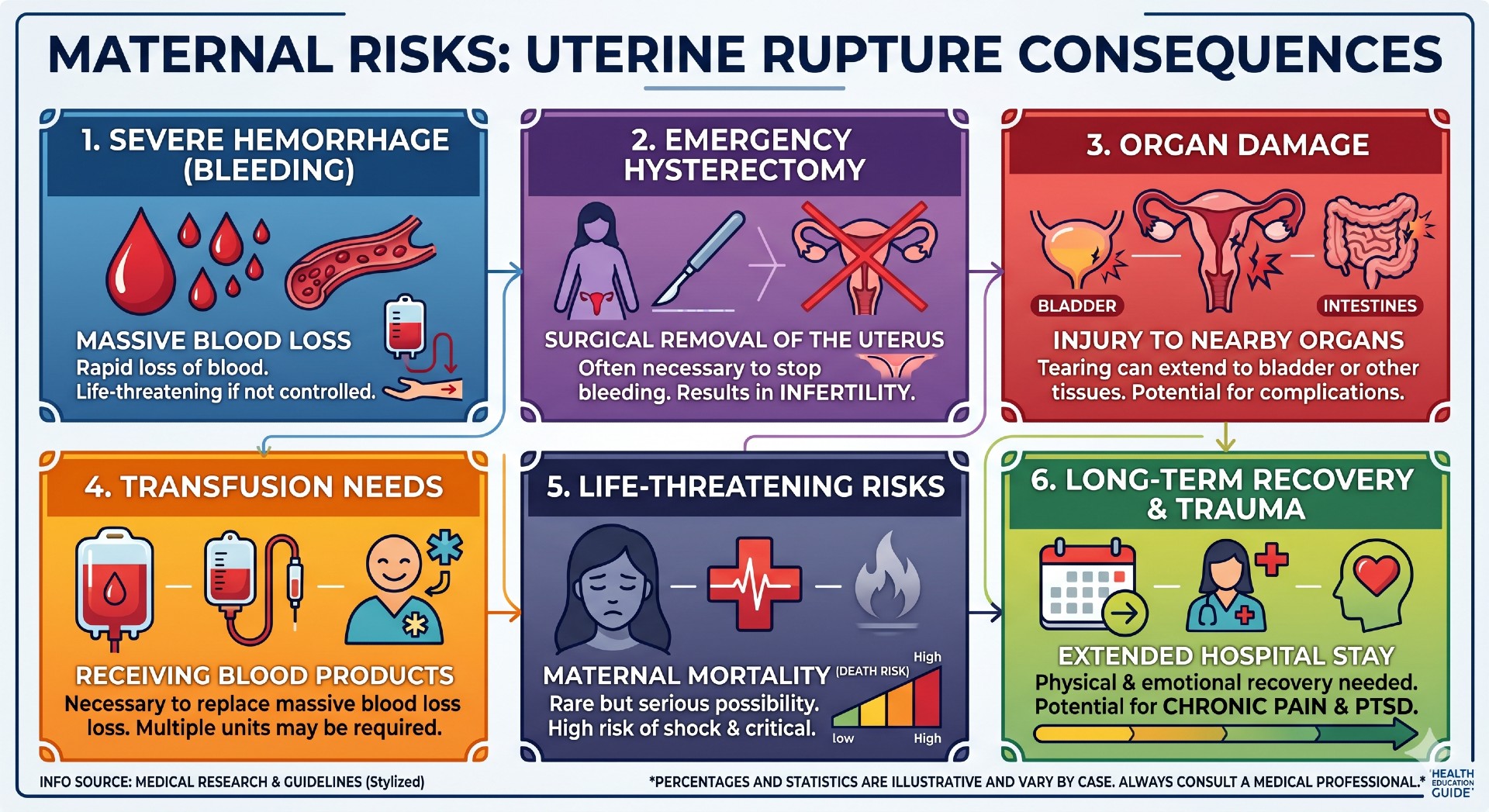
infographic describing the consequences to the mother when uterine rupture occurs

The injuries a mother can suffer

The maternal harm from a uterine rupture can take several forms. Some women experience one of these injuries. Others experience several.

  1. Severe hemorrhage, meaning dangerous blood loss that may require transfusion.
  2. Hysterectomy, the surgical removal of the uterus, sometimes performed as the only way to stop the bleeding.
  3. Injury to the bladder or other nearby organs.
  4. The loss of the ability to carry another pregnancy.
  5. The physical toll of emergency surgery and a long, difficult recovery.
  6. Lasting emotional trauma from a delivery that became life-threatening.

The loss of fertility deserves its own mention. For a woman who hoped to have more children, a hysterectomy performed during a rupture emergency closes that door permanently. That is a profound loss, and it is a real and compensable injury.

The care a mother is owed

A rupture is an emergency for the mother just as much as for the baby. The standard of care does not stop once the baby has been delivered.

A mother in this situation is owed prompt recognition of her bleeding, fast surgical control of the source, and appropriate replacement of the blood she has lost. Her blood pressure, heart rate, and blood counts must be watched closely. When a hysterectomy becomes necessary, it should be performed competently and only when truly required to save her life or stop uncontrollable bleeding. A team that loses track of a mother’s deteriorating condition, or is slow to control her hemorrhage, can deepen an injury that better care would have limited.

Where care goes wrong

In birth injury cases involving a rupture, the mother’s care is examined alongside the baby’s. The questions overlap with the questions about the baby, because the same failures often harm both.

We look at whether the rupture should have been foreseen and prevented, including whether the mother was a proper candidate for a trial of labor and whether her labor was managed safely. We look at whether her bleeding was recognized and controlled quickly. We look at whether she received the blood she needed in time. And we look at whether a hysterectomy was genuinely unavoidable, or whether better and faster care could have saved her uterus. When a mother loses her fertility because a foreseeable emergency was handled poorly, that is a serious matter.

Frequently Asked Questions

Yes. A medical malpractice claim is about the harm a patient suffered, and the mother is a patient too. If you suffered a serious injury during a trial of labor, such as a hysterectomy, the loss of fertility, a major hemorrhage, or an organ injury, and that harm could have been prevented with proper care, you may have a claim of your own regardless of how your baby is doing.

Not necessarily. Sometimes a hysterectomy truly is the only way to stop a life-threatening hemorrhage, and that is not malpractice. But the earlier care still matters. Was the rupture preventable in the first place? Was your bleeding recognized and controlled quickly enough? Could faster, better care have saved your uterus? A hysterectomy performed in a crisis can still be the end result of failures that came before it. Those questions deserve a careful review.

An initial review and consultation is free, with no obligation. We handle medical malpractice and birth injury cases on a contingent fee basis, which means you owe no attorney fee unless we recover compensation for you. The first step is simply a conversation about what you went through.

How Lupetin & Unatin can help

At Lupetin & Unatin, we handle catastrophic birth injury and medical malpractice cases, including cases where the mother was the one seriously harmed. Attorney Brendan Lupetin and attorney Greg Unatin keep the firm’s caseload small so that each client works directly with a partner.

Our firm has recovered record verdicts and settlements in catastrophic injury and medical malpractice cases, and we bring that experience to every birth injury matter we take.

A maternal injury case is built from the labor and delivery records, the surgical and anesthesia records, the blood bank records, and the nursing notes. We obtain those records. We work with obstetricians and maternal-fetal medicine specialists who can explain whether the rupture was preventable and whether the mother’s injuries were made worse by the care she received. If your harm could have been avoided, we are prepared to prove it, and to pursue full compensation for what you have lost.

Talk to a Pittsburgh Birth Injury Attorney

If your baby or your family was harmed during a trial of labor after cesarean, the attorneys at Lupetin & Unatin, LLC are here to help you find answers. We offer free, confidential consultations, and we handle medical malpractice and birth injury cases on a contingent fee basis. You pay no attorney fee unless we recover compensation for you.

It is important not to delay. Pennsylvania law limits the time you have to file a claim.

This article is provided for general informational purposes and is not legal or medical advice. Reading it does not create an attorney-client relationship. Every case is different. If you have questions about your own situation, speak with a qualified attorney.

What can we help you find?

Generic selectors
Exact matches only
Search in title
Search in content
Post Type Selectors