

During a trial of labor after a cesarean, the fetal heart monitor is not a routine piece of equipment. It is the warning system. It is, in most cases, the first and best chance to catch a uterine rupture before it harms the baby. When that warning system is not used correctly, the warning never comes, and the response never comes in time.
If your delivery ended in an injury, you may wonder whether something on the monitor was missed. In this article we explain how fetal monitoring is supposed to work during a trial of labor, and how a breakdown in monitoring can lead to a preventable injury.
Why monitoring matters more during a trial of labor
A trial of labor after cesarean, often called TOLAC, carries a specific danger that an ordinary labor does not. The old cesarean scar on the uterus can tear during labor. This is a uterine rupture, and it is an emergency for both mother and baby.
When a rupture begins, the most common early sign is a sudden change in the baby’s heart rate. ACOG identifies the fetal heart tracing as the most reliable early clue that a rupture may be happening. That single fact explains why monitoring is so important. The monitor is how the team sees the emergency starting. Without it, the first sign of trouble may be missed entirely.
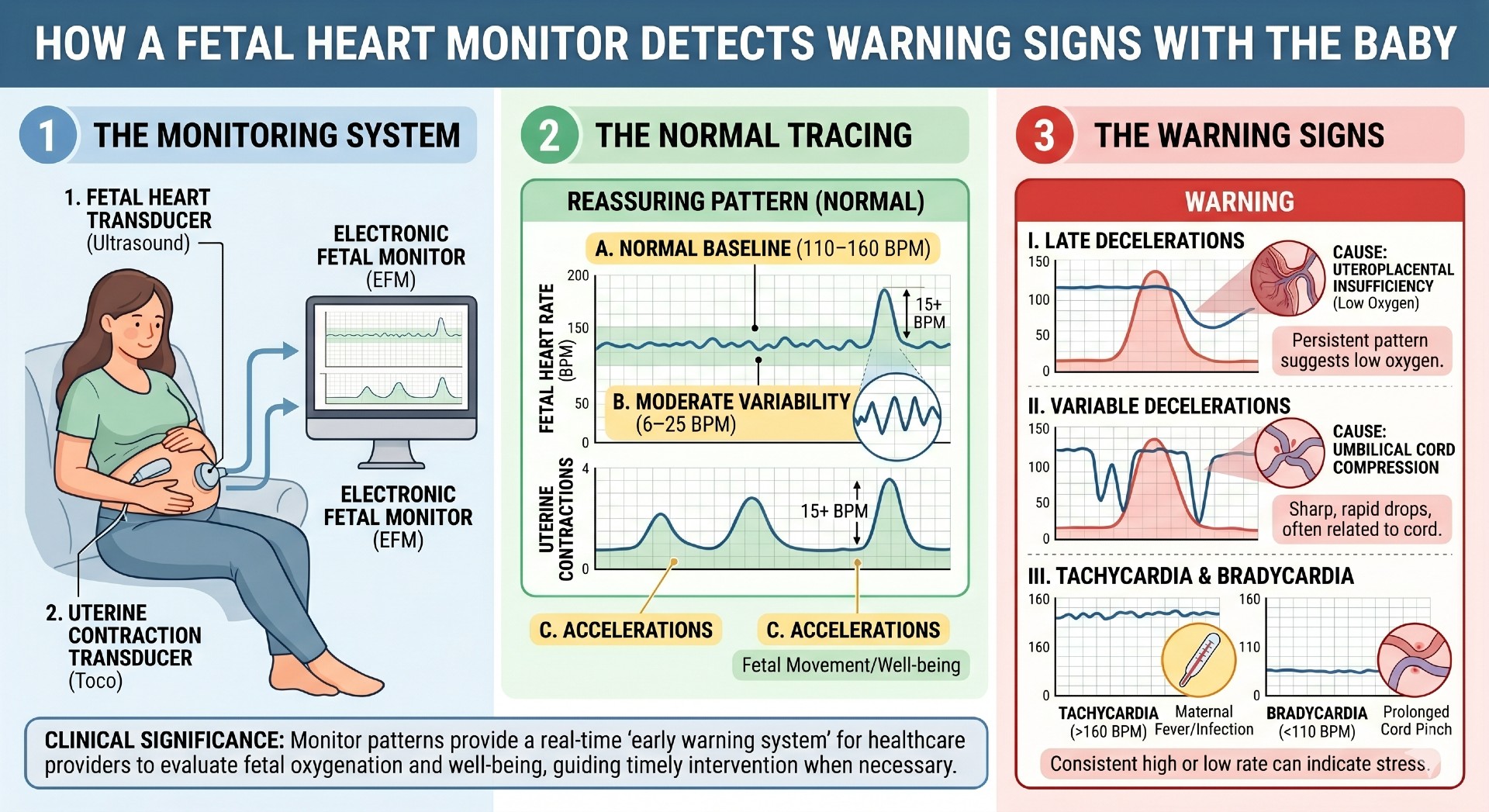
What continuous monitoring means
For a trial of labor after cesarean, ACOG recommends continuous electronic fetal monitoring. The word continuous is doing real work in that sentence.
Continuous monitoring means the baby’s heart rate and the mother’s contractions are tracked without interruption throughout labor. It is not the same as checking the heartbeat every so often. It is not a monitor that is left running while no one looks at the screen. True continuous monitoring means an unbroken recording and a qualified person actually watching and interpreting it as labor goes on.
The monitor produces a strip, a moving record of the baby’s heart rate and the contraction pattern. Reading that strip correctly is a skill. Certain patterns are reassuring. Others are warning signs. A trained nurse or physician is supposed to recognize the difference and act on it.
How monitoring fails
A monitoring failure during a trial of labor can take several forms. In our work on birth injury cases, we see the same breakdowns repeatedly.
- The monitor was removed or paused, leaving a gap with no recording at the very moment trouble began.
- The signal was poor or kept dropping out, and no one corrected it or switched to a more reliable method.
- The monitor was running, but no one was watching the strip closely enough to catch a developing problem.
- A warning pattern appeared on the strip, but it was misread as normal or not concerning.
- A nurse recognized a warning pattern but did not escalate it to a physician quickly enough.
Each of these failures has the same effect. It blinds the team to the emergency, or delays the moment the team finally sees it. And during a uterine rupture, delay is the enemy. Every minute the baby’s oxygen supply is compromised, the risk of permanent injury grows.
The strip is the evidence
There is an important fact about fetal monitoring that families should know. The monitor strip is saved. It becomes part of the permanent medical record.
That means the same record used to manage your labor can later be reviewed to find out what happened. The strip shows the baby’s heart rate, the contraction pattern, and the times. A qualified expert can examine it and see when a warning sign first appeared. The nursing notes show when the team responded. Sometimes the strip even contains notes that are not in the medical record. By comparing the strip to the notes, it becomes possible to measure the gap between the moment trouble was visible and the moment anyone acted on it.
When that gap is long, and a healthy baby was harmed inside it, the strip often shows that the injury was preventable.