

If your child has cerebral palsy from a preventable birth injury, the first question is rarely about money. It is about answers. What went wrong. Who is responsible. Whether your child will ever walk, speak, or live independently.
Eventually, though, the money question comes. It has to. The cost of raising a child with severe cerebral palsy in Pennsylvania can exceed ten million dollars over a lifetime. Families need to know what a successful lawsuit can recover, and how that number gets built.
This article explains what drives the value of a Pennsylvania cerebral palsy case. The honest answer is that every case is different. But the framework that lawyers, doctors, and economists use to value these cases is consistent. Once you understand it, the range of possible outcomes makes a lot more sense.
The Short Answer
Cerebral palsy birth injury cases in Pennsylvania typically resolve in the seven to eight figure range when liability is clear and the injuries are severe. Some settle for less. A handful settle for more. The wide range reflects the wide range of injuries, the strength of the medical evidence, and the lifetime needs of the child.
Our firm has handled cerebral palsy and birth injury cases that settled or resolved for amounts well into the eight figures. One recent example: a $13.5 million settlement for a child who suffered catastrophic injuries during a late-term pregnancy procedure at a Pittsburgh hospital. The settlement reflected decades of needed care, lost earning capacity, and the failure of the medical team to follow basic safety rules.
But a number on a webpage tells you almost nothing about your case. What matters is how a case gets valued. That is what we will walk through next.
The Four Pillars of Case Value
Pennsylvania law allows a child injured by medical negligence to recover damages in four broad categories. Each one has to be proven. Each one has to be quantified.
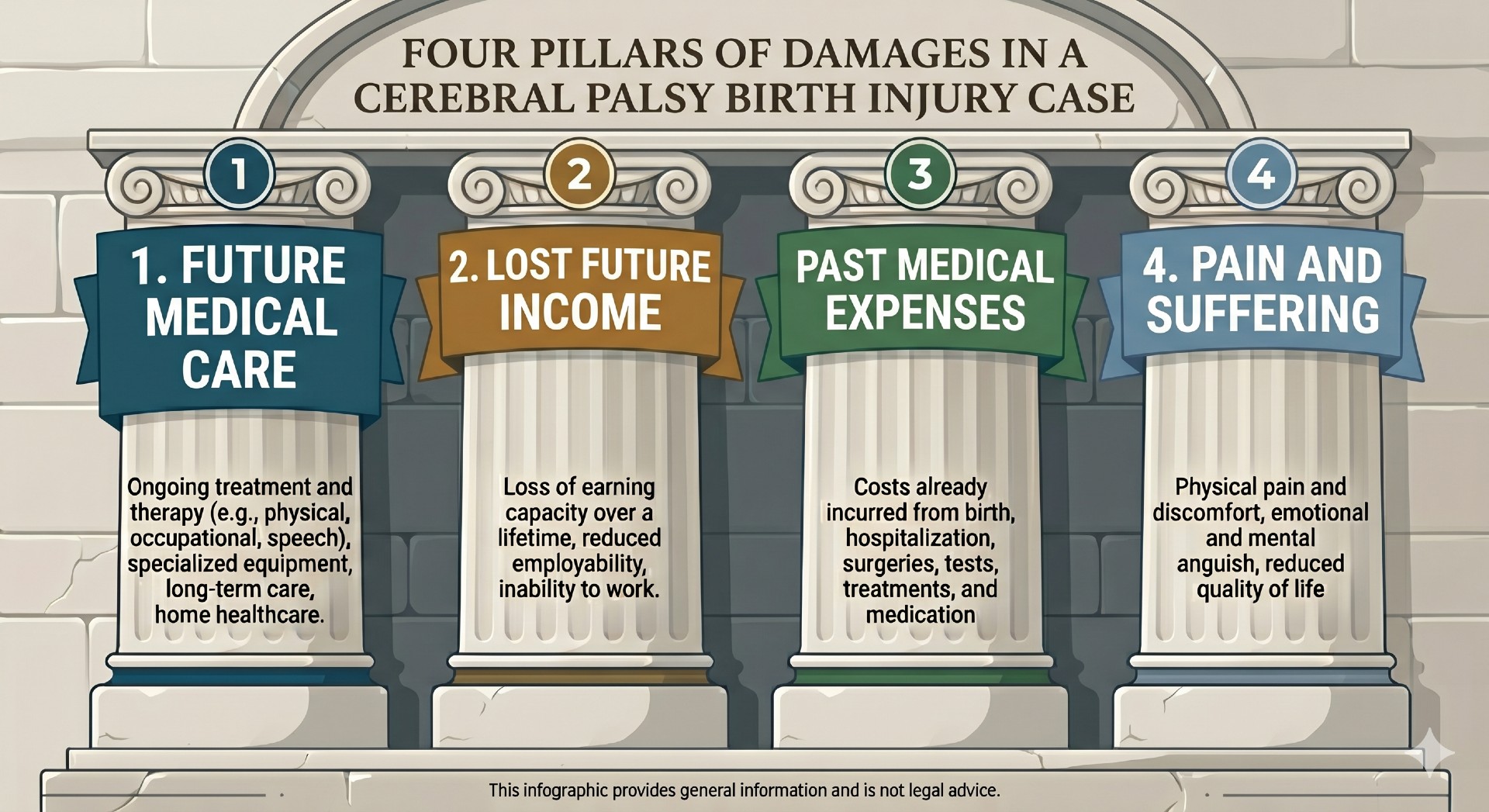
1. Future Medical Care
This is usually the largest component of a cerebral palsy case. It covers everything the child will need for the rest of their life. Wheelchairs. Specialized vehicles. Home modifications. Physical therapy. Occupational therapy. Speech therapy. Feeding tubes. Anti-seizure medication. Botox injections for spasticity. Orthopedic surgery. Communication devices. Around-the-clock nursing in severe cases.
A board-certified life care planner builds this number. They review the medical records. They interview the family and the treating doctors. They project out what the child will need at every life stage. An economist then converts those projected costs into present-day dollars using accepted financial methods. The result is a defensible, evidence-based number that a jury can understand.
For a child with severe spastic quadriplegic cerebral palsy who needs lifelong nursing care, the future medical care number alone can exceed $10 million.
2. Lost Earning Capacity
A child born today has a working life ahead of them. Children with severe cerebral palsy often cannot work at all. Children with milder forms may work but at reduced capacity.
A vocational expert and an economist work together to calculate what the child would have earned in a typical career, then subtract whatever earning capacity remains. The difference is the lost earning capacity claim. For a child who will never work, this category alone can exceed $2 million when adjusted to present value.
3. Pain and Suffering
Pennsylvania law allows compensation for the physical pain, mental anguish, and loss of life’s pleasures that the child will experience because of the injury. This is not a math equation. It is what a jury decides is fair after hearing the evidence.
Pennsylvania does not cap non-economic damages in medical malpractice cases. That distinction matters. Many states do cap them, often at $250,000 or $500,000. Pennsylvania does not. A jury can award what the evidence supports.
4. Past Medical Expenses
Everything that has already been spent on the child’s care since birth. NICU bills. Surgery. Therapy. Equipment. Medication. These are usually documented in medical bills and insurance records.
What Makes a Case Worth More
Two cerebral palsy cases with identical diagnoses can settle for very different amounts. Here is what moves the number up.
Severity of the injury.
A child with severe spastic quadriplegia who cannot walk, talk, or feed independently will have a much higher case value than a child with mild hemiplegia who is fully verbal and ambulatory. Both deserve compensation. The numbers are very different.
Clear liability.
When the medical records show an obvious breach of the standard of care — an ignored fetal heart strip, a delayed C-section, a misread of an obvious uterine rupture — the case is worth more. Defendants pay more when they know a jury will not be sympathetic to them.
Strong causation evidence.
It is not enough to show the doctor made a mistake. You have to show that the mistake caused the cerebral palsy. In HIE cases, this often comes down to the timing of oxygen deprivation, cord blood gases, MRI findings, and placental pathology. Cases with clean causation evidence are worth significantly more than cases where the defense can argue the injury was caused by something else.
A young plaintiff.
A newborn has decades of future medical care and lost earning capacity ahead of them. That increases the damages base.
A defendant with deep insurance coverage.
Most Pennsylvania hospitals and obstetricians carry meaningful malpractice insurance, including coverage through the MCARE Fund. Adequate insurance is what allows large settlements and verdicts to actually be paid.
What Makes a Case Worth Less
Honesty matters. Several factors can reduce case value.
- Strong defense causation evidence — for example, a genetic condition that could have caused the cerebral palsy independently.
- Comparative fault — though Pennsylvania still allows recovery in most cases where the plaintiff is less than 51% at fault, this matters less in pure birth injury cases.
- A child whose long-term needs are uncertain or appear less severe than first feared.
- A defendant with limited insurance coverage.
- Weak liability — meaning the medical care was within the broad range of acceptable practice.
How Pennsylvania Law Affects the Numbers
Several Pennsylvania-specific rules shape what a cerebral palsy case is worth.
No Cap on Non-Economic Damages
Unlike many states, Pennsylvania does not limit what a jury can award for pain, suffering, and loss of life’s pleasures in a medical malpractice case. That is a meaningful advantage for plaintiffs.
MCARE Fund Coverage
The Pennsylvania Medical Care Availability and Reduction of Error (MCARE) Act requires hospitals and most physicians to carry a layer of insurance, with the MCARE Fund providing additional excess coverage. This structure helps ensure that large judgments in birth injury cases can actually be collected.
Statute of Limitations for Minors
Generally, Pennsylvania medical malpractice claims must be filed within two years of when the injury was discovered or should have been discovered. For injuries to minors, that clock is tolled — meaning paused — until the child turns 18. That gives families time, but waiting is rarely the right move. Evidence disappears. Witnesses move. Memories fade. The best cases get filed while the records are fresh.
Certificate of Merit
Every Pennsylvania medical malpractice lawsuit requires a Certificate of Merit from a qualified medical expert within 60 days of filing the complaint. Without that certificate, the case is dismissed. This rule keeps frivolous cases out of court — and it is one of many reasons experienced birth injury counsel matters.
How Settlements Get Structured
A multi-million-dollar settlement for a child with cerebral palsy is almost never paid as one lump check. Instead, settlements are typically structured to provide guaranteed lifetime income, predictable funding for future medical care, and protection of the child’s eligibility for public benefits.
Structured settlements use insurance company annuities to pay out tax-free streams of money over decades. A special needs trust may hold the funds to preserve Medicaid and Supplemental Security Income eligibility. A guardian — often the parent — manages the funds under court oversight.
This is sophisticated work. It needs to be done right. Our firm regularly coordinates with structured settlement consultants and special needs trust attorneys to make sure the money lasts the child’s lifetime and that public benefits are protected.
What a Case Actually Looks Like
In a typical severe birth injury case our firm handles, the breakdown often looks something like this:
- Future medical care: $6 million to $12 million (depending on severity and life expectancy)
- Lost earning capacity: $1.5 million to $3 million (present value)
- Past medical expenses: $200,000 to $1 million (depending on age at settlement)
- Pain and suffering for the child: varies widely — sometimes the largest single number on a verdict form
- Loss of consortium and emotional distress claims for parents: varies by jurisdiction and facts
Add those numbers together and you understand why severe cerebral palsy cases in Pennsylvania often settle in the eight figures. The numbers are not arbitrary. They are built from medical reality.
Why Many Families Settle Rather Than Try
Most cerebral palsy cases that get filed eventually settle. There are good reasons for that. Trials are expensive, emotionally exhausting, and uncertain. A confident settlement at a fair number gives the family certainty. The child gets care now, not five years from now after appeals.
But the threat of trial is what produces fair settlements. Defendants do not settle big cases unless they believe the plaintiff’s lawyer will try the case if pushed. Pittsburgh birth injury defense lawyers know which firms try cases and which firms do not. That reputation drives settlement value, sometimes more than the medicine does.
At Lupetin & Unatin, we try cases. Our partners have spent careers in front of Western Pennsylvania juries. Defendants know that. Our settlements reflect it.