

Slip, Trip, and Fall Cases Are Premises Liability Cases
Slip-and-fall and trip-and-fall cases fall under Pennsylvania’s premises liability law. The core principle is straightforward: people who own or control property have a legal duty to maintain it in a reasonably safe condition. When they fail that duty, and someone is seriously injured as a result, the property owner can be held financially responsible.
The word “reasonably” matters. A property owner is not automatically at fault every time someone falls. The law does not make owners guarantee that no one will ever be hurt. Instead, it asks whether the owner acted reasonably: did they address, or warn about, a dangerous condition they knew about or should have discovered? A fall becomes a case when the answer is no. For a fuller explanation of the underlying law, see our guide to premises liability in Pennsylvania.
What Causes Slip, Trip, and Fall Injuries
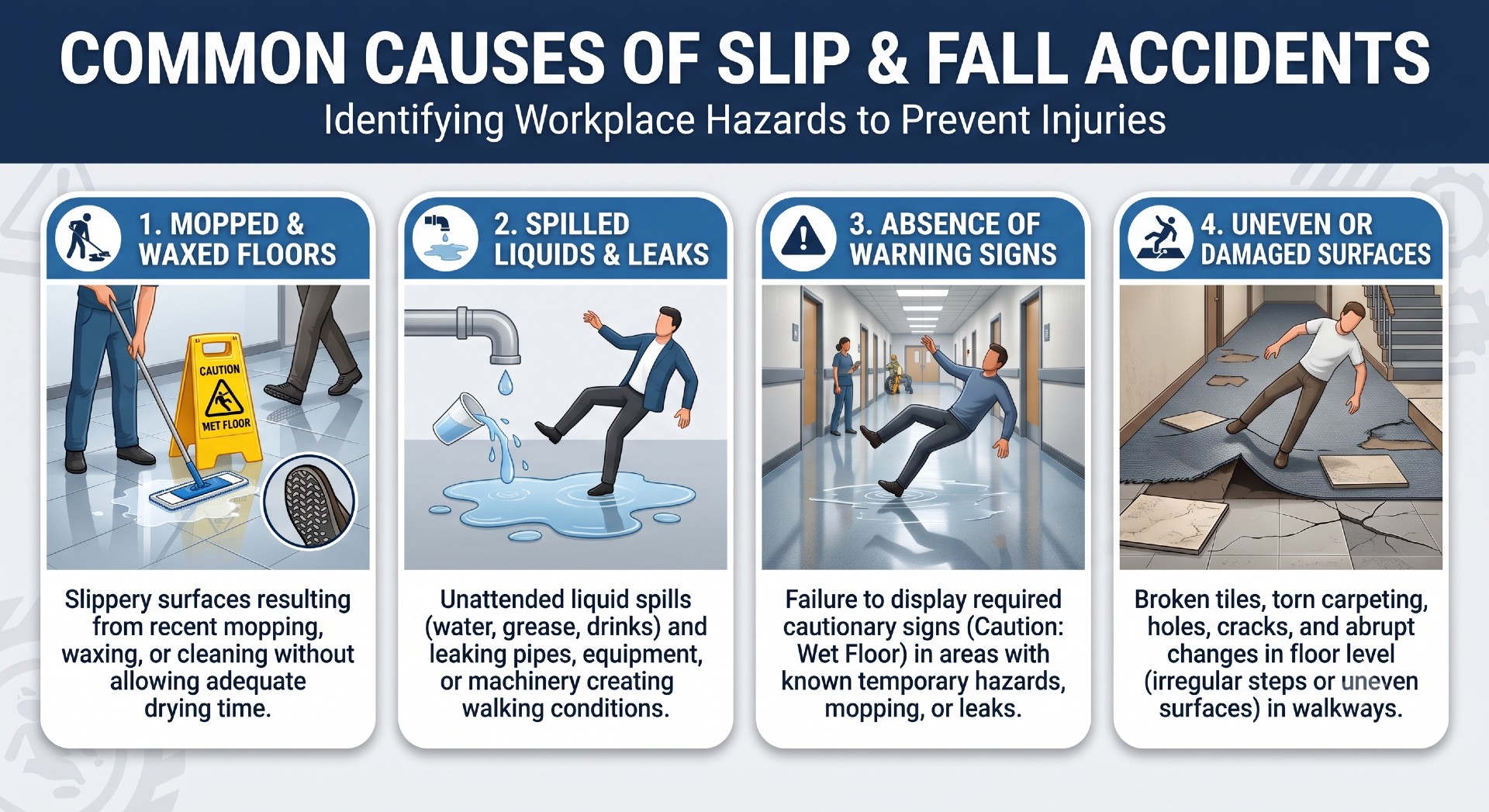
These falls are usually caused by a hazardous condition that should have been fixed or marked. Common causes include:
- Spills and wet floors, from leaks, spilled products, mopping, or tracked-in rain, especially without a warning sign.
- Freshly mopped or waxed floors left unmarked.
- Uneven or damaged flooring, torn carpet, loose mats, or transitions between surfaces.
- Broken or poorly maintained stairs, and missing or loose handrails.
- Poor lighting, which hides hazards in stairwells, hallways, and parking areas.
- Cluttered walkways and merchandise left in aisles.
- Potholes, cracks, and uneven pavement in parking lots and on walkways.
- Snow and ice, which carry special rules in Pennsylvania (discussed below).
The specific cause matters, because it shapes what has to be proven, and because it points to the evidence that will make or break the case.
The Heart of a Fall Case: Notice
Most slip-and-fall cases turn on a single question: did the property owner know, or should they have known, about the hazard in time to do something about it? This is called notice, and it is usually the central battleground.
Actual notice means the owner actually knew, for example, an employee saw the spill or was told about it.
Constructive notice means the hazard existed long enough that a reasonable owner, inspecting the property as they should, would have found and fixed it. This is why time is so important: a puddle that sat for an hour is very different, legally, from one that appeared seconds before the fall.
A hazard the owner created — such as an unmarked, freshly mopped floor — essentially builds in notice, because the owner made the very condition that caused the fall.
Proving notice usually requires evidence about time and knowledge: surveillance video, inspection and cleaning logs, maintenance records, incident reports, prior complaints, and employee testimony. Much of this evidence is in the property owner’s hands, and some of it, especially video, can be erased within days. That is why acting quickly to preserve evidence is so important in these cases.
Snow and Ice: Pennsylvania’s Special Rule
Falls on snow and ice follow a special rule in Pennsylvania known as the “hills and ridges” doctrine. In general, this doctrine means a property owner is not liable for a fall on snow or ice that accumulated naturally during an ongoing storm and formed only a generally slippery condition. To recover, an injured person usually must show that the snow or ice had unreasonably accumulated into ridges or elevations that created an obstruction, and that the owner had notice and failed to act.
There are important exceptions, though. The doctrine generally does not protect an owner when the icy condition was caused by the owner’s own actions (such as a broken downspout or poor drainage) rather than natural accumulation, or when the ice was localized rather than the result of general community-wide conditions. Pennsylvania’s snow-and-ice rules are widely misunderstood, and a fall that seems hopeless at first can turn out to be a strong case once the facts are examined. Our firm has, in fact, won record verdicts in exactly these kinds of ice-fall cases.
How Pennsylvania’s Fault Rules Apply
Pennsylvania uses modified comparative negligence. This means your recovery is reduced by your share of fault, and if you are found more than 50 percent at fault, more to blame than the property owner, you recover nothing.
This rule is the reason property owners so often argue that you “should have watched where you were going” or “should have seen” the hazard. They are trying to shift enough blame onto you to defeat or shrink your claim. But being partly at fault does not end your case, and the comparison is what matters: an owner who left a dangerous spill unmarked for an hour is usually far more responsible than a customer who did not spot it. Overcoming these blame-shifting arguments is a central part of winning a fall case.
The Serious Injuries Falls Cause
The falls that lead to significant cases are the ones that cause serious, lasting harm. Falls are surprisingly dangerous, especially for older adults. According to the Centers for Disease Control and Prevention, falls are the leading cause of traumatic brain injuries and a major cause of hip fractures and other serious injuries. Common serious fall injuries include:
- Traumatic brain injuries (TBI), from striking the head, which can cause lasting cognitive, emotional, and physical problems.
- Hip fractures, which are especially serious for older adults and can permanently affect independence and mobility.
- Spinal cord injuries, including paralysis.
- Broken bones in the wrists, arms, ankles, and elsewhere.
- Shoulder injuries, such as rotator cuff tears, often requiring surgery.
- Back and neck injuries, including herniated discs and fractures.
- Chronic pain conditions, which can persist for years.
These are the injuries that drive the value of a fall case, because they carry high medical costs, lost income, and a heavy human toll.
What a Slip-and-Fall Case Is Worth
There is no single formula, because value depends on the specific harm. The main drivers include the severity and permanence of the injury, the medical expenses (past and future), lost wages and lost earning capacity, and the pain, suffering, and life changes the injury caused. A minor fall with a full recovery is generally a modest claim. A fall causing a brain injury, a hip fracture, or permanent disability can be a very significant case.
It is worth knowing that these cases are often fought hard by well-funded insurers, and that a serious fall case, properly built and, if necessary, tried to a jury, can be worth far more than an early settlement offer suggests. Our firm’s record verdicts in these cases came after insurers offered a small fraction of what juries ultimately awarded.
The Time Limit to File in Pennsylvania
In Pennsylvania, the statute of limitations for personal injury claims, including slip-and-fall cases, is generally two years from the date of the injury. Some situations, such as a fall on government-owned property, can require formal notice much sooner. Because evidence like surveillance video can be erased quickly, it is wise to act promptly. You can read more on our statutes of limitations page.
How Lupetin & Unatin Can Help
We are Lupetin & Unatin, a Pittsburgh law firm, and we are among the most accomplished slip-and-fall and premises liability trial lawyers in Pennsylvania. Our results speak for themselves. Our firm secured what are believed to be the two largest slip-and-fall verdicts in Erie County history, a $7.25 million verdict against UPMC Hamot (a fall on snow-covered ice) and a $3.2 million verdict against Saint Vincent Surgery Center (a fall on an unmarked wet floor), along with a $2.1 million jury verdict against Target Corporation in Allegheny County, where the injured shopper had been offered just $85,000 before trial. Several of these were cases other firms had declined because the facts looked difficult.
We approach these cases differently than the average firm. We move quickly to secure the video and records that prove notice, we work with leading experts to establish the full extent of an injury, and we know how to defeat the “you should have watched where you were going” defense. When insurers refuse to be fair, we are trial lawyers who take these cases to juries, and win.