
It was supposed to be the best day of your life. Then it became the worst.
Maybe you were in labor for hours and felt like no one was paying attention. Maybe the baby’s heart rate was going down and no one rushed in. Maybe you needed a C-section that came too late. Maybe you were hurt during delivery. A hysterectomy you never expected. Maybe your baby was hurt. Maybe both of you were.
Now you are home. The crib that was supposed to hold a healthy newborn does not feel right. You are running to appointments. You are reading reports you do not fully understand. You are watching your child miss milestones, or you are recovering from injuries no one ever warned you about.
You are wondering what really happened in that delivery room. Something just doesn’t feel right.
This article walks through the warning signs that something went wrong during labor and delivery and that what happened may have been preventable.

Contact Us for a Free, Confidential Consultation
Article written by Brendan Lupetin, Esq. Brendan is a managing partner in the law firm of Lupetin & Unatin, a medical malpractice law firm located in Pittsburgh and serving Western Pennsylvania.
Our practice is limited to high-value catastrophic cases because that is where we can do the most for our clients and for patient safety.
What Is Supposed to Happen During Labor and Delivery
Modern obstetric care is built around watching for problems and responding fast when they appear. Continuous fetal heart monitoring. Regular cervical exams. Frequent checks on the mother’s blood pressure and vital signs. A team that includes nurses, residents, attending obstetricians, anesthesiologists, and pediatric staff.
When labor goes off course, the team is supposed to recognize it and act. Move to a C-section. Call neonatal staff. Manage bleeding. Treat infection. Respond to fetal distress.
When the team does not recognize the problem — or recognizes it and does not act fast enough — that is when babies and mothers get hurt.
You are wondering what really happened in that delivery room. Something just doesn’t feel right.
This article walks through the warning signs that something went wrong during labor and delivery and that what happened may have been preventable.
Warning Signs That Your Labor and Delivery Were Mishandled
- The fetal heart monitor showed problems and no one acted. Late decelerations. Prolonged decelerations. A flat tracing. A bradycardia. These patterns are well known and have to be acted on. When the strip shows trouble for an hour and nothing changes, that is a major red flag.
- The C-section was ordered too late. The standard is generally that an emergency C-section should be started within about 30 minutes of the decision. When it took much longer, because the OR was not ready, because the surgeon was not available, because the anesthesiologist was not there, the baby may have been deprived of oxygen during that delay.
- Pitocin or Cytotec was used inappropriately. Drugs that strengthen labor contractions must be used carefully. Too much medication can cause contractions that are too strong, too long, or too close together. The baby cannot recover between contractions. Oxygen deprivation can follow.
- A trial of labor after C-section (VBAC) went wrong. A previous C-section creates a risk of uterine rupture during a VBAC. If the hospital was not equipped to respond quickly, or if the team did not recognize the warning signs of rupture, the result can be devastating.
- Shoulder dystocia was mishandled. The baby’s head delivered, but the shoulders got stuck behind the mother’s pelvic bone. There are specific maneuvers for this. When they are skipped, done wrong, or done in the wrong order or when too much pulling force is used, the baby can suffer permanent nerve injury or oxygen deprivation.
- Vacuum or forceps were misused. These tools can be safe in trained hands. They can also cause serious head and brain injuries when used too aggressively, in the wrong position, for too long, or in the wrong patient.
- The mother was injured during delivery. A severe tear that was not properly repaired. An emergency hysterectomy that may not have been necessary. A serious bladder, ureter, or bowel injury. Major bleeding that was not stopped in time. A brain injury or cardiac arrest. Any major injuries to mom are red flags worth investigating.
- Postpartum hemorrhage was missed or treated too slowly. Mothers can bleed heavily after delivery. Hospitals have protocols to recognize and respond. When the bleeding was severe and the response was slow, the mother can end up with permanent organ damage or worse.
- The baby needed resuscitation and the team was not ready. The pediatric team should be available for any high-risk delivery. When they were not in the room, or when the resuscitation was clumsy, the baby’s outcome can be much worse than it had to be.
- No senior physician was involved when one was needed. Residents and nurses are part of the team. But when a delivery is going off track, an experienced attending obstetrician needs to be hands-on. When the attending stayed away for too long, problems can spiral.
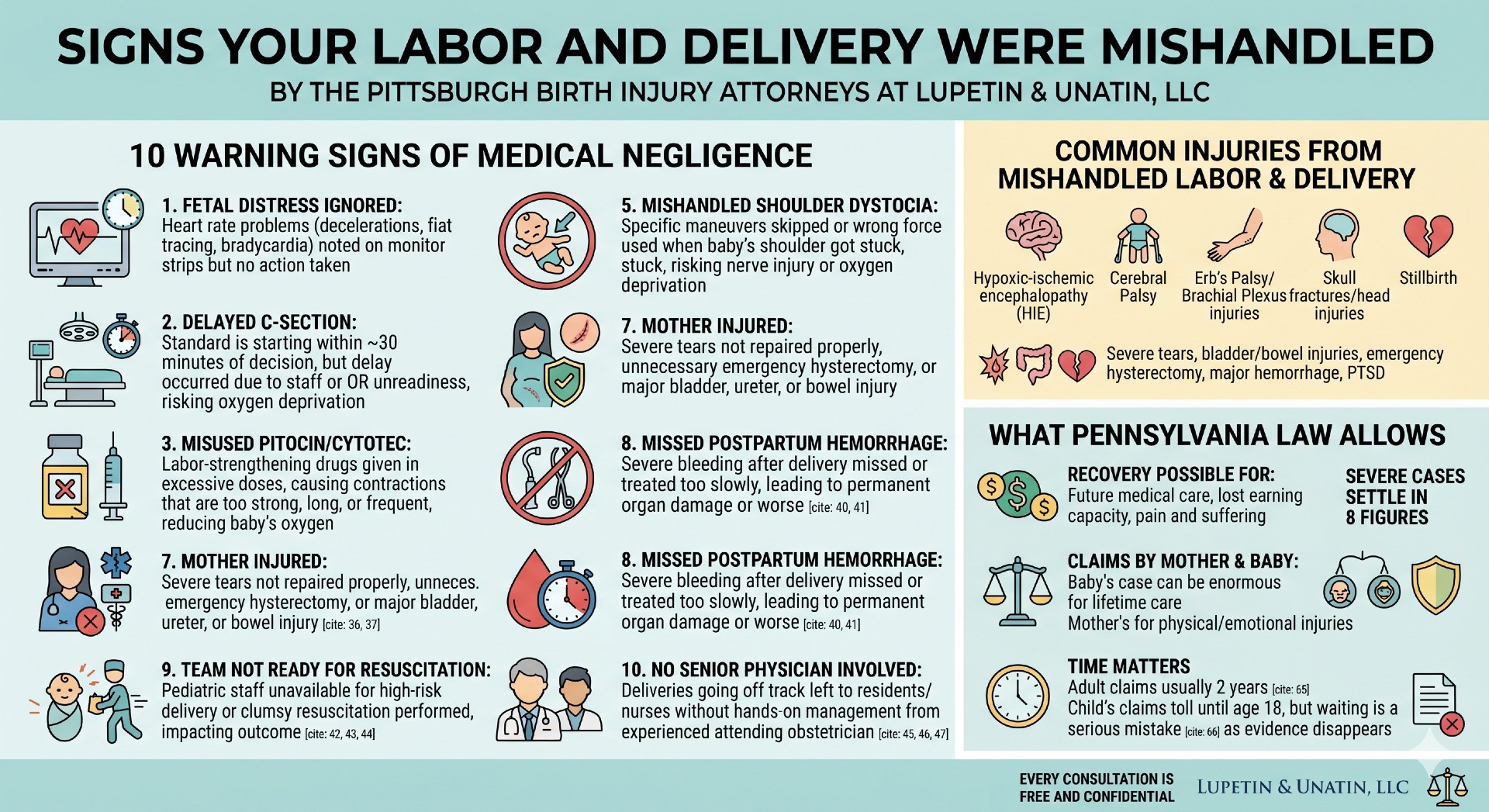
Common Injuries From Mishandled Labor and Delivery
Hypoxic-ischemic encephalopathy (HIE). The baby’s brain was deprived of oxygen during labor or delivery. Often leads to a diagnosis of cerebral palsy.
Cerebral palsy. Permanent brain injury affecting movement, muscle control, and often cognition. A common result of oxygen deprivation at birth.
Erb’s palsy and brachial plexus injuries. Damage to the nerves of the shoulder and arm, often caused by mishandled shoulder dystocia.
Skull fractures and head injuries. Often associated with misuse of vacuum or forceps.
Stillbirth. The most heartbreaking outcome. Often the result of fetal distress that was not recognized in time.
Maternal injuries. Severe tears. Bladder and bowel injuries. Emergency hysterectomy. Major hemorrhage. Some mothers also develop PTSD from traumatic deliveries.
What Pennsylvania Law Allows
When a labor and delivery goes wrong because of medical negligence, both the baby and the mother can have claims under Pennsylvania law.
The baby’s case can be enormous. A child with severe cerebral palsy or HIE may need a lifetime of medical care, therapy, equipment, and around-the-clock help. Pennsylvania law allows recovery for future medical care, lost earning capacity, and pain and suffering. Severe cases routinely settle in the eight figures.
The mother’s case can include physical injuries, surgeries, and emotional injuries including PTSD. Sometimes the father may have a claim for PTSD.
Pennsylvania does not cap pain and suffering damages in medical malpractice cases. The MCARE Act provides excess insurance through a state fund that helps ensure large judgments can actually be collected.
Time matters. Adult claims must usually be filed within two years. A child’s claims do not begin to run until the child turns 18, but waiting that long is almost always a serious mistake. Evidence disappears. Witnesses move on. Memories fade.
Frequently Asked Questions
Not always but often, yes. Many cases of cerebral palsy are linked to oxygen deprivation during labor and delivery. Determining whether that oxygen deprivation was preventable requires expert review of the fetal monitor strips, the records, the imaging, and the timeline. That is what we do.
Possibly, yes. Mothers have their own legal claims for physical injuries suffered during labor and delivery, and in many cases for the emotional harm, including PTSD, that follows a traumatic birth.
For a child, the deadline is tolled until age 18 but cases should be investigated as soon as possible. For the mother or father, the deadline is generally two years from when they knew, or should have known, of the injury and that is was caused by negligence. Talk to a lawyer to get clarity on your specific situation.
How Lupetin & Unatin Can Help
Lupetin & Unatin, LLC, led by attorneys Brendan Lupetin and Greg Unatin, is a Pittsburgh medical malpractice and catastrophic injury law firm. We have spent decades representing Pennsylvania families against the largest hospitals and health systems in the state. Our partners try cases. Our results include eight-figure settlements and verdicts in some of the most complex medical cases litigated in Western Pennsylvania.
We work on a contingent fee. That means you pay nothing unless we recover for your family. We advance every cost for medical records, expert witnesses, depositions, life care plans, court reporters. If we do not win, you owe us nothing.
If you have a case, we will figure it out and win for you.
Free Consultation — No Fee Unless We Win
Every consultation is free. Every consultation is confidential. Call us at (412) 281-4100 or fill out a free case evaluation on our website. We will personally review the records and tell you honestly whether you have a case worth pursuing.