
Something Was Very Wrong.
It may not have felt like the movies. Maybe there was chest pressure, tightness, or pain. But maybe it was something else. Shortness of breath. A cold sweat. Pain in your jaw, neck, back, or arm. Nausea, or a sick feeling in your stomach. A wave of crushing fatigue. A sense of doom you could not explain. Maybe you are a woman, and your signs did not match what most people picture a heart attack to be. But you knew something was very wrong.

Contact Us for a Free, Confidential Consultation
Article written by Brendan Lupetin, Esq. Brendan is a managing partner in the law firm of Lupetin & Unatin, a medical malpractice law firm located in Pittsburgh and serving Western Pennsylvania.
Our practice is limited to high-value catastrophic cases because that is where we can do the most for our clients and for patient safety.
So you got help. You went to the ER or to an urgent care. You told them how you felt. And maybe they did not take it seriously enough. Maybe they called it anxiety, a panic attack, heartburn, acid reflux, or a pulled muscle. Maybe they did one EKG, said it looked fine, and sent you home. Maybe they never drew the blood test that shows heart damage. The whole time, your heart was starving for blood.
By the time someone realized it was your heart, the damage may have been done. A heart attack that is caught fast can often be treated, and the heart muscle saved. A heart attack that is missed can leave a person with a weakened heart, or take their life. Maybe you survived but are forever changed. Maybe you are reading this because someone you love was sent home and did not survive. And you cannot stop asking: why didn’t they catch this in time?
That question matters. A heart attack is one of the most time-sensitive emergencies in medicine. When it is missed or treated too slowly, the harm is often catastrophic and often preventable. This article explains the warning signs that a heart attack was misdiagnosed. It explains the serious harm a delay can cause. And it explains what you can do next. If any of this sounds like your story, Lupetin & Unatin is here to help.
What a Heart Attack Is, in Plain Terms
A heart attack happens when blood flow to part of the heart is blocked, usually by a clot in one of the heart’s arteries. Without blood, that part of the heart muscle starts to die. Doctors call this a myocardial infarction. The longer the blockage lasts, the more heart muscle is lost.
That is why time is everything. As the Cleveland Clinic explains, a heart attack is a life-threatening emergency, and the sooner treatment begins, the better the chance of survival and of limiting damage to the heart. Treatment often means opening the blocked artery with a procedure called angioplasty, or with clot-busting drugs.
The key word is time. Doctors often say “time is muscle.” Every minute of delay means more heart muscle dies and cannot be recovered. A fast diagnosis, fast testing, and fast treatment can save the heart and the life. A delay can cost both.
Why a Heart Attack Gets Misdiagnosed
A heart attack can be missed because its symptoms can look like other things, and because not everyone has the “classic” crushing chest pain. Women, older adults, and people with diabetes often have different signs, like shortness of breath, fatigue, nausea, or pain in the jaw or back. So a busy provider may land on a less serious answer, like anxiety or indigestion, and stop looking.
But doctors are trained to take cardiac symptoms seriously and to test for them. As research on missed heart attacks shows, the error is most often a failure to consider the diagnosis in patients with atypical symptoms, rather than a failure to read a test. The key tests are an EKG and a blood test called troponin. A critical point: a single normal EKG or a single normal troponin does not rule out a heart attack. Heart damage shows up over time, so the standard of care is usually to repeat these tests over several hours. As the CDC explains, getting to treatment quickly can mean the difference between life and death, which is why warning signs must be acted on, not dismissed.
Here are the common reasons a heart attack gets misdiagnosed:
- Symptoms were blamed on anxiety, a panic attack, or stress.
- Chest discomfort was called heartburn, reflux, or a muscle strain.
- The patient was a woman whose atypical symptoms were not recognized.
- The patient was told they were “too young” or “too healthy” for a heart problem.
- Only one EKG was done, and a normal result ended the workup.
- The troponin blood test was never ordered, or was checked only once, too early.
Risk Factors Doctors Are Supposed to Consider
Some people are at much higher risk of a heart attack. These risk factors should make a doctor more careful and quicker to test when a patient has possible cardiac symptoms.
Common risk factors include:
- High blood pressure. A leading risk factor that strains the heart and arteries.
- High cholesterol. This builds up in the arteries and can lead to blockages.
- Diabetics are at high risk, and may have unusual or even painless heart attacks.
- A major and well-known risk factor.
- A family history of heart disease. Especially heart disease at a young age.
- Older age. Risk rises with age, though heart attacks happen in younger people too.
- Obesity and a sedentary lifestyle. Both add to the risk.
- A prior heart attack, stent, or bypass. Past heart problems are an important warning sign.
Here is why this matters for your case. A patient with these risk factors who comes in with chest discomfort, shortness of breath, or other possible cardiac signs is not a routine case. A careful doctor should think about the heart, run the right tests, and repeat them. When those clues are in the chart and the doctor still treats it as anxiety or heartburn, that can be a failure to meet the standard of care.
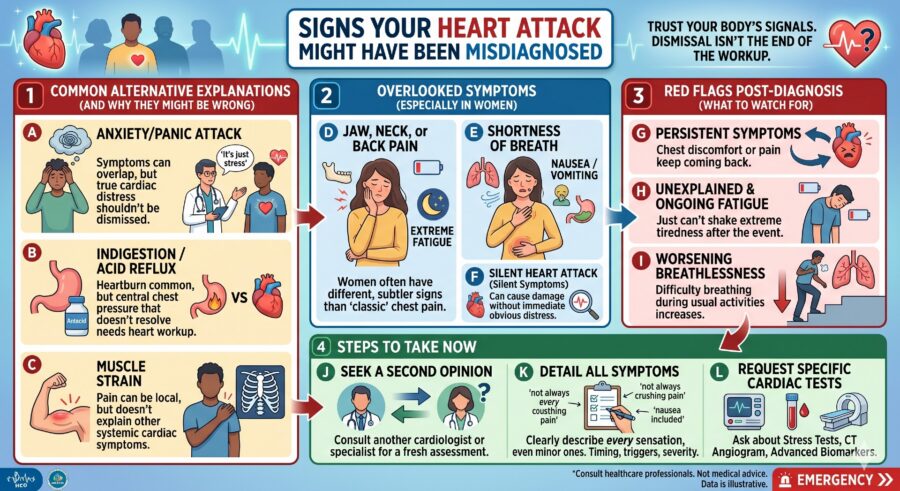
Signs Your Heart Attack Was Misdiagnosed
Below are the red flags. If you recognize several of these, it may be worth a closer look at the care that was given.
Your Symptoms Were Blamed on Anxiety or Stress
Heart attack symptoms, especially in women, are often dismissed as anxiety or a panic attack. If you had cardiac warning signs and were sent home with an anxiety label, without proper testing, that is a major red flag.
Your Chest Discomfort Was Called Heartburn or a Muscle Strain
Heart attacks are often mistaken for indigestion, acid reflux, or a pulled muscle. If your discomfort was brushed off as one of these and it turned out to be your heart, the diagnosis may have been missed.
You Were Told You Were “Too Young” or “Too Healthy”
Heart attacks can happen to younger and otherwise healthy people. If you were sent away because a doctor assumed you could not be having a heart attack, that assumption may have been a serious mistake.
Only One EKG Was Done
A single normal EKG does not rule out a heart attack. The standard of care often calls for repeat EKGs over time when symptoms continue. If one normal EKG ended your workup and you were sent home, a heart attack could have been missed.
The Troponin Blood Test Was Skipped or Checked Only Once
Troponin is a blood marker of heart damage. It can be normal in the first hours, so it is usually checked more than once, hours apart. If this test was never done, or was done only once too early, that gap could be a failure in your care.
You Were Sent Home and Got Much Worse
This one is tragically common. You go to the ER with symptoms. They send you home. Hours or days later, you collapse, or you are rushed back having a full heart attack, or worse. A proper workup might have caught it the first time.
You Suffered Lasting Harm
Sometimes the clearest sign that something went wrong is the outcome itself. People treated fast often keep more of their heart function. When treatment comes too late, the damage can be permanent. The next section covers the serious harm a delay can cause.
The Serious Harm a Heart Attack Delay Can Cause
When a heart attack is not treated fast, more heart muscle dies. The longer the delay, the more harm it does. Here are the serious injuries and outcomes a missed or delayed diagnosis can cause.
Death.
This is the gravest risk. A heart attack can be fatal, especially when treatment is delayed. Many people die after being sent home with the wrong diagnosis. If you lost a loved one this way, your family may have a wrongful death claim.
Permanent heart damage.
Heart muscle that dies does not come back. A delay can leave the heart permanently weakened.
Heart failure.
A damaged heart may no longer pump well. This can lead to heart failure, a lasting condition that limits daily life.
Dangerous heart rhythms.
Damage can cause abnormal heart rhythms, some of which are life-threatening.
Cardiac arrest.
A heart attack can trigger a cardiac arrest, where the heart stops. Even if revived, the person may suffer brain damage.
Need for major procedures.
A delayed heart attack can mean more extensive treatment, like bypass surgery, that early care might have avoided.
Reduced ability to be active.
A weakened heart can leave a person short of breath and unable to do the things they once could.
Lasting disability.
Many survivors cannot return to work or to the life they had before.
Emotional trauma.
Surviving a heart attack, or losing a loved one to one, leaves deep wounds. Many people and families struggle with anxiety, depression, and grief for years.
Many of these outcomes share one thing in common. They often trace back to time that was lost. Time that doctors had to act, and did not use.
When a Missed Diagnosis Becomes Malpractice
Not every bad outcome is malpractice. Doctors do not have to be perfect, and some heart attacks are genuinely hard to diagnose. But doctors do have to meet a basic standard. That standard is the level of care a careful doctor would have given in the same situation.
To have a malpractice case, a few things usually need to be true. First, there was a doctor-patient relationship. Second, the care fell below the accepted standard. Third, that failure caused real harm. Fourth, the harm led to losses, such as medical bills, lost income, the loss of a loved one, or pain and suffering.
Heart attack cases often turn on a few key questions. Did the patient have warning signs or risk factors? Were the symptoms taken seriously, or written off as anxiety or heartburn? Were EKGs and troponin tests done and repeated as needed? When the signs were there and no one acted, that delay can be the heart of a strong case. You can read more about how cardiac negligence can lead to lasting harm on our heart failure and medical malpractice page. Proving it takes work, records, and the right medical experts. That is where Lupetin & Unatin comes in.
What You Should Do Now
If you think your heart attack, or that of a loved one, was misdiagnosed, take these steps.
Get the medical records, including all EKGs and lab results. You have a right to them. In a heart case, the EKG tracings, the troponin levels, and the timeline are often the heart of the case.
Ask for the serial results. A single normal test can be misleading. The pattern over several hours often tells the real story, so ask for every EKG and every troponin value.
Write down what you remember. Note your symptoms, what you told the staff, what tests were done, and how long everything took. Memory fades, so do this soon.
Do not wait too long to ask questions. Every state has a deadline for filing a malpractice claim. In Pennsylvania, that deadline is usually two years. There are some exceptions, but the clock can run out fast. Acting early protects your rights.
Talk to a lawyer who knows these cases. Heart attack claims are complex. They need medical experts and a deep understanding of emergency and cardiac care. A general lawyer may not be the right fit. A firm focused on medical malpractice will know what to look for.
How Lupetin & Unatin Can Help
We are Lupetin & Unatin. We are a Pittsburgh medical malpractice firm. We focus on serious injury and death from medical errors. Cases involving the missed and delayed diagnosis of heart attacks and other cardiac emergencies are part of our work. We know how these errors happen. We know how hospitals defend them. And we know how to hold them accountable.
We have handled catastrophic delayed-diagnosis and wrongful death cases. We understand how a treatable emergency can turn fatal when the warning signs are missed and the clock runs out. We know the medicine, and we know how to prove what a careful doctor should have done.
We take a small number of cases so we can give each one real attention. We work on contingency. That means you pay nothing up front. You pay nothing unless we win. There is no risk in finding out if you have a case.
You deserve answers. You deserve to know if this suffering or loss could have been prevented. A short conversation can tell you a lot.
Frequently Asked Questions
You may not know for sure on your own. That is normal. The answer is usually in the medical records. We look at what symptoms you reported, what risk factors you had, whether your heart was tested, whether the EKG and troponin were repeated, and how long everything took. Some heart attacks are hard to diagnose, but the law asks what a careful doctor would have done with the same information. A careful review tells us whether the care fell below the standard. That review costs you nothing.
In most cases, the deadline in Pennsylvania is two years. For a wrongful death claim, that period generally runs from the date of death. Some exceptions can change the deadline. These rules are tricky. The safest move is to call us soon so we can protect your rights before time runs out.
Nothing up front. We work on contingency. That means we only get paid if we win money for you. There is no fee to talk with us and no fee to review your case. If we take your case and do not win, you owe us no attorney fee. This lets you seek justice without financial risk.
Reach Out Today
If any part of this article sounds like your story, please contact us. Tell us what happened. We will listen. We will review the records. We will tell you honestly whether we think there is a case.
A heart attack can take a life in a matter of hours. A missed diagnosis can change everything. If a hospital or doctor failed you or someone you love, you have the right to seek justice. Let us help you find out what really happened.