
You went to the ER. They sent you home.
Something felt very wrong. Chest pressure. Pain in your arm or jaw. Trouble breathing. Sweating. Nausea. You were scared. The ER ran a few tests. They told you it was anxiety. Indigestion. A pulled muscle. Maybe reflux. They sent you home.
Hours later (or days later) you were back. This time the diagnosis was clear. You had a heart attack. And the damage was already done.
Or maybe it was your husband. Your wife. Your parent. And maybe they did not make it back.
You are wondering how this could have been missed. You are wondering what should have happened. You are wondering if the ER’s mistake cost your heart muscle or cost a life.
This article walks through how heart attacks get missed in the emergency room and the warning signs that the misdiagnosis was malpractice.

Contact Us for a Free, Confidential Consultation
Article written by Brendan Lupetin, Esq. Brendan is a managing partner in the law firm of Lupetin & Unatin, a medical malpractice law firm located in Pittsburgh and serving Western Pennsylvania.
Our practice is limited to high-value catastrophic cases because that is where we can do the most for our clients and for patient safety.
Why Heart Attacks Get Missed
Heart attacks do not always look the way they do in movies. People do not always clutch their chest and fall down. Some heart attacks have unusual symptoms. And those are the ones that get missed most often.
Women, in particular, are more likely than men to have heart attack symptoms that are dismissed as something else. Nausea. Back pain. Jaw pain. Shortness of breath without classic chest pain. Fatigue. Younger patients are also dismissed more often, especially when the ER assumes they are “too young” to have heart disease.
Like stroke, heart attack is a time-sensitive condition. The longer a heart attack goes untreated, the more heart muscle dies. That damage is permanent. It can lead to heart failure, repeat events, or death.
Warning Signs That Your Heart Attack Was Misdiagnosed
- Your symptoms were called anxiety. You came in with chest pain or shortness of breath. The ER told you it was a panic attack or anxiety. They never seriously worked up your heart.
- Your symptoms were called indigestion or reflux. Heart attacks often feel like burning or pressure in the chest. They are confused with GI problems all the time. When an ER blames it on heartburn without ruling out the heart, that is a problem.
- Your symptoms were called musculoskeletal. “Probably a pulled muscle.” “Costochondritis.” “You just slept on it wrong.” These labels go on charts when the real diagnosis was missed.
- An EKG was not done (or was done and not properly read). An EKG is a basic test. It is not perfect, but it is required for almost any patient with chest pain. A missed reading, or no EKG at all, is a major red flag.
- Cardiac enzymes were not drawn (or only drawn once). A blood test called troponin tells doctors whether heart muscle has been damaged. The standard is generally to draw it more than once over time. A single normal troponin in the first hour does not rule out a heart attack.
- The patient was “too young” to be worked up. People in their 30s and 40s have heart attacks. So do people with risk factors like diabetes, smoking, family history, high cholesterol, or cocaine use. When age was used as a reason to skip the workup, that is often negligence.
- A woman’s symptoms were treated less seriously. Multiple studies show women are more likely to be misdiagnosed when they come to the ER with heart symptoms. They are more often told it is anxiety. Their workups are less aggressive. Their outcomes are worse.
- The patient was discharged without a clear plan. Sent home with no cardiology follow-up. No stress test ordered. No outpatient instructions. No warning to come back if symptoms returned.
- The cardiology team was never consulted. When chest pain symptoms were concerning and no cardiologist was called, that is often a sign the workup was not what it should have been.
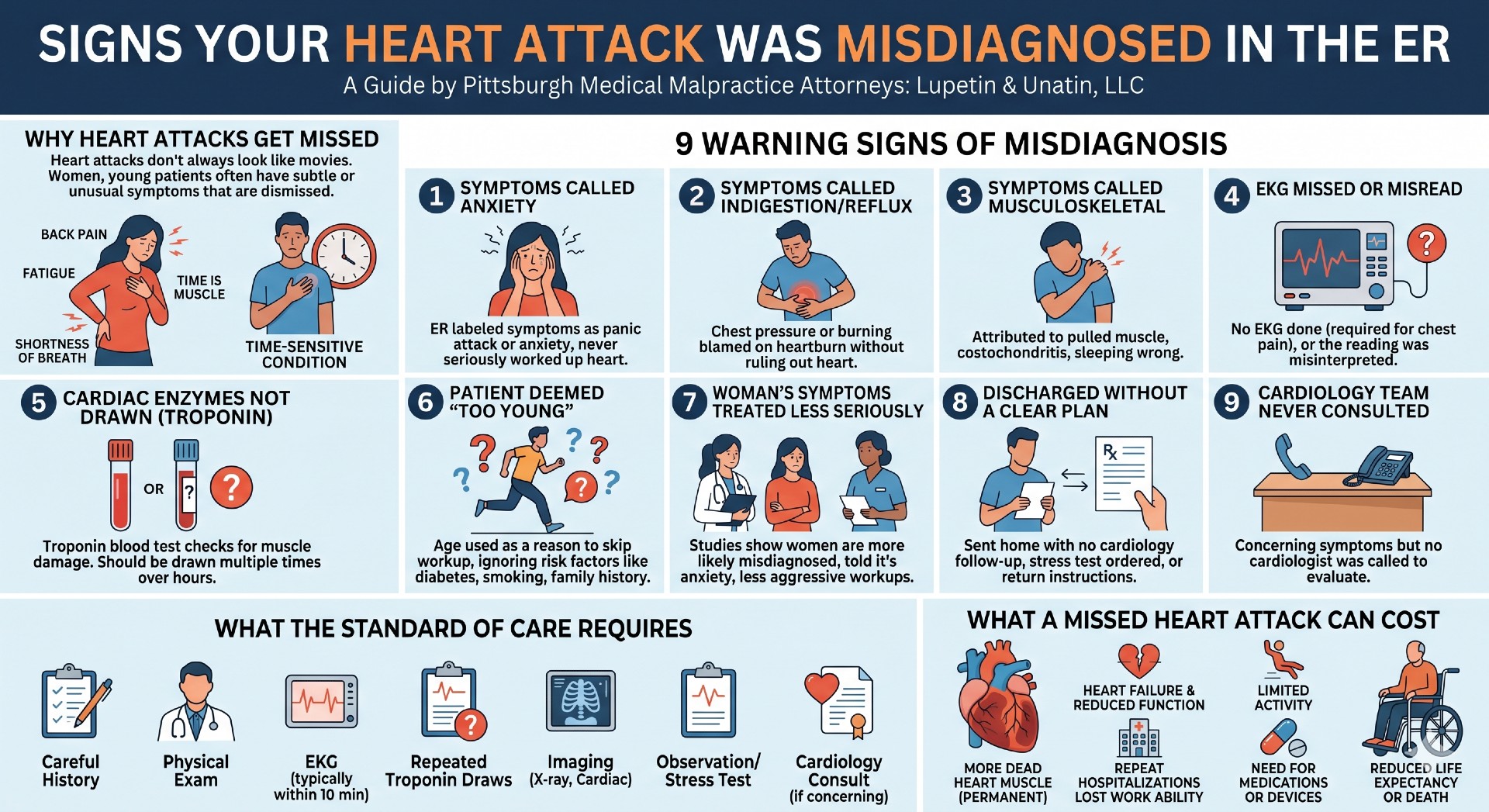
What the Standard of Care Usually Requires
When a patient comes to the ER with possible heart symptoms, the standard usually includes some combination of:
- Taking a careful history of the symptoms.
- Performing a physical exam.
- Getting an EKG. This should typically be done within 10 minutes of arrival.
- Drawing blood for troponin and repeating it.
- Considering imaging, such as a chest X-ray or, in some cases, cardiac imaging.
- Considering observation, stress testing, or admission for further workup.
- Discussing the case with cardiology when symptoms are concerning.
Not every patient needs every test. But when several of these steps are skipped and the patient turns out to have a heart attack, there is reason to look closely at the care.
What a Missed Heart Attack Can Cost
The longer a heart attack goes untreated, the more heart muscle dies. That damaged heart muscle does not grow back.
Survivors often live with reduced heart function. Heart failure. Limited activity. Repeat hospitalizations. Reduced life expectancy. Lost ability to work. The need for medications, devices like defibrillators, or even heart transplant in severe cases.
In the worst cases, the patient dies before they can get back to a hospital.
Frequently Asked Questions
Possibly. The key is whether the ER met the standard of care in working up your symptoms. “Anxiety” is one of the most common misdiagnoses in missed heart attack cases. If the workup was inadequate, the diagnosis was wrong, and the delay caused harm, that supports a claim.
Survival does not eliminate a claim. The damage from a missed heart attack is often permanent. Loss of heart function, future cardiac problems, and loss of working ability are all compensable harms under Pennsylvania law.
In most cases, two years from when the patient knew, or should have known, that the misdiagnosis caused harm. For deaths, the deadline is generally two years from the date of death. Talk to a lawyer to get a clear answer for your situation.
How Lupetin & Unatin Can Help
Lupetin & Unatin, LLC is a Pittsburgh medical malpractice and catastrophic injury law firm. We have spent decades representing Pennsylvania families against the largest hospitals and health systems in the state. Our partners try cases. Our results include eight-figure settlements and verdicts in some of the most complex medical cases litigated in Western Pennsylvania.
We work on a contingent fee. That means you pay nothing unless we recover for your family. We advance every cost — medical records, expert witnesses, depositions, life care plans, court reporters. If we do not win, you owe us nothing.
Free Consultation — No Fee Unless We Win
Every consultation is free. Every consultation is confidential. Call us at (412) 281-4100 or request a free case evaluation. We will personally review the records and tell you honestly whether you have a case worth pursuing.