

Article:

Delay In Delivering Via C-Section During VBAC

Free Case Evaluation

Fill out the form below to schedule a free evaluation.

This field is for validation purposes and should be left unchanged.

The Minutes That Matter

The consequences of a delay in delivering a baby during a VBAC emergency.

Brendan Lupetin, Esq.

Contact Us for a Free, Confidential Consultation

Article written by Brendan Lupetin, Esq. Brendan is a managing partner in the law firm of Lupetin & Unatin, a medical malpractice law firm located in Pittsburgh and serving Western Pennsylvania.

Our practice is limited to high-value catastrophic cases because that is where we can do the most for our clients and for patient safety.

In a labor emergency, there is a moment when everyone in the room understands the baby has to come out now. What happens after that moment can decide a child’s entire future. The required time between the decision to perform an emergency cesarean and the actual delivery of the baby is short by design. When it stretches too long, a baby who could have been born healthy may instead suffer a permanent injury.

This article explains why that interval matters so much during a trial of labor after a cesarean, and how a delay in those minutes can be the difference between a healthy child and a lifelong disability.
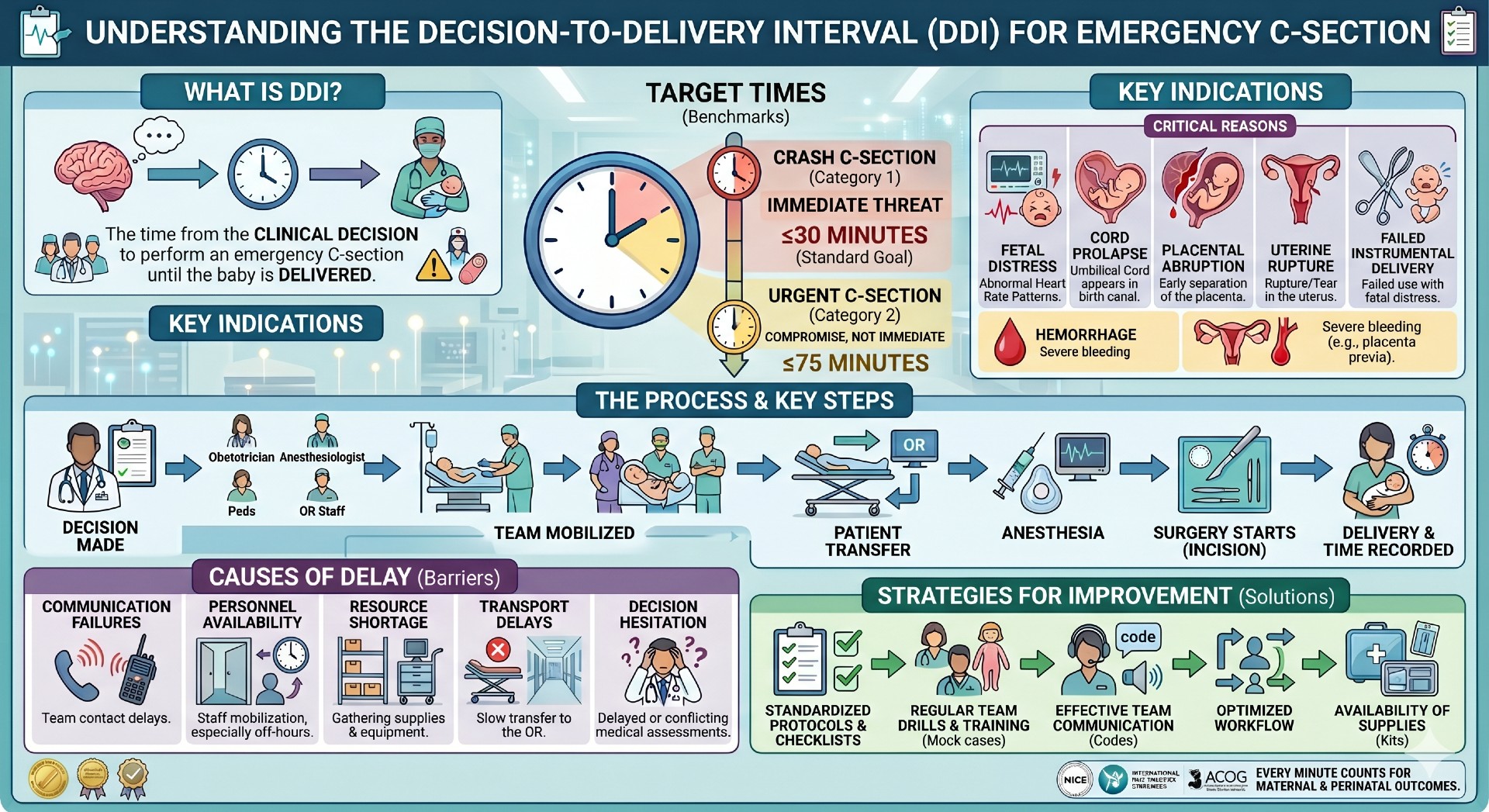
an infographic explaining the "decision to delivery interval" for emergency c-section

Why the interval is so important

A trial of labor after cesarean, often called TOLAC, carries the risk of uterine rupture, when the old cesarean scar tears during labor. When a rupture happens, the baby can lose its oxygen supply quickly. The placenta may separate. The baby may be pushed out of the uterus.

Once that happens, the only effective fix is delivery. The baby has to be born and resuscitated before lasting harm is done. And the harm grows with time. Every minute the brain goes without enough oxygen, more damage is done. This is why the interval between the decision and the delivery is treated as critical. It is the window in which a baby can still be saved from a brain injury.

What the standard expects

Hospitals commonly plan around a benchmark of being able to begin an emergency cesarean within about thirty minutes of the decision to operate. This figure comes from longstanding guidance on perinatal care, and it is widely used as a planning target.

But two things should be understood about that number. First, it is a benchmark, not a law. The legal question is not whether a hospital hit thirty minutes exactly. It is whether the team responded as quickly as a reasonable, well-prepared team should have under the circumstances. Second, and more important, thirty minutes is an outer planning limit, not a goal. In a true uterine rupture, where the baby’s oxygen supply may already be cut off, faster is better. A team that treats thirty minutes as a comfortable allowance, rather than racing to beat it, misunderstands the emergency.

Where the delay comes from

When the interval stretches too long, the cause is usually a chain of smaller delays. In our work on birth injury cases, we see the same links in that chain.

  1. The warning signs were recognized late, so the decision to operate came late.
  2. A nurse saw the problem but did not escalate it to a physician quickly.
  3. The physician was not immediately available and had to be summoned.
  4. No anesthesia provider was on hand to begin surgery.
  5. No operating room was open and staffed.
  6. The team moved without urgency, treating the situation as less dire than it was.

Each link adds minutes. A delay in recognizing the emergency, a delay in calling the surgeon, a delay in readying the room. Added together, they can push the delivery well past the point where the baby could have been protected.

How the delay is measured

A delay case is built from the timeline, and the timeline is in the records. The fetal monitor strips are time-stamped. The nursing notes record when warning signs appeared and when calls were made. Physician orders, anesthesia records, and operating room logs all carry times.

By placing these documents side by side, a qualified expert can reconstruct the emergency minute by minute. When did the warning sign first appear? When was a physician notified? When was the decision to operate made? When was the baby actually born? The intervals between those moments are where a case is found. When a baby was harmed inside an interval that should have been shorter, the record shows it.

Frequently Asked Questions

Not necessarily. The thirty-minute figure is a planning benchmark, not a safe harbor. In a true uterine rupture, the baby’s oxygen supply may already be compromised, and faster delivery is better. The real question is whether the team moved as quickly as a reasonable, well-prepared team should have given what was happening. A delivery that took close to thirty minutes can still reflect a response that was too slow for the specific emergency. We examine the full timeline, not just the final number.

The records contain the answer. The fetal monitor strips, nursing notes, physician orders, anesthesia records, and operating room logs are all time-stamped. By assembling them, a qualified expert can determine when the warning signs appeared, when the decision to operate was made, and when your baby was delivered. We know which records to obtain and how to build that timeline.

Sooner is better. Pennsylvania sets deadlines for filing a medical malpractice claim, with different rules for an injured child than for an adult. Records are also most complete when a case is reviewed promptly. Reaching out costs nothing and commits you to nothing. An initial consultation with our office is free, and we work on a contingent fee basis, so there is no fee unless we recover for your family.

How Lupetin & Unatin can help

At Lupetin & Unatin, we handle catastrophic birth injury and medical malpractice cases. Attorney Brendan Lupetin and attorney Greg Unatin keep the firm’s caseload small so that each family works directly with a partner who knows the timeline in detail.

Our firm has recovered record verdicts and settlements in catastrophic injury and medical malpractice cases, and we bring that experience to every birth injury matter we take.

We obtain the complete record, including the fetal monitor strips, nursing notes, anesthesia records, and operating room logs. We work with maternal-fetal medicine specialists and neonatologists who can explain how fast a competent team should have moved, and what the delay cost. If a preventable delay turned a survivable emergency into a permanent injury, we are prepared to prove it.

Talk to a Pittsburgh Birth Injury Attorney

If your baby or your family was harmed during a trial of labor after cesarean, the attorneys at Lupetin & Unatin, LLC are here to help you find answers. We offer free, confidential consultations, and we handle medical malpractice and birth injury cases on a contingent fee basis. You pay no attorney fee unless we recover compensation for you.

It is important not to delay. Pennsylvania law limits the time you have to file a claim.

This article is provided for general informational purposes and is not legal or medical advice. Reading it does not create an attorney-client relationship. Every case is different. If you have questions about your own situation, speak with a qualified attorney.

What can we help you find?

Generic selectors
Exact matches only
Search in title
Search in content
Post Type Selectors