
Chest Pain: When Is It an Emergency? A Simple Guide to Knowing the Signs
If you are feeling chest pain right now, it is terrifying. Your mind immediately goes to the worst-case scenario: a heart attack.
The good news is that many causes of chest pain are not life-threatening. It could be heartburn, a pulled muscle, or even anxiety.
However, you should never ignore chest pain. It is your body’s most urgent warning signal. The challenge is knowing the difference between a condition that can wait for a doctor’s appointment and one that requires an immediate call to 911.
This guide will help you understand the critical signs of a medical emergency and the serious conditions that could be causing your pain.
THE RED FLAGS: Call 911 Immediately If…
Do not try to diagnose yourself. If you have any combination of the following symptoms with your chest pain, call 911 or your local emergency number right now. Do not drive yourself to the hospital.
- Uncomfortable Pressure, Squeezing, Fullness, or Pain in the Center of Your Chest. It lasts more than a few minutes, or goes away and comes back. It might feel like an elephant is sitting on your chest.
- Pain or Discomfort That Spreads to Other Areas. This includes one or both arms, the back, neck, jaw, or stomach.
- Shortness of Breath. This can happen with or without chest discomfort. You feel like you can’t catch your breath, even when resting.
- Breaking Out in a Cold Sweat, Nausea, or Lightheadedness. You might suddenly feel sick to your stomach, dizzy, or clammy.
- A “Feeling of Impending Doom.” An intense, unexplained feeling that something terrible is about to happen.
The 4 Life-Threatening Causes of Chest Pain
When emergency doctors evaluate chest pain, they are primarily looking to rule out four critical, time-sensitive conditions. These are emergencies where every minute counts.
Heart Attack (Myocardial Infarction)
This is the most common fear. A heart attack occurs when the blood flow that brings oxygen to the heart muscle is severely reduced or cut off completely.
- What it feels like: Often described as a crushing pressure, tightness, or squeezing in the center of the chest. It is not always a sharp, stabbing pain.
- Why it’s an emergency: The longer the blood flow is blocked, the more heart muscle dies. Quick treatment can restore blood flow and save your heart.
Pulmonary Embolism (PE)
A pulmonary embolism is a blood clot that gets stuck in an artery in the lungs, blocking blood flow to part of the lung. These clots most often start in the legs.
- What it feels like: The pain is usually sharp and sudden, gets worse when you take a deep breath or cough. It is often accompanied by sudden, unexplained shortness of breath, a rapid heart rate, and sometimes coughing up blood-streaked sputum.
- Why it’s an emergency: A large clot can be fatal very quickly by preventing your blood from getting enough oxygen.
Aortic Dissection
The aorta is the main artery carrying blood from your heart to the rest of your body. An aortic dissection is a serious condition in which the inner layer of the aorta tears. Blood surges through the tear, causing the inner and middle layers of the aorta to separate (dissect).
- What it feels like: Patients often describe a sudden, severe, “tearing” or “ripping” pain in the chest or upper back that radiates downwards as the tear extends. It is often the worst pain a person has ever felt.
- Why it’s an emergency: The tear can lead to a rupture of the aorta or block blood flow to vital organs, which is often fatal without immediate surgery.
Collapsed Lung (Pneumothorax)
This occurs when air leaks into the space between your lung and chest wall. This air pushes on the outside of your lung and makes it collapse.
- What it feels like: Sudden, sharp chest pain on one side of the chest, along with shortness of breath. Your breathing may feel shallow and painful.
- Why it’s an emergency: The buildup of pressure can not only collapse the lung but also squeeze the heart and major blood vessels, leading to life-threatening shock.
How to Differentiate: Is it My Heart or Something Else?
While only a doctor can tell for sure, the quality of the pain can give you important clues.
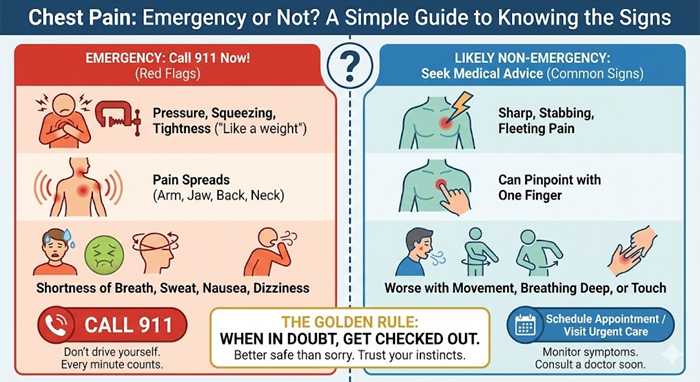
Signs Pointing to a Cardiac or Serious Issue:
- Nature of Pain: Dull pressure, squeezing, heaviness, or tightness. “Like a weight on my chest.”
- Location: Diffuse; you can’t pinpoint it with one finger. It covers a broad area in the center or left side of the chest.
- Radiation: Pain spreads to your arm (especially left), jaw, neck, or back.
- Triggers: Often brought on by physical exertion or extreme emotional stress and relieved by rest.
- Associated Symptoms: Shortness of breath, sweating, nausea, dizziness.
Signs Pointing to a Likely Non-Cardiac Issue (Muscle, Gut, Anxiety):
- Nature of Pain: Sharp, stabbing, fleeting, or “electric-shock” like.
- Location: Highly localized; you can point to the exact spot with one finger.
- Triggers: Pain gets worse when you take a deep breath, cough, move your body in a certain way, or press on the sore spot (suggests muscle/bone issue). Pain that occurs only after eating heavily or when lying down and is described as “burning” (suggests acid reflux/heartburn).
- Duration: Pain that lasts for only a few seconds or is constant for many days without other symptoms is less likely to be an emergency.
The Bottom Line: When in Doubt, Get Checked Out
It is always better to be safe than sorry. Emergency room doctors and paramedics would much rather you come in for a false alarm than stay home with a life-threatening condition.
Do not let embarrassment or fear of being wrong stop you from seeking help. If you are worried about your chest pain, that worry is reason enough to get medical attention immediately. Trust your instincts.