
The Surgeon Who Stayed Home
A Case Study on Vascular Negligence, A Preventable Amputation, and a Widow’s Fight for Justice
In the high-stakes world of vascular surgery, time is tissue. When blood flow is cut off to a limb, a clock starts ticking. If a surgeon acts within that window, a leg can be saved. If they choose to “wait and see,” the result is often catastrophic. This is the story of “Robert,” a proud Vietnam veteran from a suburb south of Pittsburgh, whose routine knee surgery turned into a nightmare due to a vascular surgeon’s refusal to come to the hospital during a critical emergency. It is a story of a preventable amputation, a life confined to a basement, and a legal battle that went all the way to the courtroom floor.
This case study details how Lupetin & Unatin, LLC utilized a relentless “Show Up, Team Up, Open Up” legal strategy to hold the surgeon and hospital accountable. We took this case to trial and convinced the defense to settle after jury selection, securing the financial future of Robert’s widow, “Margaret.”
A Life of Service and Strength
To understand the magnitude of this loss, you have to understand the man Robert was before the negligence occurred. At 73, Robert was the definition of “Pittsburgh Strong”. A Vietnam veteran, he had spent his life in service and hard work. For decades, he worked as a foreman for a local gas company—a job that required grit, leadership, and physical capability. Even in retirement, when most would slow down, Robert joined the TSA at the Pittsburgh International Airport shortly after 9/11, driven by a desire to keep his country safe.
At home, he was the rock of the family. He handled the finances, the yard work, and the repairs. He and his wife of 45 years, Margaret, were inseparable. They enjoyed a vibrant social life—dinners out, visiting friends, and dancing whenever a band was playing. Robert was an active father to his two adult sons, sharing a love for hunting, fishing, and watching the Steelers. He was independent, capable, and the pillar upon which his wife leaned.
But in early 2022, a series of health challenges brought Robert to a community hospital outside of Pittsburgh. An infection in his artificial knee had developed into sepsis, requiring surgery to remove the joint and place an antibiotic spacer. It was a serious procedure, but one he was expected to recover from.
On the day of the surgery, Robert had normal blood flow to his legs. He went into the operating room with two legs, expecting to come out with two legs.
The Medical Emergency: Acute Limb Ischemia
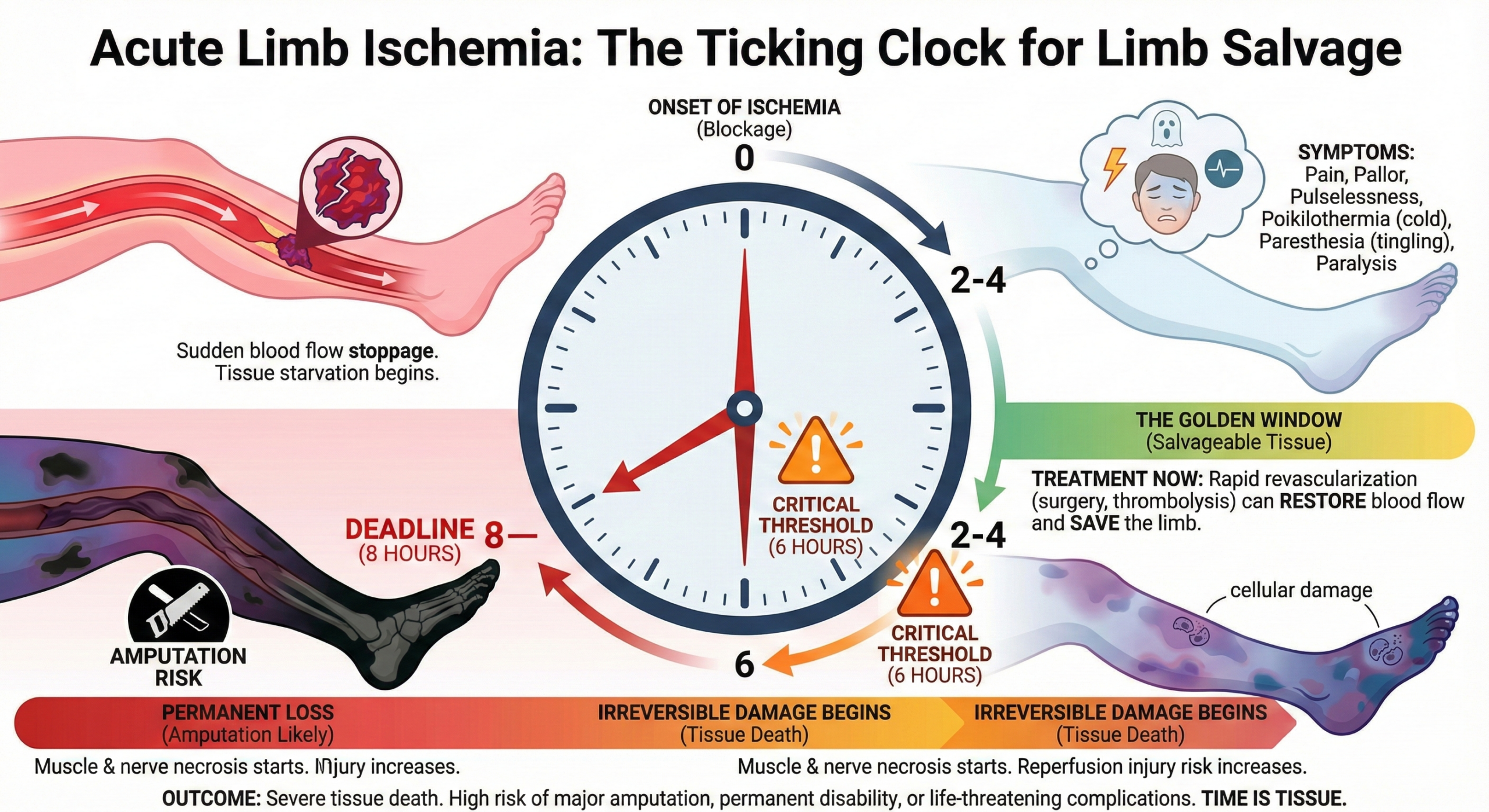
The orthopedic surgery to address the knee infection went as planned. However, immediately after the procedure, the orthopedic surgeon noticed something terrifying: Robert’s right foot was cold, pale, and pulseless.
This is the classic presentation of Acute Limb Ischemia (ALI). It is the vascular equivalent of a heart attack. A blood clot had formed, completely blocking the femoral artery—the main highway of oxygen-rich blood to the lower leg.
In vascular medicine, there is a strict rule: You have six to eight hours to restore blood flow. After that window closes, the muscles and nerves die. The damage becomes irreversible.
The orthopedic surgeon recognized the emergency instantly and called for a vascular surgery consult. The on-call vascular surgeon, “Dr. V,” was responsible for handling exactly these types of life-or-limb emergencies.
The Negligence: The “Wait and See” Approach
Dr. V was not at the hospital. He was at home, miles away from the patient whose leg was dying.
When he received the call about Robert’s cold, pulseless leg, Dr. V ordered an angiogram (an imaging test to see the blood vessels). The on-call radiologist came into the hospital in the middle of the night, performed the scan, and confirmed the worst: there was a total blockage of the femoral artery. The radiologist could not clear it with a catheter. Surgery was the only option.
The Failure to Show Up This was the moment of truth. The standard of care required Dr. V to drive to the hospital, examine Robert, speak with the radiologist, and perform an embolectomy—a surgery to physically remove the clot.
Instead, Dr. V stayed home.
He reviewed the images on his home computer. He never called the radiologist to discuss the findings. He never examined Robert’s leg. He never spoke to Robert or Margaret to explain their options. From the comfort of his home, he unilaterally decided that Robert was “not a candidate” for surgery. He told the orthopedic team to “wait and see”.
The Result of Waiting While Dr. V slept, Robert lay in his hospital bed, his leg starving for oxygen. One hour passed. Then two. Then six. By morning, the six-to-eight-hour window had closed. The tissue in Robert’s lower leg died.
Because the vascular surgeon chose not to intervene, the infection in Robert’s knee—which required blood flow to heal—raged out of control. Several days later, Robert was taken back to the operating room. Not to save his leg, but to cut it off. He underwent an above-the-knee amputation.
The Harm Caused: A Life Confined
The amputation devastated Robert’s life. The active, independent man who loved to dance and work in the yard was gone.
Robert and Margaret lived in a split-level home that they had shared for decades. It was impossible to make the upper levels accessible for a wheelchair. As a result, Robert was forced to live out the rest of his days in the basement.
The separation broke the couple’s hearts. Margaret lived upstairs; Robert lived downstairs. The simple intimacies of marriage—sleeping in the same bed, sitting together for coffee, watching TV side-by-side—were stolen from them.
The basement lacked a proper shower. To bathe her husband, Margaret had to wheel him into the garage. There, utilizing a garden watering can filled with warm water, she would gently wash the man who had once been her protector. It was a profound loss of dignity for a proud veteran, and a heartbreaking burden for a loving wife.
The Legal Battle: “Show Up, Team Up, Open Up”
When Margaret contacted Lupetin & Unatin, LLC, she wanted answers. Why did the doctor not try to save the leg?
We launched a comprehensive investigation. We obtained phone records which proved Dr. V never spoke to the radiologist. We hired a leading vascular surgeon from Johns Hopkins, to review the case. His conclusion was damning: Robert’s leg likely could have been saved if Dr. V had simply done his job.
The Defense’s Excuses As is common in medical malpractice cases, the defense tried to complicate the narrative. They argued:
- Robert was “too sick” for surgery.
- The infection made vascular surgery too risky.
- Blood thinners would have caused bleeding.
- The blockage was “chronic” and inevitable.
We knew these were excuses constructed after the fact. Dr. V’s medical note from that night was a template, devoid of any of these justifications.
Our Theory of the Case We distilled the medical standard of care into three simple, irrefutable concepts that any juror could understand:
- Show Up: In a limb-threatening emergency, the surgeon must come to the hospital and examine the patient. Dr. V didn’t.
- Team Up: The surgeon must consult with the radiologist to understand the blockage. Dr. V didn’t.
- Open Up: The surgeon must open the artery to restore flow, or at minimum, “open up” to the patient about the risks and benefits of surgery versus amputation. Dr. V did neither.
We argued that Dr. V robbed Robert of his choice. Even if surgery carried risks, the alternative (doing nothing) guaranteed amputation. Robert deserved the right to decide if he wanted to fight for his leg. Dr. V made that decision for him, from his couch.
The Trial: A Moment of Truth
We filed suit in the Court of Common Pleas of Allegheny County. The defense refused to offer a fair settlement, convinced that a jury would be swayed by Robert’s age and underlying health issues. They underestimated the power of the evidence and the clarity of our argument.
We proceeded to trial. A jury was selected. And then, the defendants finally decided to settle.
The Turning Point: The Defense Sees the Truth
We filed suit in the Court of Common Pleas of Allegheny County. For months, the defense refused to offer a fair settlement, convinced that a jury would be swayed by Robert’s age and underlying health issues. We prepared relentlessly for trial, crafting an opening statement that would lay bare the full extent of the negligence.
As the trial date arrived, the defense team realized exactly what the jury was about to hear. They saw the message we had prepared—one that cut through the medical jargon and went straight to the heart of the moral failure.
Our prepared case strategy was undeniable:
- The Timeline of Negligence: We were prepared to use a minute-by-minute timeline showing the jury exactly what Dr. V was doing (staying home) while the clock ticked down on Robert’s leg.
- Covering Tracks: We were ready to show the jury the text messages Dr. V sent to other doctors, attempting to cover his tracks by suggesting they document that “limb loss was possible” before the amputation even happened.
- The Watering Can: We were prepared to tell the heartbreaking story of how Margaret would bathe Robert in their garage using a gardening can to pour water over him.
- Split Level Home Split the marriage: We also planned to paint a vivid picture of a marriage physically separated by a flight of stairs and the loss of dignity Robert suffered daily.
- Increased Risk of Harm: We were ready to explain the legal concept of “Increased Risk of Harm”—that by failing to act, Dr. V took away Robert’s only chance at a normal life.
The impact of this evidence was palpable even before it was presented to a jury. The defense team saw the reality of the situation. They realized that their “medical judgment” defense would crumble under the weight of these facts. They understood that no jury would accept that a doctor could simply choose not to show up for a patient in dire need.
The Outcome: Justice for Margaret
Immediately following the opening statements, before a single witness took the stand, the defense capitulated. They offered a substantial confidential settlement to resolve the case.
Why This Matters Sadly, Robert passed away from unrelated causes before the trial began. He never got to see the outcome. But this victory was for Margaret.
- Financial Security: The settlement ensures that Margaret will live comfortably for the rest of her life, without the financial strain that often follows the loss of a spouse and a prolonged medical crisis.
- Vindication: The settlement served as an acknowledgment of the wrong done to Robert. It was the accountability he deserved.
- A Message Sent: By taking this case to the brink of trial, we sent a message to hospital systems in Pennsylvania: On-call specialists cannot phone it in. When a patient is in danger, you must show up.
Why Choose Lupetin & Unatin?
This case exemplifies the Lupetin & Unatin difference. Many firms might have shied away from this case due to the patient’s age or pre-existing conditions. We didn’t. We saw a clear violation of the standard of care and a family that had been wronged.
We prepare every case as if it is going to trial. We invest in the best experts, we master the medicine, and we tell our clients’ stories with passion and precision.
If you or a loved one has suffered a catastrophic injury due to a doctor’s failure to treat a medical emergency—whether it’s a stroke, a heart attack, or acute limb ischemia—in Pittsburgh or anywhere in Pennsylvania, contact us today. We are ready to fight for the justice you deserve.
Disclaimer: The case study described above is based on a real matter handled by Lupetin & Unatin, LLC. Names and identifying details have been changed to protect the privacy of the clients. Past results do not guarantee future outcomes.