
From Tragedy to Triumph
A Case Study of Severe Birth Injury, Hypoxic Ischemic Encephalopathy (HIE), and a Family’s Fight for Justice in Pittsburgh, PA
For any expectant couple, the birth of a first child is a moment of unparalleled anticipation. It is the culmination of months of preparation, dreams, and the careful stewardship of a new life. For “Sarah” and “Michael,” a young couple from the Pittsburgh area, the pregnancy had been textbook perfect. They did everything right: attended every prenatal appointment, followed every doctor’s recommendation, and eagerly prepared their home for the arrival of their son, “Liam”.
However, what should have been the happiest day of their lives turned into a harrowing ordeal that would forever alter the trajectory of their family. This case study details how a series of preventable medical errors during labor and delivery led to severe Hypoxic Ischemic Encephalopathy (HIE) and a lifetime of complex needs for a beloved child. It also tells the story of how the medical malpractice attorneys at Lupetin & Unatin, LLC fought to secure the financial future of this family, ensuring that Liam would have the care, dignity, and resources he deserves for the rest of his life.
Understanding Hypoxic Ischemic Encephalopathy (HIE) and Medical Malpractice
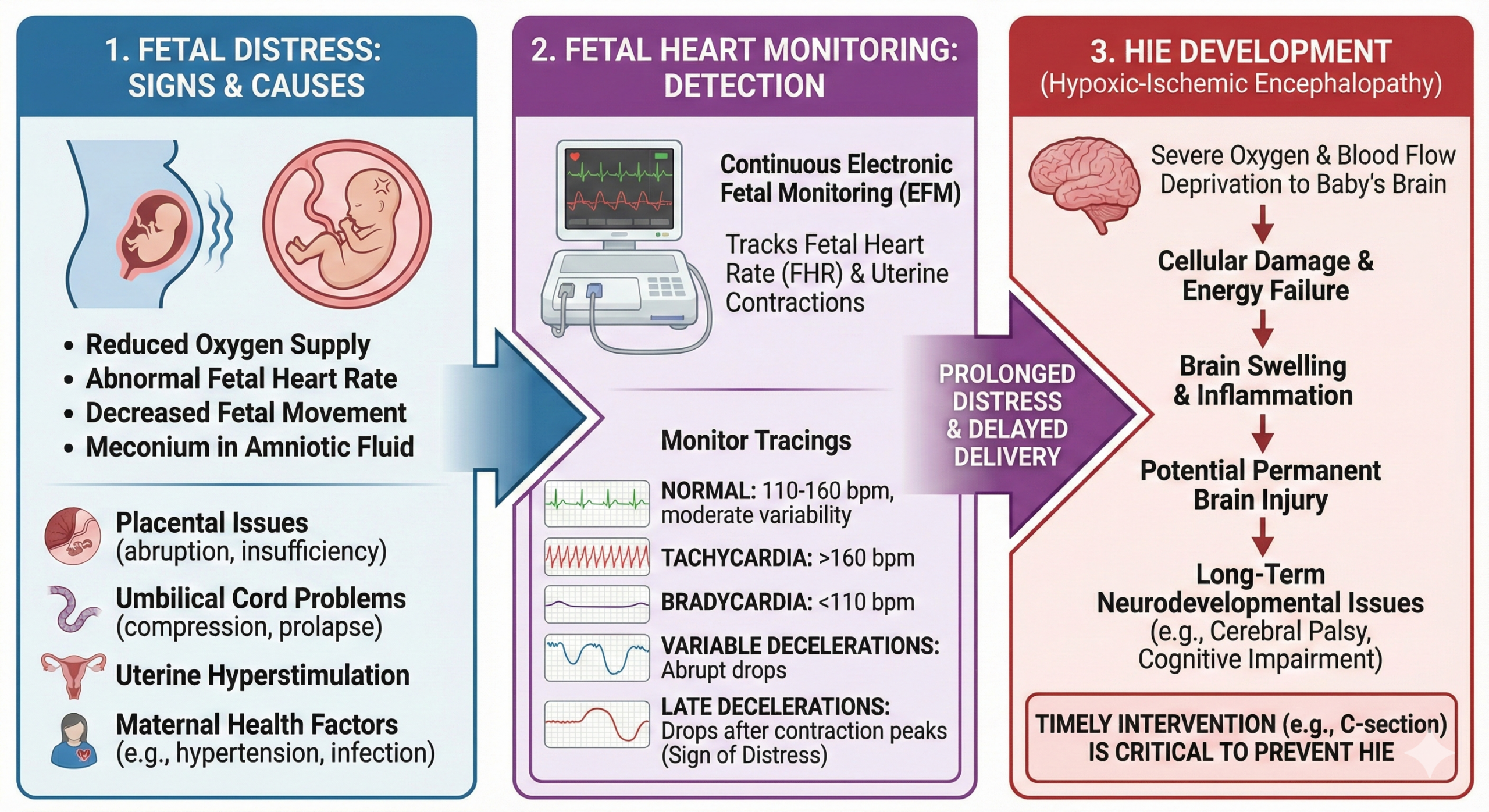
Hypoxic Ischemic Encephalopathy (HIE) is a type of brain dysfunction that occurs when the brain doesn’t receive enough oxygen or blood flow for a period of time. In the context of childbirth, it often happens when there is a complication during labor that cuts off the baby’s oxygen supply. While some instances are unavoidable, many are the direct result of medical negligence—specifically, the failure of medical professionals to recognize and respond to signs of fetal distress.
In Pennsylvania medical malpractice law, demonstrating negligence often hinges on the “standard of care.” This is the level of care, skill, and treatment that, under the given circumstances, is recognized as acceptable and appropriate by reasonably prudent healthcare providers. When doctors or nurses fail to meet this standard—for example, by ignoring warning signs on a fetal heart monitor—and injury results, they can be held liable.
For Sarah and Michael, the standard of care was breached in a way that had catastrophic consequences.
The Medical Condition: A Failure to Monitor
Sarah was admitted to a Pittsburgh area hospital for a scheduled induction of labor. She was 40 weeks pregnant, healthy, and ready. The plan was to use a medication called Cervidil to help induce labor. This is a common procedure, but it requires vigilant monitoring because induction agents can sometimes cause uterine hyperstimulation, stressing the baby.
A fetal heart monitor was placed to track Liam’s heart rate and Sarah’s contractions. This device is the lifeline of modern obstetrics; it provides the medical team with real-time data on how the baby is tolerating labor.
The Critical Error:
Shortly after the induction process began, the fetal heart monitor began to show concerning signs. Specifically, it showed “late decelerations” and “prolonged decelerations.” In obstetrics, these are red flags. A deceleration means the baby’s heart rate is dropping, and “late” means it is dropping after a contraction has started and recovering late. This is a classic sign of uteroplacental insufficiency—meaning the baby is not getting enough oxygen from the placenta.
Despite these clear warning signs appearing on the strip for over an hour, the labor and delivery nurse responsible for Sarah’s care failed to recognize the severity of the situation. Instead of notifying the on-call obstetrician immediately or stopping the induction agent, the nurse proceeded to administer more medication to induce labor. This acted like adding fuel to a fire. The medication caused stronger contractions, which further compressed the blood vessels supplying the placenta, deepening the baby’s oxygen deprivation.
It wasn’t until nearly two hours after the first signs of distress appeared that a different nurse finally recognized the danger and called the doctor. By the time the obstetrician arrived and performed an emergency C-section, Liam had suffered a prolonged period of bradycardia (dangerously low heart rate). He was born limp, pale, and not breathing. He had suffered severe oxygen deprivation, leading to HIE, acute kidney injury requiring a transplant, and permanent brain damage.
The Harm Caused: A Lifetime of Consequences
The diagnosis of severe HIE was devastating. Liam spent months in the Neonatal Intensive Care Unit (NICU) at UPMC Children’s Hospital of Pittsburgh. The lack of oxygen had caused damage to the areas of his brain responsible for motor control and cognition. He was diagnosed with spastic cerebral palsy, a condition that affects muscle control in the entire body.
The impact on Liam is profound:
- Mobility: He cannot walk, stand, or sit without support. He requires a wheelchair and specialized orthotics.
- Communication: He is non-verbal, communicating through expressions and basic sounds, though his parents understand his unique language of love.
- Daily Living: He is dependent on a feeding tube (G-tube) for all nutrition and requires 24/7 care for all activities of daily living, including hygiene and dressing.
- Medical Complexity: Beyond the brain injury, the oxygen deprivation destroyed his kidneys. He required dialysis as an infant and eventually received a life-saving kidney transplant from his mother. He will require anti-rejection medication and likely future transplants for the rest of his life.
The impact on the family was equally immense. Sarah and Michael, both professionals with promising careers, had to sacrifice everything. Sarah left her job to become Liam’s full-time caregiver and medical advocate. Their home, a standard two-story house in the suburbs, became a prison of obstacles. Carrying a growing child up and down stairs, managing dialysis equipment in a cramped bedroom, and navigating a wheelchair through narrow hallways became their daily struggle.
Despite the heartbreak, Sarah and Michael never gave up. They poured every ounce of their energy into therapies, appointments, and giving Liam the best life possible. But they knew they needed help. They needed to ensure that no matter what happened to them, Liam would be safe. That is when they turned to Lupetin & Unatin, LLC.
The Legal Intervention: Lupetin & Unatin, LLC Fight for Liam
When Sarah and Michael contacted us, they weren’t looking for a payout; they were looking for answers and security for their son. They wanted to know why a healthy pregnancy ended in such tragedy.
Our team, led by Brendan Lupetin and Greg Unatin, immediately launched a comprehensive investigation. We obtained thousands of pages of medical records from the delivery hospital and the pediatric specialists.
Building the Case
We consulted with top-tier medical experts from across the country to review the evidence.
- Obstetrics Experts: Confirmed that the fetal heart monitor strips showed clear, undeniable evidence of fetal distress hours before the C-section. They testified that had the nurse followed the standard of care, the doctor would have been called earlier, the C-section would have happened sooner, and Liam would have been born healthy.
- Neuroradiology Experts: Reviewed Liam’s MRI scans. They utilized advanced timing techniques to prove that the brain injury occurred specifically during that window of delay in the labor and delivery room, ruling out genetic causes or events prior to admission.
- Nursing Experts: Analyzed the actions of the hospital staff, identifying critical breaches in protocol regarding chain of command and patient monitoring.
- Life Care Planners: We worked with rehabilitation specialists to create a “Life Care Plan.” This detailed document outlined every single need Liam would have for the next 60+ years—from wheelchair replacements and home nursing hours to future kidney transplants and accessible housing. The projected cost of his care was tens of millions of dollars.
The Theory of Liability
Our argument was clear: This was not an accident. This was a preventable tragedy caused by a failure to monitor. In Pennsylvania, hospitals are responsible for the actions of their nursing staff. By failing to interpret the fetal monitoring strips correctly, the hospital staff denied Liam the timely delivery that would have saved his brain and kidneys.
We prepared for trial meticulously. We conducted depositions of the nurses and doctors involved, exposing inconsistencies in their stories and highlighting the missed opportunities to intervene. We prepared compelling demonstrative exhibits to show a jury exactly what the nurse saw on the monitor versus what she should have seen.
The Outcome: Security, Dignity, and a New Home
As the trial date approached, the strength of our case became undeniable. The defense recognized that a jury would likely be moved by Liam’s plight and angered by the preventable nature of his injuries.
Following intense negotiations and mediation, Lupetin & Unatin, LLC secured a landmark settlement for Liam and his family. While the specific terms are confidential, the settlement was sufficient to cover the full extent of Liam’s lifetime medical and therapy needs.
The Impact of the Settlement: The result was life-changing.
- A Forever Home: The family was able to move out of their cramped, inaccessible house. They purchased a spacious, single-story home that was custom-renovated to meet Liam’s needs. It features wide doorways for his wheelchair, a roll-in shower, a therapy room, and space for all his medical equipment. For the first time, Liam can move freely through his own home.
- Financial Security: A Special Needs Trust was established to manage the funds. This ensures that Liam’s medical bills, future surgeries, and daily care costs are covered for the rest of his life, without jeopardizing his eligibility for essential government benefits.
- Quality of Care: Sarah and Michael can now afford professional nursing support, giving them respite and allowing them to be parents rather than just caregivers. Liam has access to the best private therapies and adaptive technology available.
Why Choose Lupetin & Unatin for Birth Injury Cases?
This case exemplifies why Lupetin & Unatin, LLC is a leader in Pennsylvania medical malpractice law. We understand that birth injury cases are not just about legal arguments; they are about the sanctity of family and the promise of a future.
- We Dig Deeper: We don’t just read the summary; we analyze every heartbeat on the monitor strip.
- We Hire the Best: We spare no expense in retaining the world’s leading medical experts to prove your case.
- We Care: We get to know our clients. We visited Liam’s home, saw the struggles firsthand, and fought for him as if he were our own.
If your family has suffered due to a birth injury, delay in delivery, or HIE in Pittsburgh or anywhere in Pennsylvania, you don’t have to fight alone. Contact us today to discover how we can help you find answers and secure your child’s future.
Disclaimer: The case study described above is based on a real matter handled by Lupetin & Unatin, LLC. Names and identifying details have been changed to protect the privacy of the family. Past results do not guarantee future outcomes.