
It may have started like a sore throat, but it got bad fast.
The throat pain became severe, far worse than a normal sore throat. Swallowing hurt so much that you, or your child, could not even swallow spit, and drool ran from the mouth. The voice sounded muffled, like talking with a hot potato in the mouth. There was a fever. Breathing got harder, maybe with a high-pitched sound. Maybe you found yourself sitting up, leaning forward, just trying to get air. Something was closing off the airway.

Contact Us for a Free, Confidential Consultation
Article written by Brendan Lupetin, Esq. Brendan is a managing partner in the law firm of Lupetin & Unatin, a medical malpractice law firm located in Pittsburgh and serving Western Pennsylvania.
Our practice is limited to high-value catastrophic cases because that is where we can do the most for our clients and for patient safety.
So you got help. You went to the ER or to the doctor. You said the throat pain was unbearable and breathing was getting hard. And maybe they did not take it seriously enough. Maybe they looked in the throat, saw nothing dramatic, and called it a regular sore throat, strep, a cold, or laryngitis. Maybe they sent you home with throat lozenges or an antibiotic. The whole time, the epiglottis, the flap of tissue at the top of the airway, was swelling and threatening to seal the airway shut.
By the time someone realized what it was, the airway may have been in crisis. Epiglottitis can block breathing and cause death within hours. Maybe you or your child survived a frightening emergency. Maybe brain damage resulted from a lack of oxygen. Maybe you are reading this because someone you love did not survive. And you cannot stop asking: why didn’t they catch this in time?
That question matters. Epiglottitis is a true airway emergency, and it can move fast. When it is missed or treated too slowly, the harm is often catastrophic and often preventable. This article explains the warning signs that epiglottitis was misdiagnosed. It explains the serious harm a delay can cause. And it explains what you can do next. If any of this sounds like your story, Lupetin & Unatin is here to help.
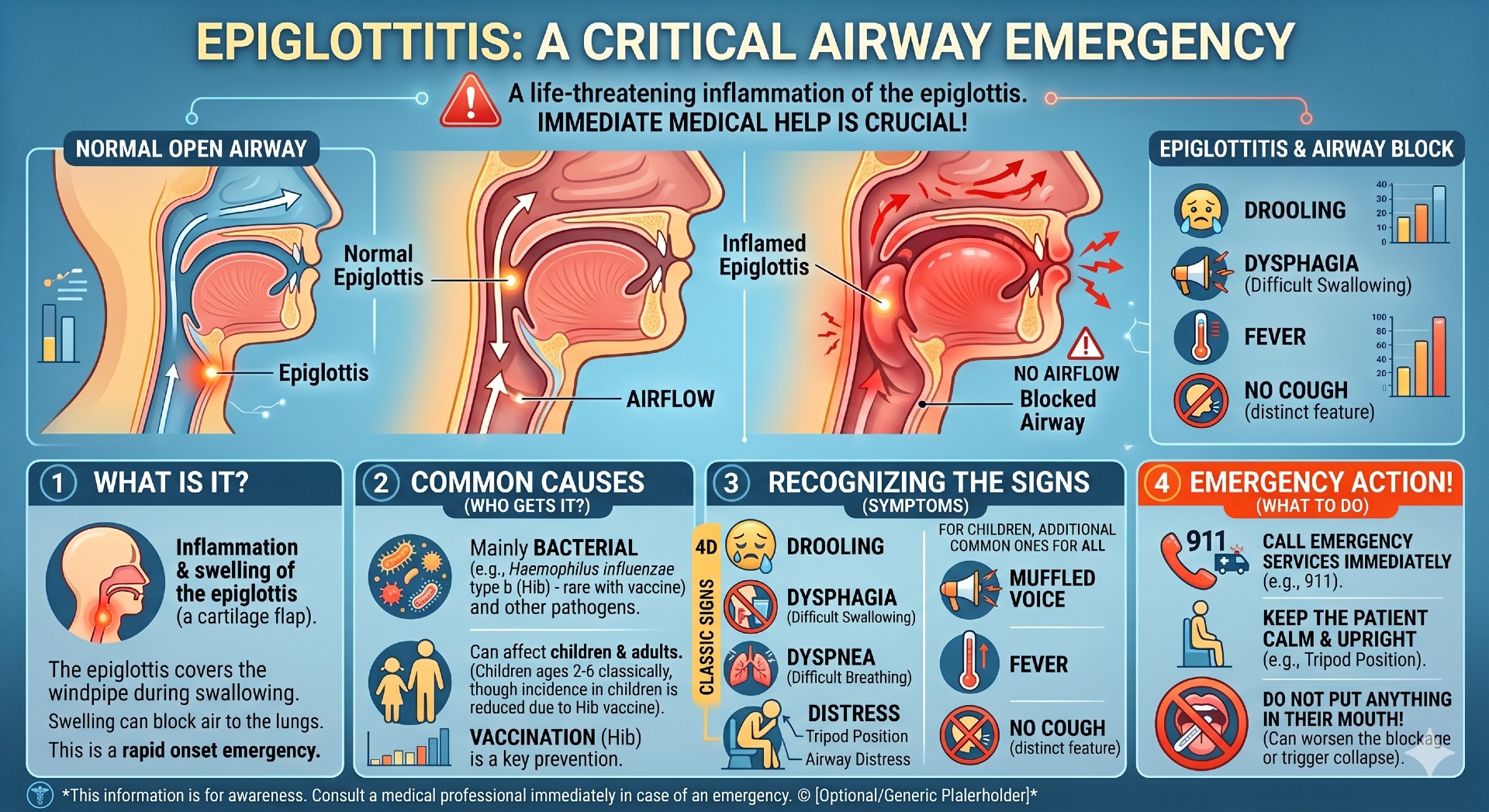
What Epiglottitis Is, in Plain Terms
The epiglottis is a small flap of stiff tissue at the base of the tongue. Its job is to cover the entrance to the windpipe when you swallow, so food and drink do not go down the wrong way. Epiglottitis is when this flap and the tissue around it become infected and badly swollen.
The danger is simple and terrifying. As the swelling grows, it can block the airway. As the Merck Manual explains, in children the swelling can narrow the airway and cause fatal blockage within a few hours of the first symptoms, and adults can die too if diagnosis and treatment are delayed. Treatment means protecting the airway, often with a breathing tube placed in an operating room, and giving antibiotics.
The key word is time. Epiglottitis can close an airway in hours. That is why it is an emergency that calls for fast recognition, careful airway management, and urgent specialist care. A delay can be fatal.
Why Epiglottitis Gets Misdiagnosed
Here is the central trap. Epiglottitis often looks like a common sore throat at first, and the throat may look normal when a doctor peers inside. The swelling is lower down, on the epiglottis, where a quick look does not reach. So a provider may see an ordinary-looking throat and send the patient home, while the real danger sits just out of view.
But doctors are trained to recognize the warning pattern. A key clue is severe throat pain that is out of proportion to what the throat looks like. As the Merck Manual notes, when a person has severe throat pain but a normal-appearing throat, doctors should suspect epiglottitis, especially with drooling or noisy breathing. The diagnosis is confirmed by carefully looking at the epiglottis, usually in a setting where the airway can be protected. There is also an important safety rule: a provider should not poke at a child’s throat with a tongue depressor when epiglottitis is suspected, because it can trigger a sudden, complete airway blockage.
Here are the common reasons epiglottitis gets misdiagnosed:
- Severe throat pain was treated as an ordinary sore throat or strep.
- The throat looked normal, so the danger was assumed to be low.
- Drooling, muffled voice, and trouble breathing were not recognized as red flags.
- The patient was sent home with lozenges or an antibiotic instead of being watched.
- No specialist was called to look at the epiglottis and protect the airway.
- In an adult, the slower onset led the team to underestimate the danger.
The Warning Signs Doctors Are Supposed to Recognize
These are the warning signs of epiglottitis. They are the same signs a careful provider should act on fast. Several together, especially with a normal-looking throat, should raise the alarm.
- Severe sore throat out of proportion to the exam. Pain far worse than the throat looks.
- Drooling. Being unable to swallow even saliva is a major danger sign.
- Trouble swallowing. Painful or impossible swallowing.
- A muffled or “hot potato” voice. The voice sounds thick and muffled.
- Trouble breathing or noisy breathing. A high-pitched sound (stridor) is a late and dangerous sign.
- Sitting up and leaning forward. The “tripod” position, used to keep the airway open, is a red flag.
- High fever and looking very ill. Especially with a rapid onset.
When several of these signs are present, a careful provider should treat it as an airway emergency, keep the patient calm, and get urgent specialist help. When these signs were brushed off, the diagnosis may have been missed.
Signs Your Epiglottitis Was Misdiagnosed
Below are the red flags. If you recognize several of these, it may be worth a closer look at the care that was given.
Severe Throat Pain Was Treated as a Simple Sore Throat
The pain of epiglottitis is severe and often far worse than the throat looks. If you or your child had unbearable throat pain and it was dismissed as a routine sore throat or strep, that is a major red flag.
The “Normal-Looking” Throat Gave False Comfort
In epiglottitis, the visible throat can look normal because the swelling is lower down. If a doctor looked, saw nothing dramatic, and sent you home, a dangerous infection could have been hiding just out of view.
Drooling and Trouble Swallowing Were Ignored
Drooling and being unable to swallow are serious danger signs. They mean the airway may be at risk. If these were present and not acted on, the diagnosis may have been missed.
A Muffled Voice or Noisy Breathing Was Overlooked
A muffled “hot potato” voice and a high-pitched sound when breathing in are warning signs of a narrowing airway. If these were present and the response was slow, that delay can be devastating.
No Specialist Was Called to Look at the Epiglottis
When epiglottitis is suspected, the epiglottis must be examined carefully, and the airway protected, usually with specialist help. If you had the warning signs and no one called for that help, that gap could be a failure in your care.
You or Your Child Was Sent Home and Got Much Worse
You go in with a severe sore throat and trouble breathing. They send you home. Hours later, the airway closes and it becomes a life-or-death emergency. A careful workup might have caught it the first time.
You Suffered Lasting Harm
Sometimes the clearest sign that something went wrong is the outcome itself. People treated in time usually recover fully. When the airway closes, the lack of oxygen can cause permanent harm. The next section covers the serious harm a delay can cause.
The Serious Harm an Epiglottitis Delay Can Cause
When epiglottitis is not treated fast, the airway can close and cut off oxygen. The longer the delay, the more harm it does. Here are the serious injuries and outcomes a missed or delayed diagnosis can cause.
Death. This is the gravest risk. A blocked airway can cause death within hours, especially in children. If you lost a loved one this way, your family may have a wrongful death claim.
Brain damage from lack of oxygen. When the airway closes and oxygen is cut off, the brain can be permanently injured in minutes. This can cause lasting disability.
Emergency surgical airway. If the airway closes before a breathing tube can be placed, an emergency cut into the windpipe may be needed, which carries its own risks.
Respiratory arrest. Breathing can stop entirely, requiring resuscitation, with the risk of lasting harm even if the person is revived.
Complications of low oxygen. A lack of oxygen can damage the heart and other organs.
Spread of the infection. The infection can spread to the blood or lungs, causing further serious illness.
Long hospital and ICU stays. Survivors often need intensive care and a breathing tube for a period of time.
Lasting disability. When brain injury occurs, the effects can be permanent and life-changing.
Emotional trauma. Living through a child’s airway emergency, or losing a loved one, leaves deep wounds. Many families struggle with anxiety, depression, and grief for years.
Many of these outcomes share one thing in common. They often trace back to time that was lost. Time that doctors had to act, and did not use.
When a Missed Diagnosis Becomes Malpractice
Not every bad outcome is malpractice. Doctors do not have to be perfect, and epiglottitis can be hard to diagnose because the throat may look normal. But doctors do have to meet a basic standard. That standard is the level of care a careful doctor would have given in the same situation.
To have a malpractice case, a few things usually need to be true. First, there was a doctor-patient relationship. Second, the care fell below the accepted standard. Third, that failure caused real harm. Fourth, the harm led to losses, such as medical bills, lost income, the loss of a loved one, or pain and suffering.
Epiglottitis cases often turn on a few key questions. Did the patient have severe throat pain out of proportion to the exam, drooling, a muffled voice, or trouble breathing? Were these danger signs recognized? Was the airway protected and specialist help called? When the signs were there and no one acted, that delay can be the heart of a strong case. Proving it takes work, records, and the right medical experts. That is where Lupetin & Unatin comes in.
What You Should Do Now
If you think your epiglottitis, or that of a loved one, was misdiagnosed, take these steps.
Get the medical records. You have a right to them. They hold the timeline of what happened and when. In these cases, the symptoms recorded and the timing are often the heart of the case.
Write down what you remember. Note when the symptoms started, how fast they got worse, and what you told the staff. Note any drooling, voice changes, or trouble breathing. Memory fades, so do this soon.
Do not wait too long to ask questions. Every state has a deadline for filing a malpractice claim. In Pennsylvania, that deadline is usually two years. There are some exceptions, including special rules for children. The clock can run out fast, so acting early protects your rights.
Talk to a lawyer who knows these cases. Epiglottitis claims are complex. They need medical experts and a deep understanding of emergency, airway, and pediatric care. A general lawyer may not be the right fit. A firm focused on medical malpractice will know what to look for.
How Lupetin & Unatin Can Help
We are Lupetin & Unatin. We are a Pittsburgh medical malpractice firm. We focus on serious injury and death from medical errors. Cases involving missed and delayed diagnosis of dangerous infections and airway emergencies are part of our work. We know how these errors happen. We know how hospitals defend them. And we know how to hold them accountable.
We have handled catastrophic delayed-diagnosis and wrongful death cases. We understand how a treatable emergency can turn fatal when the warning signs are missed and the clock runs out. We know the medicine, and we know how to prove what a careful doctor should have done.
We take a small number of cases so we can give each one real attention. We work on contingency. That means you pay nothing up front. You pay nothing unless we win. There is no risk in finding out if you have a case.
You deserve answers. You deserve to know if this suffering or loss could have been prevented. A short conversation can tell you a lot.
Frequently Asked Questions
You may not know for sure on your own. That is normal. The answer is usually in the medical records. We look at what symptoms were reported, especially severe throat pain, drooling, voice changes, and trouble breathing, what the doctors did, and how long everything took. Epiglottitis can be hard to spot because the throat may look normal, but the law asks what a careful doctor would have done with the same information. A careful review tells us whether the care fell below the standard. That review costs you nothing.
In most cases, the deadline in Pennsylvania is two years. For a wrongful death claim, that period generally runs from the date of death. For children, special rules can extend the deadline. These rules are tricky, especially in cases involving a child or a death. The safest move is to call us soon so we can protect your rights before time runs out.
Nothing up front. We work on contingency. That means we only get paid if we win money for you. There is no fee to talk with us and no fee to review your case. If we take your case and do not win, you owe us no attorney fee. This lets you seek justice without financial risk.
Reach Out Today
If any part of this article sounds like your story, please contact Lupetin & Unatin. Tell us what happened. We will listen. We will review the records. We will tell you honestly whether we think there is a case.
Epiglottitis can take a life in a matter of hours. A missed diagnosis can change everything. If a hospital or doctor failed you or someone you love, you have the right to seek justice. Let us help you find out what really happened.
Call Lupetin & Unatin today for a free, no-pressure review of your case.