
Those first days were supposed to be a blur of joy.
Those first days after your baby was born were supposed to be a blur of joy. Instead, something went wrong. Maybe your baby turned more and more yellow. Maybe your baby was sleepy, hard to wake, and would not feed. Maybe there was a high-pitched cry, or an arched back, or strange movements. Or maybe your baby seemed fine when you took them home, and the trouble only became clear later. Somewhere along the way, you heard a word you will never forget: kernicterus.

Contact Us for a Free, Confidential Consultation
Article written by Brendan Lupetin, Esq. Brendan is a managing partner in the law firm of Lupetin & Unatin, a medical malpractice law firm located in Pittsburgh and serving Western Pennsylvania.
Our practice is limited to high-value catastrophic cases because that is where we can do the most for our clients and for patient safety.
A Quick Word on the Medicine
To understand whether your baby’s care fell short, it helps to understand what should have happened. We have written a full, plain-language guide: kernicterus and newborn jaundice, which explains how jaundice turns dangerous and how bilirubin is supposed to be screened and treated. This article focuses on the legal question: when does a kernicterus injury point to negligence? For the medical background, we will point you to that companion guide so we do not repeat it here. The single most important thing to know is this. Kernicterus is almost always preventable. Jaundice is expected in newborns, the screening test is simple, and the treatment, phototherapy, works. As the American Academy of Pediatrics emphasizes, although kernicterus is rare, its impact on children and families can be devastating, and the guidelines are built to prevent exactly these worst-case outcomes. The medical system is built to catch dangerous bilirubin before it reaches the brain, through universal screening, risk assessment, follow-up, and prompt treatment. When a baby suffers kernicterus, it almost always means one of those steps failed. That is what turns a common newborn condition into a possible malpractice case.Why Kernicterus Points to Possible Negligence
With proper care, kernicterus is a “never event,” something that should essentially never happen. The at-risk babies are identifiable, the screening test takes seconds, and the treatment is safe and effective. So when a baby suffers this devastating, permanent injury, it raises a fair and serious question: where did the safety net break? Doctors and nurses are trained to screen every newborn’s bilirubin, to identify high-risk babies, to act on rising or high levels, to arrange follow-up for jaundiced babies sent home, and to escalate urgently when bilirubin approaches a dangerous level. When those things do not happen, a fully preventable condition can become a lifelong injury. That is what these cases are about.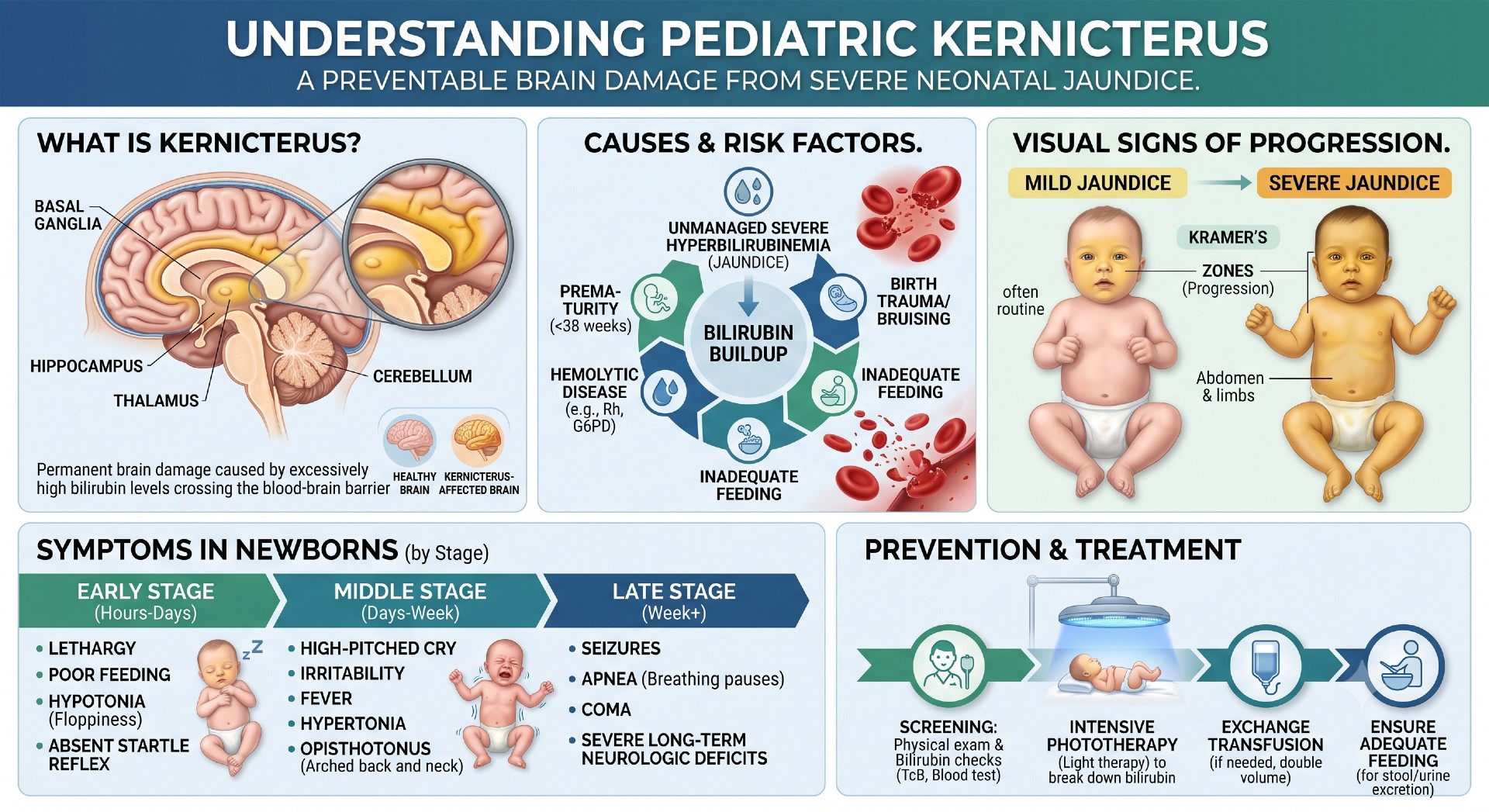
Signs Your Child’s Kernicterus Injury May Have Been Caused by Negligence
Below are the red flags. If you recognize several of these, it may be worth a closer look at how your baby’s care was handled.
Your Baby’s Bilirubin Was Never Checked
The standard of care is to screen every newborn’s bilirubin level, usually between 24 and 48 hours of life or before discharge. If your baby’s bilirubin was never measured, or was not checked when your baby was visibly yellow, a critical safety step may have been skipped.
Visible Jaundice Was Not Acted On
If your baby was clearly yellow and a provider noted it but did not measure the bilirubin or arrange treatment, that is a major red flag. Jaundice that is visible, especially early or spreading down the body, calls for a bilirubin level, not reassurance.
A High or Rising Bilirubin Level Was Ignored
Sometimes the level is checked, comes back high or rising quickly, and the response is too slow or absent. If a dangerous level was documented but phototherapy or escalation did not follow promptly, that gap could be a serious failure in your baby’s care.
Jaundice in the First 24 Hours Was Not Treated as Urgent
Jaundice that appears in the first day of life is a warning sign of a more serious problem, such as blood type incompatibility. If your baby was jaundiced that early and it was not urgently worked up, the diagnosis may have been mishandled.
Your Baby Was Sent Home Without Proper Follow-Up
A jaundiced baby, or one discharged early, often needs a recheck within a day or two. If your baby was sent home with rising jaundice and no follow-up plan, and the bilirubin then climbed dangerously, that discharge decision deserves a close look.
Risk Factors Were Ignored
Prematurity, blood type incompatibility, significant bruising, poor feeding, or a sibling who needed jaundice treatment all raise the risk. If your baby had these risk factors and was not monitored more closely, that may point to a failure in care.
Treatment Was Delayed When Bilirubin Was Very High
When bilirubin approaches the exchange transfusion threshold, it is a medical emergency requiring intensive treatment without delay. If your baby reached that level and treatment was delayed, that delay can be the difference between a healthy child and a permanent injury.
The Serious Harm Kernicterus Can Cause
Kernicterus leaves a child with a distinct and permanent set of disabilities. Here are the serious harms it can cause.
Cerebral palsy. Kernicterus classically causes dyskinetic cerebral palsy, with involuntary, uncontrolled movements and difficulty with posture and coordination.
Hearing loss or deafness. Damage to the hearing pathways is a hallmark of kernicterus.
Problems with eye movement. Especially difficulty looking upward.
Dental problems. Such as poorly formed tooth enamel.
Developmental effects. Some children face intellectual and developmental challenges, though many have normal intelligence in a body they cannot fully control.
A lifetime of care. Children with kernicterus often need therapy, equipment, communication devices, and assistance for the rest of their lives.
In the most severe cases, death. Very high bilirubin can be fatal.
The toll on the family. Beyond the medical harm, families carry the emotional weight, the cost of care, and the heartbreak of knowing the injury was almost certainly preventable.
Many of these outcomes share one thing in common. They trace back to a jaundice that should have been caught and treated in time.
When Mismanaged Jaundice Becomes Malpractice
Not every bad outcome is malpractice. But kernicterus is different from many injuries, because it is considered almost always preventable. Doctors and nurses have to meet a basic standard. That standard is the level of care a careful provider would have given in the same situation.
To have a malpractice case, a few things usually need to be true. First, there was a provider-patient relationship. Second, the care fell below the accepted standard. Third, that failure caused real harm. Fourth, the harm led to losses, such as medical bills, future care costs, and pain and suffering.
Kernicterus cases often turn on a few key questions. Was the baby’s bilirubin screened? Was visible jaundice acted on? Was a high or rising level treated promptly? Was the baby given proper follow-up after discharge? Because the condition is so preventable, a documented failure in this chain can be the heart of a strong case. These cases require the medical records and the right experts. That is where Lupetin & Unatin comes in.
What You Should Do Now
If you think your child’s kernicterus injury was caused by negligence, take these steps.
Get the complete medical records. You have a right to them. The records that matter include the newborn nursery records, every bilirubin value and the time it was taken, the feeding records, the discharge instructions, and any follow-up visits. These records often tell the whole story.
Get the follow-up documentation. If your baby was sent home and later readmitted, the records of that readmission, and the bilirubin levels at that point, are important.
Write down what you remember. Note when you first noticed yellowing, how it changed, what you told the providers, and what they did. Note your child’s diagnoses and treatments. Memory fades, so do this soon.
Act within the time limits, but know that children have special protections. In Pennsylvania, the deadline to file is generally two years, but for injuries to a child, the minor’s tolling rule can extend that time. You can read more on our page about the minor’s tolling statute. Even so, waiting is risky, because key evidence can be lost. It is best to ask early.
Talk to a lawyer who knows these cases. Birth injury claims are complex. They need medical experts, including neonatologists and pediatric neurologists, and a deep understanding of newborn care. A general lawyer may not be the right fit. A firm focused on medical malpractice and birth injury will know what to look for.
How Lupetin & Unatin Can Help
We are Lupetin & Unatin, a Pittsburgh medical malpractice firm. Birth injury is one of our core practice areas, and we have spent decades representing Pennsylvania families against the largest hospital systems in the region. We know how these injuries happen. We know how hospitals defend them. And we know how to hold them accountable.
We do the medical investigation ourselves. When you contact us, we obtain the complete medical record at no cost to you, and we work with top experts in neonatology and pediatric neurology to determine exactly what happened and whether your child’s injury could have been prevented. We understand how a treatable jaundice can become a permanent brain injury when the safety net fails, and we know how to prove what a careful team should have done.
We take a small number of cases so we can give each one real attention. We work on contingency. That means you pay nothing up front. You pay nothing unless we win. There is no risk in finding out if you have a case.
You deserve answers. You deserve to know if your child’s injury could have been prevented. A short conversation can tell you a lot.
Frequently Asked Questions
You may not know for sure on your own. That is normal. The answer is usually in the medical records. We look at whether your baby’s bilirubin was screened, whether visible jaundice was acted on, whether a high or rising level was treated promptly, and whether your baby got proper follow-up. Kernicterus is considered almost always preventable, so the law asks what a careful provider would have done with the same information. A careful review tells us whether the care fell below the standard. That review costs you nothing.
For an adult, the deadline is generally two years. But for an injury to a child, Pennsylvania’s minor’s tolling rule can extend the time to file, sometimes for years. That said, key evidence can be lost over time, and waiting can seriously hurt a case. The safest move is to call us soon so we can review the deadlines that apply to your child and preserve the evidence.
Nothing up front. We work on contingency. That means we only get paid if we win money for your family. There is no fee to talk with us and no fee to review your case. If we take your case and do not win, you owe us no attorney fee. This lets you seek justice without financial risk.
Reach Out Today
If any part of this article sounds like your story, please contact Lupetin & Unatin. Tell us what happened. We will listen. We will review the records. We will tell you honestly whether we think there is a case.
Kernicterus is a lifelong injury from a condition that is almost always preventable. When it happens, your family deserves answers. If a hospital or provider failed your child, you have the right to seek justice. Let us help you find out what really happened.
Call Lupetin & Unatin today for a free, no-pressure review of your case.