
The pain hit hard and deep
It may have been in your belly, your back, your flank, or your side. It may have felt like the worst pain of your life. Maybe it came on suddenly. Maybe you felt faint, broke into a sweat, or nearly passed out. Maybe your belly felt full or you could feel a pulsing mass. Maybe your legs felt weak. Something had given way deep inside, and you were bleeding internally.

Contact Us for a Free, Confidential Consultation
Article written by Brendan Lupetin, Esq. Brendan is a managing partner in the law firm of Lupetin & Unatin, a medical malpractice law firm located in Pittsburgh and serving Western Pennsylvania.
Our practice is limited to high-value catastrophic cases because that is where we can do the most for our clients and for patient safety.
So you got help. You went to the ER. You described the terrible pain in your belly or back. And maybe they did not take it seriously enough. Maybe they called it a kidney stone, a back strain, constipation, or a stomach bug. Maybe they gave you pain medicine and a fluid drip and watched you for a while. Maybe no one felt your belly for a pulsing mass or ordered the scan that would have shown the truth. The whole time, a weakened, ballooned section of your body’s largest artery was leaking or had burst.
By the time someone recognized it, the bleeding may have been overwhelming. A ruptured aortic aneurysm is one of the deadliest emergencies in medicine, and survival drops fast with every minute of delay. Maybe you survived emergency surgery. Maybe you are reading this because someone you love was sent home or watched too long and did not survive. And you cannot stop asking: why didn’t they catch this in time?
That question matters. A ruptured or rupturing aortic aneurysm is a true surgical emergency. When it is missed or treated too slowly, the harm is often catastrophic and often preventable. This article explains the warning signs that an aortic aneurysm rupture was missed. It explains the serious harm a delay can cause. And it explains what you can do next. If any of this sounds like your story, Lupetin & Unatin is here to help.
What an Aortic Aneurysm Rupture Is, in Plain Terms
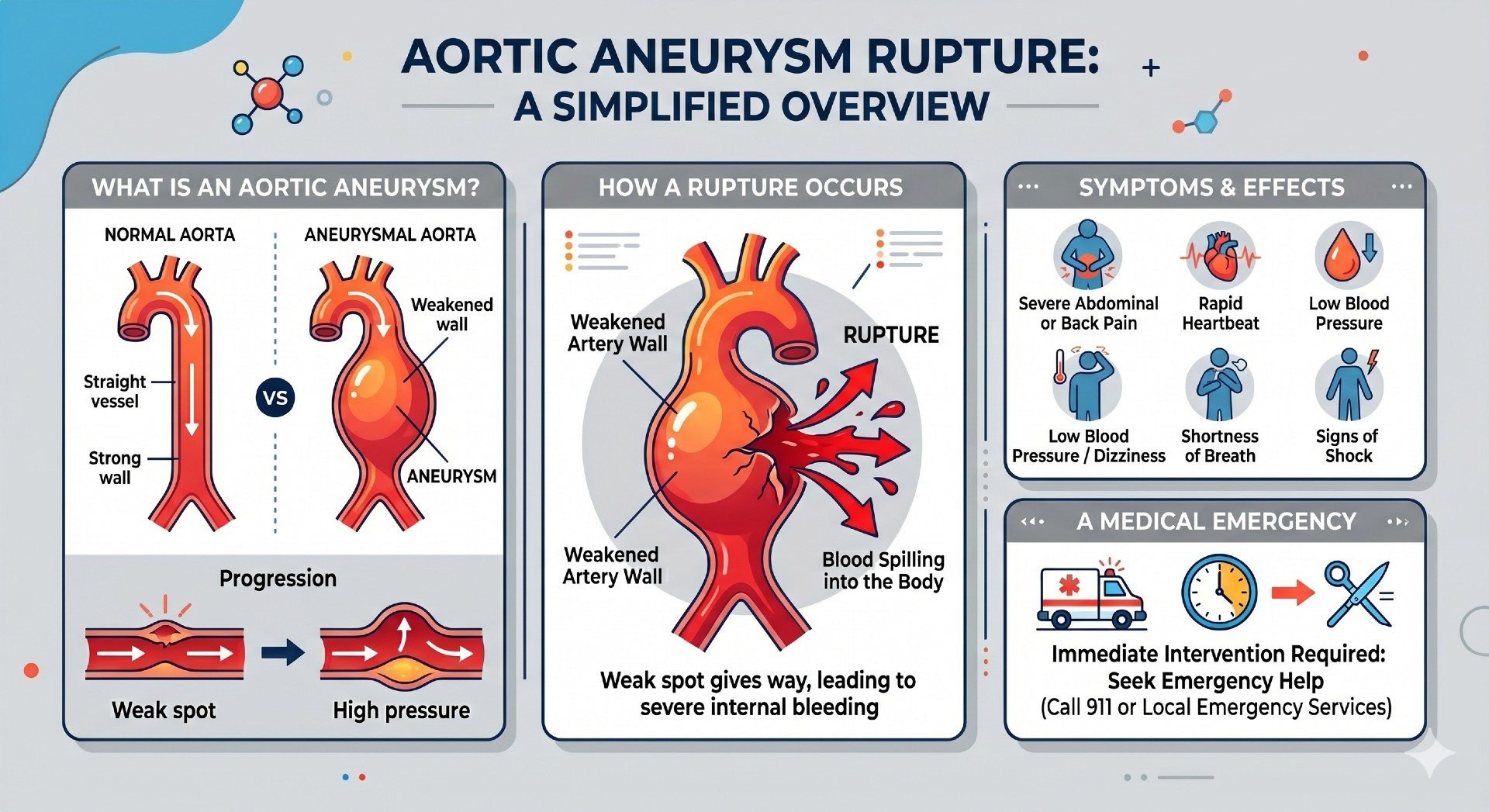
The aorta is the largest blood vessel in your body. It carries blood from your heart down through your chest and belly. An aneurysm is a weak, bulging spot in the wall of the aorta, like a thin balloon. Most often it forms in the belly, where it is called an abdominal aortic aneurysm, or AAA.
The danger is rupture. When the weakened wall tears or bursts, blood pours out under high pressure. As the Cleveland Clinic explains, a ruptured abdominal aortic aneurysm is a life-threatening emergency that needs surgery right away, and it can quickly cause deadly internal bleeding. Many aneurysms cause no symptoms until they start to leak or rupture, so the rupture is often the first sign of trouble.
The key word is time. A ruptured aneurysm bleeds fast, and the chance of survival falls with every minute. The treatment is emergency surgery to repair the aorta. The test that finds it quickly is usually a CT scan, and at the bedside, an ultrasound can show the aneurysm in minutes. Fast recognition and fast surgery are what save lives.
Why an Aortic Aneurysm Rupture Gets Missed
Here is the central trap. The pain of a rupturing aneurysm, belly pain, back pain, or flank pain, looks like many far more common problems. The most frequent wrong diagnosis is a kidney stone. Others include diverticulitis, a back strain, or a stomach problem. So a busy provider may land on a common answer and miss the deadly one.
The “classic” signs are belly or back pain, low blood pressure, and a pulsing mass in the belly. But here is what makes this so dangerous: studies show that all three signs are present together in only a minority of cases, and in patients who are misdiagnosed, the classic triad appears in fewer than 1 in 10. Research shows that 30 to 40 percent of ruptured aneurysms are misdiagnosed at first. A careful provider should think of an aneurysm in an older patient with these risk factors and sudden belly or back pain, feel the belly, and order imaging. When that does not happen, a deadly rupture can be missed.
Here are the common reasons an aortic aneurysm rupture gets missed:
- Severe belly, back, or flank pain was blamed on a kidney stone.
- The pain was called a back strain, constipation, or a stomach bug.
- No one felt the belly for a pulsing mass.
- No CT scan or bedside ultrasound was done.
- The patient’s risk factors, like age, smoking, and high blood pressure, were not considered.
- A known aneurysm was not connected to the new pain.
Risk Factors Doctors Are Supposed to Consider
Some people are at much higher risk of an aortic aneurysm and its rupture. These risk factors should make a doctor more careful and quicker to image when a patient has sudden belly or back pain.
Common risk factors include:
- Older age, especially over 65. Risk rises sharply with age.
- Being male. Aneurysms are more common in men, though women are more often misdiagnosed.
- Smoking. One of the strongest risk factors.
- High blood pressure. This strains the aortic wall.
- A known aneurysm. A previously found aneurysm being watched is a major clue.
- A family history of aneurysm. Aortic disease can run in families.
- Hardening of the arteries (atherosclerosis). This weakens vessel walls.
Here is why this matters for your case. An older patient who smokes or has high blood pressure, or who has a known aneurysm, and who comes in with sudden belly or back pain, is not a routine case. A careful doctor should think about an aneurysm and order imaging. When those clues are in the chart and the doctor still treats it as a kidney stone or a back strain, that can be a failure to meet the standard of care.
Signs Your Aortic Aneurysm Rupture Was Missed
Below are the red flags. If you recognize several of these, it may be worth a closer look at the care that was given.
Your Pain Was Blamed on a Kidney Stone
A kidney stone is the single most common wrong diagnosis for a rupturing aneurysm. If your sudden, severe belly, back, or flank pain was called a kidney stone, especially without imaging, that is a major red flag.
Severe Pain Was Called a Strain or Stomach Problem
A rupturing aneurysm can be mistaken for a back strain, constipation, or a stomach bug. If your severe pain was waved off as one of these and it turned out to be an aneurysm, the diagnosis may have been missed.
Your Risk Factors Were Ignored
If you are older, a smoker, have high blood pressure, or have a known aneurysm, those facts should have shaped your care. If you came in with sudden belly or back pain and no one connected it to your risk factors, that may point to a missed diagnosis.
No One Felt Your Belly or Ordered Imaging
A careful exam can find a pulsing mass, and a CT or bedside ultrasound can find the aneurysm fast. If no one examined your belly or ordered imaging, a deadly aneurysm could have been missed.
You Felt Faint or Went Into Shock and It Was Not Acted On
Feeling faint, sweating, or signs of shock along with belly or back pain are danger signs of internal bleeding. If these were present and not acted on urgently, that delay can be devastating.
A Known Aneurysm Was Not Connected to Your Pain
If you had a previously diagnosed aneurysm and then developed new belly or back pain, that connection should have been obvious. If no one made it, a rupture may have been missed.
You Suffered Lasting Harm
Sometimes the clearest sign that something went wrong is the outcome itself. People who reach surgery fast have a chance to survive. When the diagnosis comes too late, the bleeding is often fatal. The next section covers the serious harm a delay can cause.
The Serious Harm an Aortic Aneurysm Rupture Delay Can Cause
When a rupturing aneurysm is not found and repaired fast, the internal bleeding can be overwhelming. The longer the delay, the more harm it does. Here are the serious injuries and outcomes a missed or delayed diagnosis can cause.
Death. This is the gravest risk. A ruptured aortic aneurysm is often fatal, and survival drops sharply with every minute of delay. Many patients die before or soon after the diagnosis is finally made. If you lost a loved one this way, your family may have a wrongful death claim.
Massive blood loss and shock. The internal bleeding can cause severe shock, which can damage the body even if the person survives.
Organ damage from low blood flow. When blood pressure collapses, the kidneys, intestines, and other organs can be injured or die.
Kidney failure. The kidneys are very sensitive to blood loss and can fail, sometimes requiring dialysis.
Loss of part of the bowel. Loss of blood flow to the intestines can cause bowel death, requiring surgery.
Leg and limb damage. Reduced blood flow can harm the legs, sometimes leading to amputation.
Complications of emergency surgery. The lifesaving surgery itself carries serious risks, made worse by delay.
Long ICU stays and lasting disability. Survivors often face a long, difficult recovery and may not return to the life they had before.
Emotional trauma. Surviving a near-fatal event, or losing a loved one to one, leaves deep wounds. Many people and families struggle with anxiety, depression, and grief for years.
Many of these outcomes share one thing in common. They often trace back to time that was lost. Time that doctors had to act, and did not use.
When a Missed Diagnosis Becomes Malpractice
Not every bad outcome is malpractice. Doctors do not have to be perfect, and a rupturing aneurysm can mimic common problems. But doctors do have to meet a basic standard. That standard is the level of care a careful doctor would have given in the same situation.
To have a malpractice case, a few things usually need to be true. First, there was a doctor-patient relationship. Second, the care fell below the accepted standard. Third, that failure caused real harm. Fourth, the harm led to losses, such as medical bills, lost income, the loss of a loved one, or pain and suffering.
Aortic aneurysm cases often turn on a few key questions. Did the patient have sudden belly or back pain and risk factors? Was the belly examined? Was imaging ordered, or was the pain written off as a kidney stone? Was a known aneurysm connected to the new pain? When the signs were there and no one acted, that delay can be the heart of a strong case. Proving it takes work, records, and the right medical experts. That is where Lupetin & Unatin comes in.
What You Should Do Now
If you think your aortic aneurysm rupture, or that of a loved one, was missed, take these steps.
Get the medical records, including all imaging. You have a right to them. The timeline, the exam notes, and any scans are often the heart of the case.
Write down what you remember. Note when the pain started, where it was, and how severe. Note what you told the doctors, what tests were done, and how long everything took. Note any known aneurysm or risk factors. Memory fades, so do this soon.
Do not wait too long to ask questions. Every state has a deadline for filing a malpractice claim. In Pennsylvania, that deadline is usually two years. There are some exceptions, but the clock can run out fast. Acting early protects your rights.
Talk to a lawyer who knows these cases. Aortic aneurysm claims are complex. They need medical experts and a deep understanding of emergency, vascular, and surgical care. A general lawyer may not be the right fit. A firm focused on medical malpractice will know what to look for.
How Lupetin & Unatin Can Help
We are Lupetin & Unatin. We are a Pittsburgh medical malpractice firm. We focus on serious injury and death from medical errors. Cases involving missed and delayed diagnosis of deadly vascular emergencies are part of our work. We know how these errors happen. We know how hospitals defend them. And we know how to hold them accountable.
We have handled catastrophic delayed-diagnosis and wrongful death cases. We understand how a treatable emergency can turn fatal when the warning signs are missed and the clock runs out. We know the medicine, and we know how to prove what a careful doctor should have done.
We take a small number of cases so we can give each one real attention. We work on contingency. That means you pay nothing up front. You pay nothing unless we win. There is no risk in finding out if you have a case.
You deserve answers. You deserve to know if this suffering or loss could have been prevented. A short conversation can tell you a lot.
Frequently Asked Questions
You may not know for sure on your own. That is normal. The answer is usually in the medical records. We look at what symptoms you had, what risk factors you carried, whether your belly was examined, whether imaging was ordered, and how long everything took. A rupturing aneurysm can mimic a kidney stone, but the law asks what a careful doctor would have done with the same information. A careful review tells us whether the care fell below the standard. That review costs you nothing.
In most cases, the deadline in Pennsylvania is two years. For a wrongful death claim, that period generally runs from the date of death. Some exceptions can change the deadline. These rules are tricky. The safest move is to call us soon so we can protect your rights before time runs out.
Nothing up front. We work on contingency. That means we only get paid if we win money for you. There is no fee to talk with us and no fee to review your case. If we take your case and do not win, you owe us no attorney fee. This lets you seek justice without financial risk.
Reach Out Today
If any part of this article sounds like your story, please contact Lupetin & Unatin. Tell us what happened. We will listen. We will review the records. We will tell you honestly whether we think there is a case.
A ruptured aortic aneurysm can take a life in minutes. A missed diagnosis can change everything. If a hospital or doctor failed you or someone you love, you have the right to seek justice. Let us help you find out what really happened.
Call Lupetin & Unatin today for a free, no-pressure review of your case.