

Looking back on your delivery, you may find yourself stuck on a single thought. If someone had really explained the risks, would you have made the same choice? Many women who attempt a vaginal birth after a cesarean were never given a full and honest picture of what could go wrong. They were reassured, or steered in a certain direction, or simply handed a form to sign. That is not the same as being informed.
This page explains what informed consent means for a trial of labor after a cesarean, what an honest conversation should include, and what it means when that conversation never really happened.
What informed consent actually means
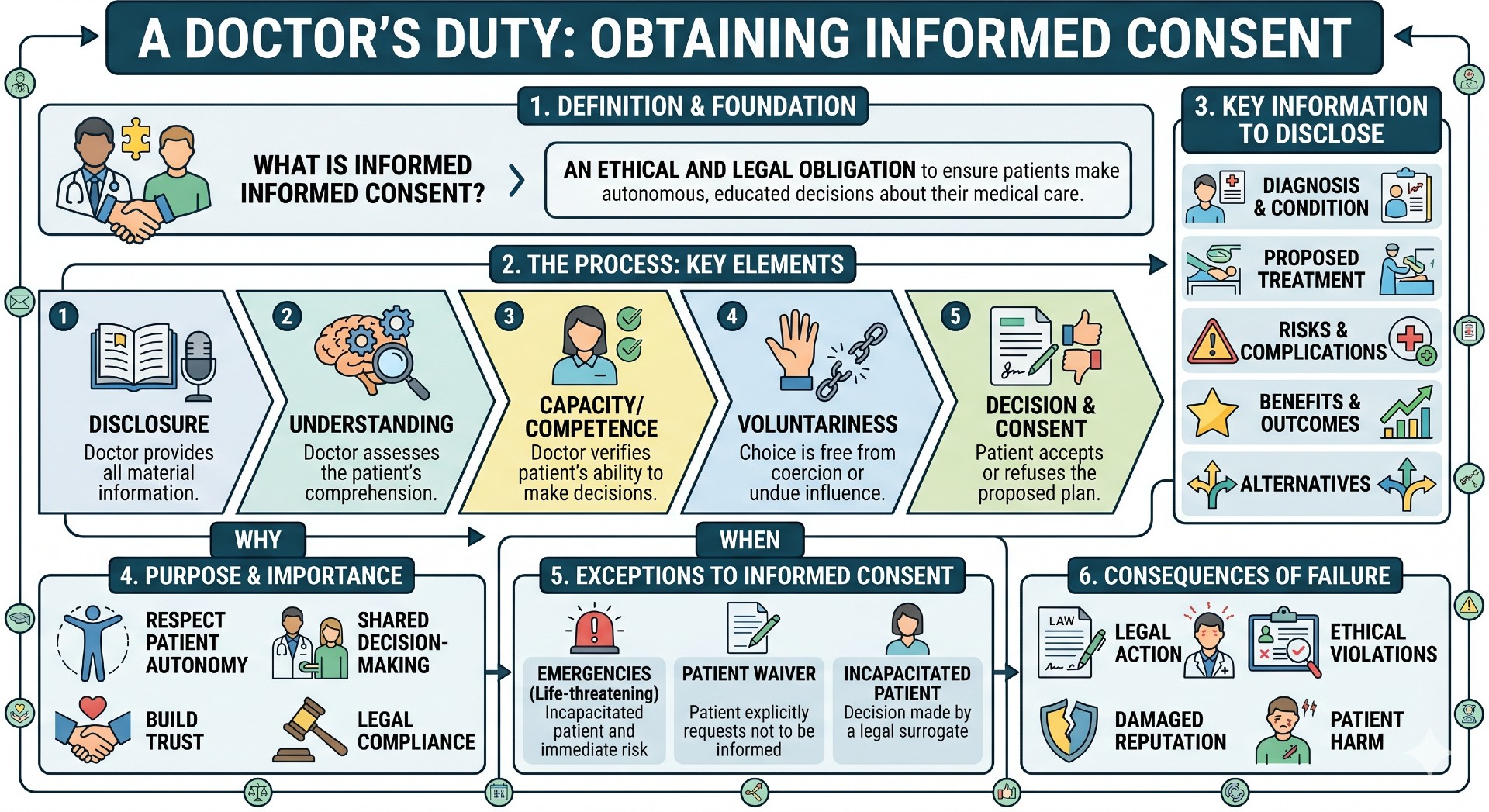
Informed consent is more than a signature on a form. It is a real conversation. Before a patient agrees to a course of care, the patient is entitled to understand the benefits, the risks, and the reasonable alternatives, in terms she can actually understand.
For a trial of labor after cesarean, often called TOLAC, the choice is genuine. A woman can attempt a vaginal birth, or she can choose a planned repeat cesarean. Both are accepted options for many women. Because there is a real choice, the woman is the one who gets to make it. But she can only make it well if she is given honest, complete information first.
What an honest VBAC conversation includes
A proper counseling conversation covers several things. ACOG stresses what it calls shared decision making, and it points to specific information a woman should receive.
She should be told her individual likelihood of a successful vaginal birth, not just a general statistic. She should be told her individual risk of uterine rupture, the most serious complication. She should be told what a rupture can mean for her baby and for herself, including the risk of brain injury to the baby and serious harm to the mother. She should be told about the alternative, a planned repeat cesarean, and how its risks and benefits compare. And she should be told whether the hospital is equipped to handle a rupture emergency.
ACOG also makes clear that this counseling and the decision that follows should be documented. A note in the chart is the record that the conversation happened and what it covered.
How consent fails
Informed consent for a trial of labor can fail in several ways. In our work on birth injury cases, we see these patterns often.
- The risk of uterine rupture was never meaningfully explained, or was mentioned so briefly it did not register.
- The woman was pressured toward a trial of labor, with the risks downplayed.
- The woman was pushed away from a trial of labor she wanted, without an honest comparison.
- Her individual risk factors, such as the type of prior incision, were never discussed.
- A consent form was signed, but no real conversation ever took place.
- There is no documentation in the chart that any counseling occurred at all.
In each of these situations, the woman did not truly choose. A decision made without the facts is not an informed decision. It only looks like one.
Why a signed form is not the end of the question
Many families assume that because a consent form was signed, the issue is closed. It is not. A signature on a form is evidence that a piece of paper was presented. It is not proof that a real conversation took place, or that the woman understood what she was agreeing to.
The deeper question is what the woman was actually told. What did the physician explain about the risk of rupture? Was her individual situation discussed? Was the alternative of a repeat cesarean presented fairly? The chart, the counseling notes, and the testimony of the people involved help answer those questions. A form does not.