

If you were trying for a vaginal birth after a cesarean, and a medication was used to ripen your cervix or start your labor, the choice of drug matters. One drug in particular, misoprostol, is widely understood to be the wrong choice for a woman with a prior cesarean. It is sold under the brand name Cytotec.
This page explains what misoprostol is, why medical authorities advise against using it to induce labor in women with a uterine scar, and how its use can lead to a uterine rupture and a serious injury.
What misoprostol is
Misoprostol is a prostaglandin. It is a medication that softens and opens the cervix and triggers contractions. It is effective and inexpensive, and it is used in obstetrics for several purposes. Cytotec is its common brand name.
For a woman with no uterine scar, misoprostol can be a reasonable tool for starting labor. But it has one feature that makes it dangerous in the wrong patient. It is potent, and once it has been given, it cannot be immediately stopped or reversed Unlike a drug given through an IV (like Pitocin), a dose of misoprostol cannot simply be switched off. If it triggers contractions that are too strong, there is no quick way to stop it.
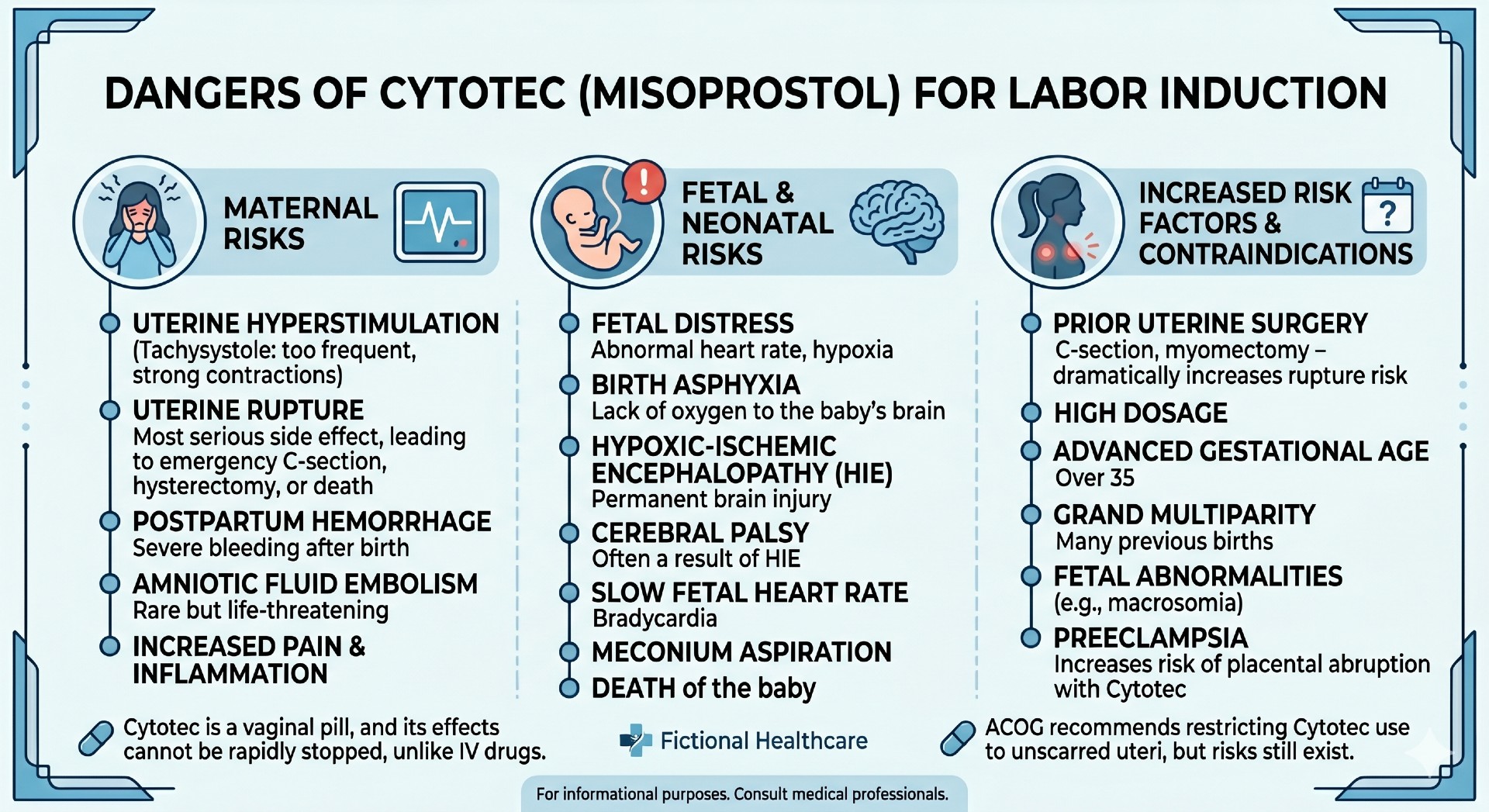
Why it is the wrong drug after a cesarean
A trial of labor after cesarean, often called TOLAC, carries the risk that the old cesarean scar will tear. This is a uterine rupture. Misoprostol makes that risk substantially worse.
The evidence here is not subtle. A randomized trial studying misoprostol for labor induction in women with a prior cesarean was stopped early because of safety concerns, after a serious number of women in the misoprostol group suffered uterine ruptures. Large population studies have also linked prostaglandin induction in women with a uterine scar to sharply higher rupture rates compared with women who did not labor at all.
Because of findings like these, the American College of Obstetricians and Gynecologists advises that misoprostol should not be used for cervical ripening or labor induction at term in a woman who has had a prior cesarean or major uterine surgery. This is not a soft suggestion. It is a clear warning against a specific, dangerous choice.
What safer induction looks like
A woman with a prior cesarean who needs help starting labor is not out of options. The point is to avoid the most dangerous one.
Oxytocin, given carefully through an IV, is generally considered a safer choice than prostaglandins for a woman with a uterine scar. This is because Pitocin can be turned off if contractions become too strong. Mechanical methods, such as a small balloon catheter that gently opens the cervix, are another option that has not been linked to the same rupture risk. The shared theme is caution. A scarred uterus calls for the gentlest effective approach and close monitoring, not the most aggressive drug available.
Where care goes wrong
In birth injury cases involving a trial of labor, we look closely at how labor was started. The medical record shows exactly which medication was given, in what dose, and at what time.
When the record shows that misoprostol or another prostaglandin was used to induce labor in a woman with a prior cesarean, that is a serious warning sign. We examine whether the mother was told the drug carried added risk for someone in her situation. We look at the medical decision making and indication for misoprostol administration. We examine what happened next, including whether her contractions became too strong and whether her baby showed signs of distress. The use of a drug that authorities specifically caution against, in a patient who should not have received it, is exactly the kind of decision a careful review is meant to uncover.