
When a Doctor Ignores Your Symptoms and a Delayed Diagnosis Changes Your Life
Key Takeaways: What You Need to Know Right Now
- It is a Medical Emergency: Cauda Equina Syndrome (CES) requires immediate surgery, usually within 24 to 48 hours.
- Time is Critical: If a doctor delayed your diagnosis or sent you home, they may have missed your “window of opportunity” for recovery.
- Symptoms are Often Dismissed: Leg weakness and bladder issues are major red flags that ER doctors sometimes mistake for simple back pain.
- You Have Options: If this happened to you in Pennsylvania, you may be entitled to compensation for your care and lost wages.
If you or a loved one are reading this, you are likely in pain, confused, and perhaps facing a life that looks very different than it did just a few weeks ago. You might be dealing with paralysis, the inability to walk, or embarrassing bathroom issues that no one prepared you for.
Most of all, you might be feeling a sense of betrayal.
You went to the doctor or the Emergency Room. You told them you were in agony. You told them your legs felt heavy or that you couldn’t go to the bathroom. But instead of rushing you into surgery, they might have given you pain pills and sent you home.
I am here to tell you: You know your body better than anyone else. If you feel that your serious condition was brushed off as “just back pain,” you might be right. And if that medical error caused permanent damage, you deserve answers.
What is Cauda Equina Syndrome? (In Plain English)
At the very bottom of your spinal cord, there is a bundle of nerves. Medical experts call this the cauda equina because it looks like a horse’s tail.
These nerves are the communication lines between your brain and your lower body. They control your legs, your feet, your bladder, your bowels, and your sexual function.
Sometimes, a herniated disc, a tumor, or an infection can squeeze (compress) these nerves. When that happens, the connection is cut off. If that pressure isn’t released immediately through surgery, those nerves can die. Once they die, they often do not grow back.
The “Red Flag” Symptoms: Did Your Doctor Miss These?
Cauda Equina Syndrome is rare, but every Emergency Room doctor is trained to look for it. It is one of the few spinal conditions that is a true emergency.
Ask yourself if any of these things happened to you:
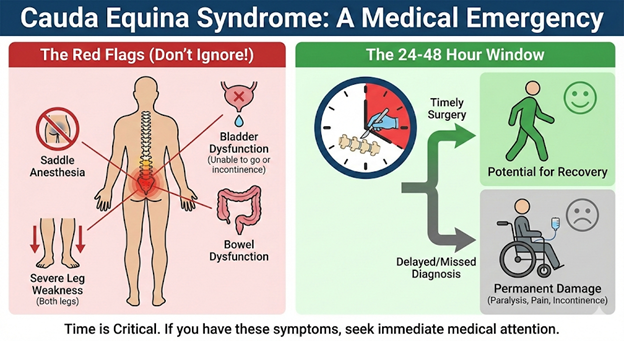
- Did you tell the doctor you had “saddle anesthesia”? This is numbness in your groin, inner thighs, or buttock area (the parts of you that would touch a saddle).
- Did you complain of bladder dysfunction? This includes being unable to pee (retention) or wetting yourself without realizing it (incontinence).
- Did you report bowel dysfunction? Being unable to control your bowel movements is a massive warning sign.
- Did you have sudden sexual dysfunction? Sudden numbness or inability to perform is a key symptom.
- Did you have muscle weakness in both legs? Simple back pain usually hurts, but it doesn’t leave you unable to lift your feet (foot drop) or stand up.
If you reported these symptoms and the doctor sent you home without an MRI, that is likely hospital negligence.
The “Window of Opportunity”
With Cauda Equina Syndrome, time is everything. We call it the “Window of Opportunity.”
Medical literature generally agrees that surgery needs to happen within 24 to 48 hours of the onset of major symptoms (like bladder issues).
- If caught in time: The pressure is taken off the nerves. Many patients walk out of the hospital and regain full function.
- If missed: The nerves are permanently damaged. This leads to lifelong disability, the need for catheters, wheelchairs, and chronic pain.
When a doctor fails to act quickly, they aren’t just making a mistake; they are closing your window of opportunity for a normal life.
How Medical Negligence Happens in Cauda Equina Syndrome Cases
As medical malpractice attorneys with experience in cases involving Cauda Equina Syndrome, we have investigated many of these cases. We rarely find that the doctor “didn’t know” what CES was. Instead, we find they were too busy, too dismissive, or too careless to check.
Common examples of preventable injury include:
- Failure to Order an MRI: This is the only test that definitely shows CES. Refusing to order one when a patient has red-flag symptoms is a critical error.
- Failure to Perform a Rectal Exam: A simple physical check can tell a doctor if the nerves are working. Skipping this is often a sign of laziness or rushing.
- Failure to Consult a Specialist: An ER doctor should call a neurosurgeon or spine specialist immediately if they suspect CES.
- Misdiagnosis: discharging a patient with a diagnosis of “sciatica” or “lumbar strain” without ruling out the more serious condition.
The Lupetin & Unatin Difference
We understand that this isn’t just a legal case to you—this is your life.
At Lupetin & Unatin, we specialize in complex medical injury cases. We have specific experience handling Cauda Equina Syndrome claims. We know the medicine as well as the law. We work with top neurosurgeons and radiologists to review your medical records and pinpoint exactly when the error occurred.
We know how to prove that if the doctor had acted sooner, you would be walking today.
Important: The Pennsylvania Statute of Limitations
If you were injured in Pennsylvania, you must be aware of the clock.
Generally, you have two years from the date of the injury (or the date you discovered the injury was caused by negligence) to file a lawsuit. If you miss this deadline, you are barred from seeking justice forever.
Two years sounds like a long time, but building a strong case takes months of investigation. Do not wait until the last minute.
Is This What Happened to You? Let’s Find Out.
You likely have mounting medical bills, lost wages from being unable to work, and the cost of future care weighing on your mind. You shouldn’t have to pay for a doctor’s mistake.
We can help you determine if your injury was preventable.
- It costs nothing to talk to us.
- We review your records for free.
- You pay no fees unless we recover money for you.
Don’t let the window for justice close, too. Contact us today for a free case evaluation.