
Severe Back Pain: When Is It an Emergency? A Simple Guide To Knowing The Signs
Most of us will experience back pain at some point in our lives. It’s the second most common reason people visit the doctor. Usually, it’s due to a muscle strain, a sprained ligament, or “wear and tear” that, while incredibly painful, is not life-threatening.
But sometimes, severe back pain is a warning siren from your body. It can be a symptom of a serious, time-sensitive medical condition that could lead to permanent damage – like paralysis – or even be fatal if not treated immediately.
The problem is, it can be incredibly difficult for a patient to tell the difference between a “bad back” and a medical emergency. This article is designed to help you identify the critical “red flags” that mean you should stop reading and call 911 or go to the Emergency Room immediately.
The Golden Rule: It’s What Accompanies the Pain
The key to knowing if your back pain is an emergency isn’t just the severity of the pain itself. It’s the other symptoms that come along with it.
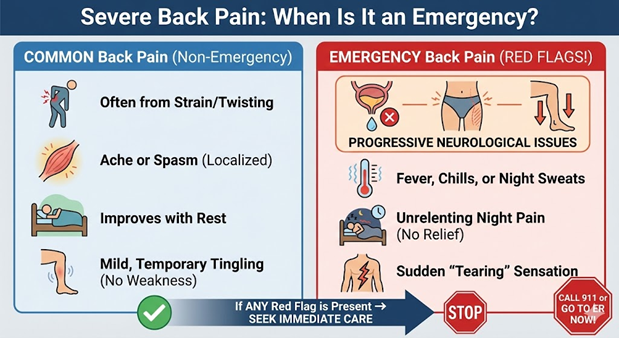
If you have severe back pain AND any one of the following “red flag” symptoms, you need urgent medical evaluation. Do not wait to see if it gets better.
The “Red Flag” Symptoms: Go to the Emergency Room If You Have…
- New Bladder or Bowel Issues: You suddenly cannot urinate (retention), or you lose control of your bladder or bowels (incontinence). This is a hallmark sign of nerve compression.
- “Saddle Anesthesia”: Progressive numbness or tingling in your inner thighs, genital area, or buttocks – the areas that would touch a saddle.
- Sudden Leg Weakness: You find your legs feel heavy, you cannot lift your foot (foot drop), or your legs are too weak to support you.
- Fever or Chills: Back pain accompanied by a fever, chills, or night sweats can be a sign of a serious spinal infection.
- Unrelenting Night Pain: Pain that does not get better with rest and is bad enough to wake you up from sleep is a warning sign, often associated with infection or a tumor.
- A “Tearing” Sensation: A sudden, severe, “tearing” or “ripping” pain in your abdomen or back that feels different from muscle pain.
- History of Cancer: If you have a history of cancer and develop new, severe back pain, it must be checked immediately.
- Recent Trauma: Pain that starts after a fall, car accident, or other significant injury.
- IV Drug Use or Recent Infection: If you use IV drugs or have had a recent infection (like a urinary tract infection) and develop severe back pain and a fever.
The Time-Sensitive Medical Emergencies
Why are the symptoms above so critical? Because they are the primary indicators of several life-altering or life-threatening conditions. Here are the main medical emergencies that can present as severe back pain.
Cauda Equina Syndrome (CES)
Cauda Equina Syndrome is a rare but devastating condition where the bundle of nerves at the very bottom of your spinal cord (the cauda equina) gets squeezed.
- Why it’s an emergency: These nerves control your bladder, bowels, and legs. If the pressure isn’t relieved with surgery within a critical window (often 24-48 hours), the nerves can die, leading to permanent paralysis and lifelong incontinence.
- Key Red Flags: Bladder/bowel dysfunction, saddle anesthesia, and leg weakness.
Abdominal Aortic Aneurysm (AAA)
The aorta is the main artery that carries blood from your heart down through your abdomen. A weak spot in the wall of the aorta can bulge out like a balloon – this is an aneurysm.
- Why it’s an emergency: If this aneurysm bursts (ruptures), it causes massive internal bleeding that is often fatal within minutes.
- Key Red Flags: A sudden, severe, “tearing” pain in the back or abdomen. It might feel like a pulsating mass in your belly. This is a 9-1-1 emergency.
Spinal Infection (Vertebral Osteomyelitis or Discitis)
Bacteria can get into the bloodstream and settle in the spinal bones (vertebrae) or the discs between them. This creates a pocket of infection (an abscess) that can grow and compress the spinal cord.
- Why it’s an emergency: The infection can destroy the bone, causing the spine to become unstable. An abscess can compress the spinal cord, causing paralysis. The infection can also spread through the body (sepsis).
- Key Red Flags: Severe back pain accompanied by fever, chills, night sweats. The spine itself is often very tender to the touch. It is more common in people with weakened immune systems, diabetes, or IV drug users.
Spinal Fracture
A break in one of the bones of your spine can occur from significant trauma, like a car crash or a fall from a height. In older adults with weakened bones (osteoporosis), a fracture can happen from something as simple as a sneeze or lifting a grocery bag.
- Why it’s an emergency: A broken bone can send fragments into the spinal canal, damaging the spinal cord and causing paralysis.
- Key Red Flags: Severe pain immediately following trauma. In older adults, sudden, severe localized pain even without major trauma.
Spinal Tumor (Cancer)
A tumor growing on or near the spine can compress the spinal cord or nerve roots. For many types of cancer, back pain is the very first symptom of metastasis (the cancer spreading to the bone).
- Why it’s an emergency: Rapidly growing tumors can cause permanent nerve damage and paralysis if not treated quickly with radiation or surgery.
- Key Red Flags: Pain that is worse at night and not relieved by rest. Unexplained weight loss along with back pain. A personal history of cancer.
Summary: Differentiating the Pain
How can you tell the difference between a common back strain and one of these emergencies? Use this simple comparison.
| Feature | Common Back Pain (Non-Emergency) | EMERGENCY Back Pain |
|---|---|---|
| Onset | Often after lifting, bending, or twisting. | Can be sudden, or progressive and unrelenting. |
| Nature of Pain | A "ache" or "spasm." Often stays in the back or buttocks. | Can be "tearing," "burning," or "deep." Radiates down legs or into the abdomen. |
| Effect of Rest | Usually gets better when you lie down in a comfortable position. | Does NOT get better with rest. Often wakes you at night. |
| Neurological Symptoms | None, or perhaps mild tingling that comes and goes. | Significant & Progressive: Numbness, weakness, foot drop, bladder/bowel issues. |
| Other Symptoms | None. | Fever, chills, weight loss, general feeling of illness. |
The Final Word: When in Doubt, Get Checked Out
You know your body better than anyone. If your back pain feels different, wrong, or is accompanied by any of the red flags listed above, do not hesitate.
It is far better to go to the Emergency Room and be told you have a bad muscle sprain than to stay home with a condition that could leave you permanently disabled or worse. Medical professionals would much rather you come in and be safe. Trust your instincts and seek immediate care.